Messier 13 by Diane Clarke

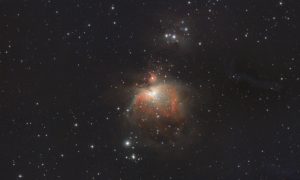
A superb image of Messier 13 by member Diane Clarke taken on the 29th April 2024 using a Seestar S50 250mm, 120 x 10sec exp @ f5. 

Messier 13 or M13 (also designated NGC 6205 and sometimes called the Great Globular Cluster in Hercules, the Hercules Globular Cluster, or the Great Hercules Cluster), is a globular cluster of several hundred thousand stars in the constellation of Hercules.

Diane wrote ''I captured this image of M13 the great Hercules cluster last night I was only able to get 20 minutes worth of data before the clouds arrived.  M13 possibly contains 300,000 to over 500,000 stars with a distance of 25117.4 Ly.  Below & to the right is HD 150679 a Spectral type A2 variable star distance approx. 425.24 Ly.  Below & to the left is HD 150998 a Spectral type K2 variable star distance approx. 1164.84 Ly.''

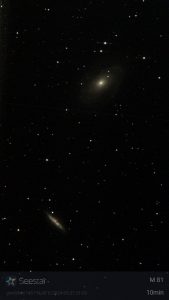
Bode’s Galaxy (M81) & the Cigar Galaxy (M82) by Jim Burchell

A super image of Bode's Galaxy & the Cigar Galaxy in the constellation Ursa Major taken by member Jim Burchell on Wednesday 27th March 2024.  Jim captured the image using a Seestar S50 smart telescope and stacking 60 x 10 second images.
 
Bode's Galaxy is towards the top of the image and the Cigar Galaxy is towards the bottom of Jim's image.

Bode’s Galaxy also known as Messier 81 (M81) is a grand design spiral galaxy which lies approximately 11.8 million light-years from Earth, with an apparent magnitude of 6.9.

The Cigar Galaxy which is also known as Messier 82 (M82) lies close to M81, and is often photographed together with Bode's Galaxy as Jim has done.  M82 is called the 'Cigar Galaxy' because of the elongated elliptical shape produced by the tilt of its starry disk relative to our line of sight. 
 
The Cigar Galaxy is a starburst galaxy approximately 12 million light-years away from Earth with an apparent magnitude of 8.4. The starburst activity is thought to have been triggered by interaction with the neighbouring Bode's Galaxy.
 
Both galaxies can be found about 10 degrees northwest of the star Dubhe in Ursa Major.

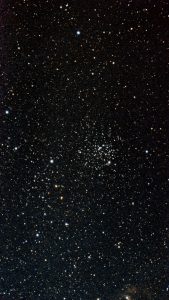
Messier 52 by Diane Clarke

A super image of Messier 52 or M52, also known as NGC 7654 taken by member Diane Clarke on the 6th March 2024 during a brief clear spell in the weather. 

Messier 52 is also known as the Scorpion Cluster or the Salt & Pepper Cluster and it is an open cluster of stars in the constellation of Cassiopeia. The cluster has an apparent magnitude of 6.9 and lies at an approximate distance of 4,600 light years from Earth.

Diane acquired the image using a Seestar S50 smart scope, 270 x 10s subs, stacked & processed using Affinity Photo.

Visible at the bottom of the image is part of the Bubble Nebula also known as C11 and NGC7635.

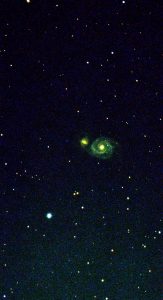
The Whirlpool Galaxy (M51a) by Diane Clarke

A great image of the Whirlpool Galaxy, also known as Messier 51a (M51a) or NGC 5194 and its companion NGC 5195 taken by member Diane Clarke on the 3rd March 2024. 
 
The Whirlpool Galaxy was the first galaxy to be classified as a spiral galaxy. 
 
NGC 5195, which is also known as Messier 51b (M51b) is a dwarf galaxy and is the smaller object to the upper left to the Whirlpool galaxy in the image. NGC 5195 is gravitationally interacting with the Whirpool Galaxy.  Both galaxies are found in the constellation Canes Venatici.
 
Diane acquired the image using a ZWO SeeStar S50 smart scope, taking 96 x 10sec subs and processed in Affinity photo.
 

Messier 3

[et_pb_section fb_built="1" _builder_version="4.24.0" _module_preset="default" global_colors_info="{}"][et_pb_row _builder_version="4.24.0" _module_preset="default" global_colors_info="{}"][et_pb_column type="4_4" _builder_version="4.24.0" _module_preset="default" global_colors_info="{}"][et_pb_text _builder_version="4.24.0" _module_preset="default" global_colors_info="{}"]

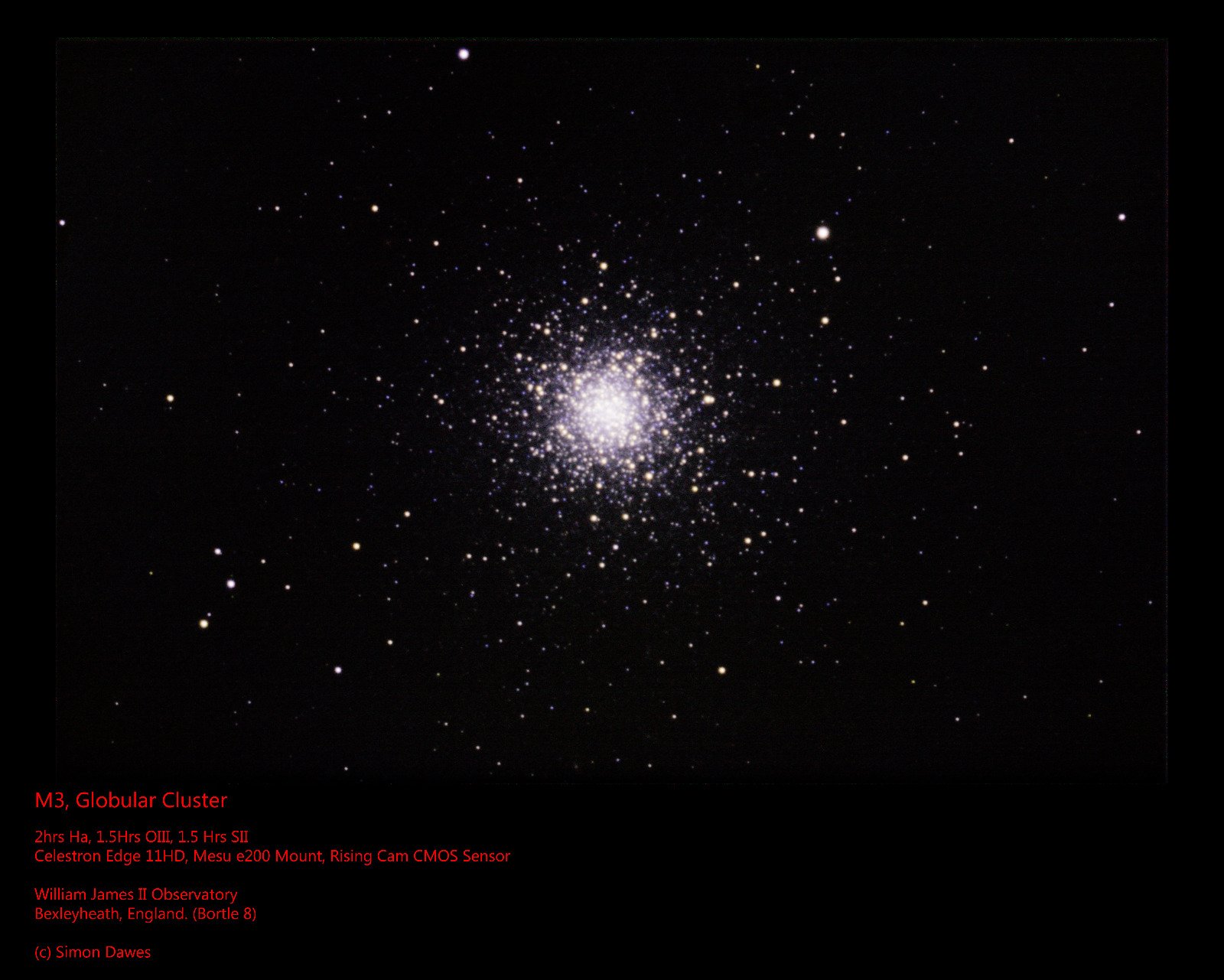
Messier 3 is a Globular Cluster in the constellation of Canes Venatici.

[/et_pb_text][/et_pb_column][/et_pb_row][et_pb_row _builder_version="4.24.0" _module_preset="default" global_colors_info="{}"][et_pb_column type="4_4" _builder_version="4.24.0" _module_preset="default" global_colors_info="{}"][et_pb_text admin_label="Images by Simon Dawes" _builder_version="3.15" global_module="2572" saved_tabs="all" global_colors_info="{}"]

Images by Simon Dawes

[/et_pb_text][/et_pb_column][/et_pb_row][et_pb_row column_structure="1_4,1_4,1_4,1_4" _builder_version="4.24.0" _module_preset="default" global_colors_info="{}"][et_pb_column type="1_4" _builder_version="4.24.0" _module_preset="default" global_colors_info="{}"][et_pb_text _builder_version="4.24.0" _module_preset="default" global_colors_info="{}"]

Simon2024M3

[/et_pb_text][/et_pb_column][et_pb_column type="1_4" _builder_version="4.24.0" _module_preset="default" global_colors_info="{}"][/et_pb_column][et_pb_column type="1_4" _builder_version="4.24.0" _module_preset="default" global_colors_info="{}"][/et_pb_column][et_pb_column type="1_4" _builder_version="4.24.0" _module_preset="default" global_colors_info="{}"][/et_pb_column][/et_pb_row][et_pb_row _builder_version="4.24.0" _module_preset="default" global_colors_info="{}"][et_pb_column type="4_4" _builder_version="4.24.0" _module_preset="default" global_colors_info="{}"][et_pb_text admin_label="Messier Links" _builder_version="4.24.0" hover_enabled="0" z_index_tablet="500" global_module="2601" saved_tabs="all" global_colors_info="{}" sticky_enabled="0"]

| M1 | M2 | M3 | M4 | M5 | M6 | M7 | M8| M9 | M10 | M11 | M12 | M13 | M14 | M15 | M16 | M17 | M18 | M19 | M20 | M21 | M22 | M23 | M24 | M25 | M26 | M27 | M28 | M29 | M30 | M31 | M32 | M33 | M34 | M35 | M36 | M37 | M38 | M39 | M40 | M41 | M42 | M43 | M44 | M45 | M46 | M47 | M48 | M49 | M50 | M51 | M52 | M53 | M54 | M55 | M56 | M57 | M58 | M59 | M60 | M61 | M62 | M63 | M64 | M65| M66 | M67 | M68 | M69 | M70 | M71 | M72 | M73 | M74 | M75 | M76 | M77 | M78 | M79 | M80 | M81 | M82 | M83 | M84 | M85 | M86 | M87 | M88 | M89 | M90 | M91 | M92 | M93 | M94 | M95 | M96 | M97 | M98 | M99 | M100 | M101 | M102 | M103 | M104 | M105 | M106 | M107 | M108 | M109 | M110 |

[/et_pb_text][/et_pb_column][/et_pb_row][/et_pb_section]

Hot off the Press!!!!! member Kevin Langford’s Pleiades image and BBC Sky at Night

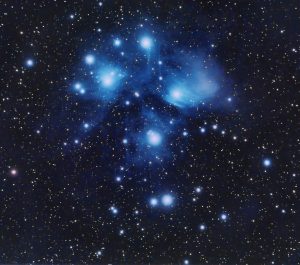
Check this out - our member Kevin Langford's brilliant Pleiades (M45) image - see above; being used on the BBC Sky at Night website.  Plus Kevin's image was shown in the programme aired on the 16th May 2023 too!.........Well Done Kevin :-)

https://www.bbc.co.uk/programmes/p0fmnyt0/p0fmp6yx

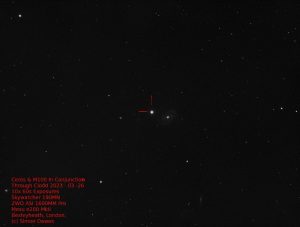
Ceres photobombing Messier 100 by Simon Dawes – 26th March 2023

On the night of the 26th/27th March 2023 Ceres appeared to 'meet' and pass directly in front of the beautiful spiral galaxy Messier 100 (M100) and for a few hours Ceres looked like a brilliant supernova beaming from one of the M100 galaxy's arms.

At the time of the line-of-sight view, Ceres was shining from a piddling distance of 150 million miles (240 million kilometers) from Earth whilst the galaxy at 56 million light-years away; so actually trillions of miles apart!  The 'meeting' took place in the constellation Coma Berenices just a few days after Ceres' opposition, which is when Earth passes between it and the Sun.

Despite the poor weather CMHASD Trustee & member Simon Dawes managed to capture the event - see his image below :-) Ceres is identified with 2 red lines and M100 is at the 4 O'clock position from Ceres.

Ceres is a dwarf planet and the largest asteroid in the main asteroid belt that is between Mars & Jupiter.  It was the first asteroid to be discovered on the 1st January 1801 and was classified as 1 Ceres in 1851. Ceres was designated a dwarf planet, a new category of solar system objects defined in August 2006 by the International Astronomical Union.

Ceres's small size; about 14 times smaller than Pluto means that even at its brightest, it is too dim to be seen by the naked eye, except under extremely dark skies.  Its apparent magnitude ranges from 6.7 to 9.3, peaking at opposition. 

Messier 100 (also known as NGC 4321) is a face-on, spiral galaxy with an apparent magnitude of 9.3.  It is one of the brightest and largest galaxies with a diameter of 160,000 light years. It was discovered in 1781.

Information of how Simon acquired his image is on his photo and for more information about this event see https://skyandtelescope.org/astronomy-news/observing-news/tell-time-with-the-big-dipper-see-ceres-transit-m100/#:~:text=By%20good%20fortune%20Ceres%20will%20pass%20directly%20in,northern%20portion%20of%20the%20Virgo%20Cluster%20this%20spring.

 

Venus & Pleiades by Jim Burchell – 10th April 2023

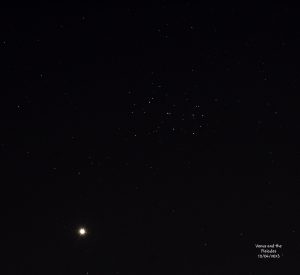
Super image of Venus and the Pleiades taken by member Jim Burchell on the 10th April 2023.

''The Pleiades are also known as The Seven Sisters, Messier 45 and other names by different cultures, is an asterism and an open star cluster containing middle-aged, hot B-type stars in the north-west of the constellation Taurus. At a distance of about 444 light years, it is among the nearest star clusters to Earth. It is the nearest Messier object to Earth, and is the most obvious cluster to the naked eye in the night sky.  The cluster is dominated by hot blue luminous stars that have formed within the last 100 million years.'' ref:https://en.wikipedia.org/wiki/Pleiades

 
Image was taken with a Pentax KP 135mm, F6.3, 10sec and ISO 8oo.
Camera was mounted on a Skywacher Star Adventurer.
 

TOP