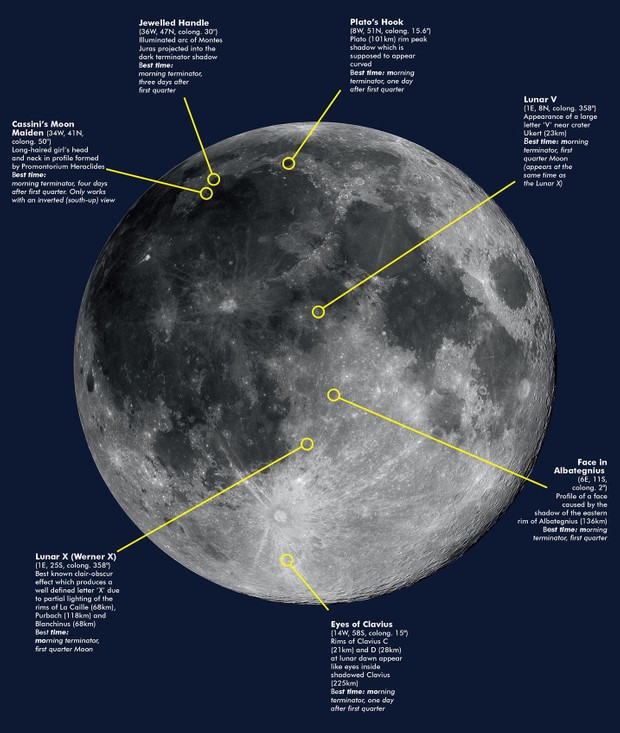
Observing the Moon
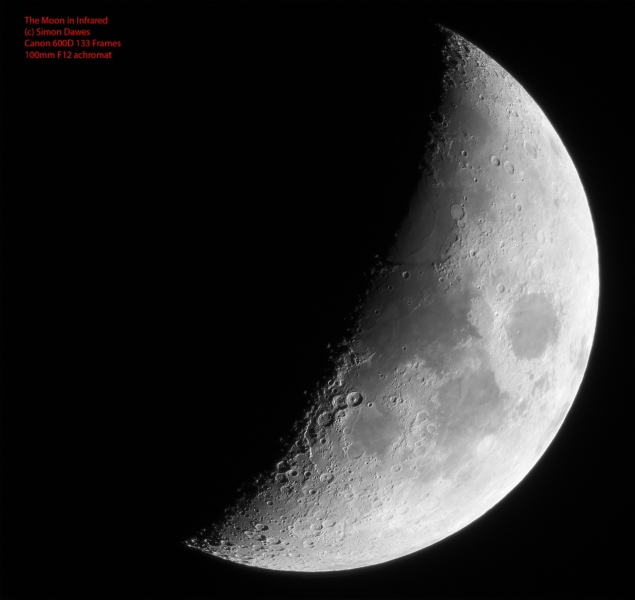
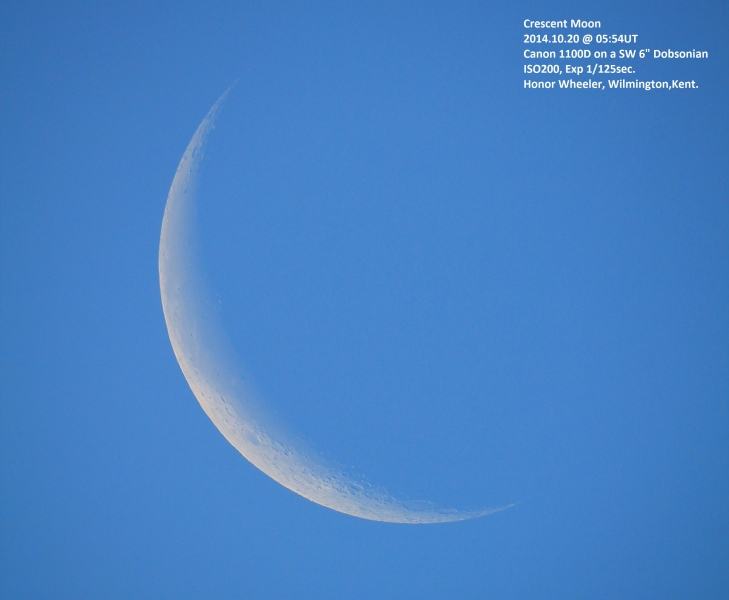
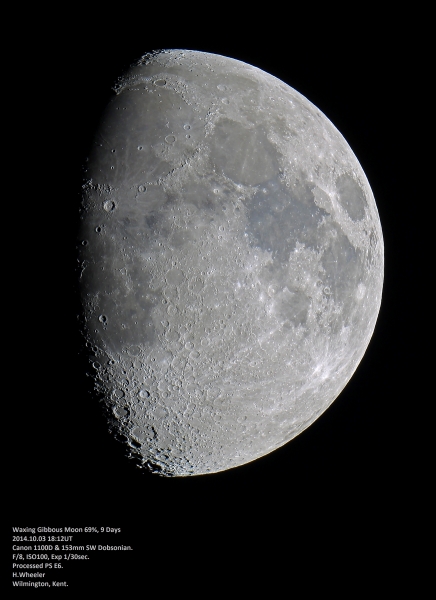
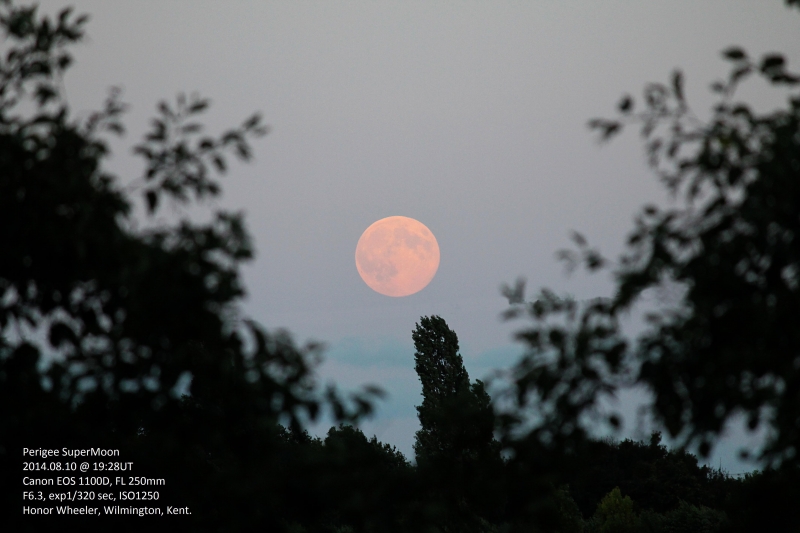
The Moons seems such an obvious object but there is much to be observed, with just your mark 1 eyeball try observing the different phases, the order they occur and the time of day best to observe them. Look for the highlands and seas and see if you can spot the wobble of the moon (libration).
However if you have a telescope try observing the Lunar 100, or imaging the Moon’s features.
BAA Lunar Section | Wikipedia Entry
Recommended Filters
Neutral Density (ND) filters to remove the glare
Fringe Killer to remove any colour cast from refractor telescopes.
Imaging Filters:
IR Pass filter to improve the seeing.
Slideshow
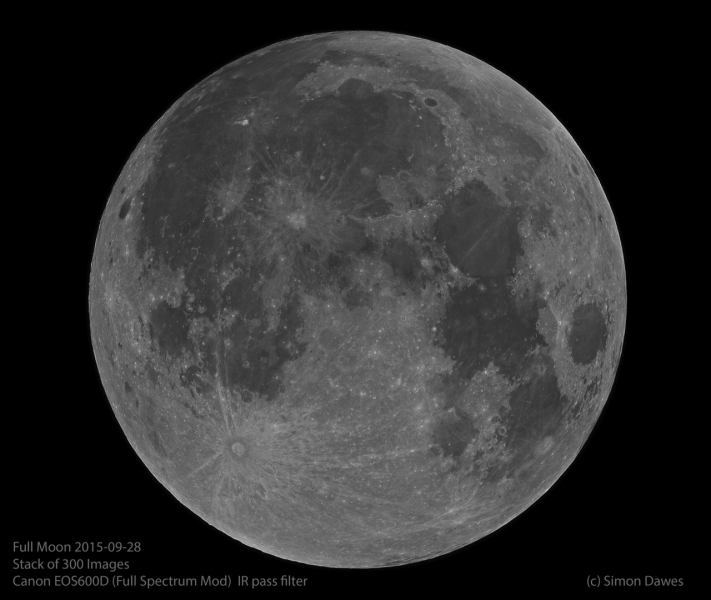
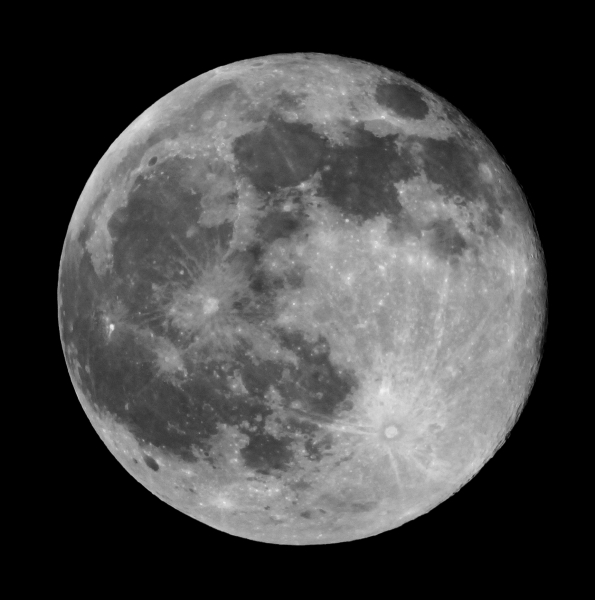
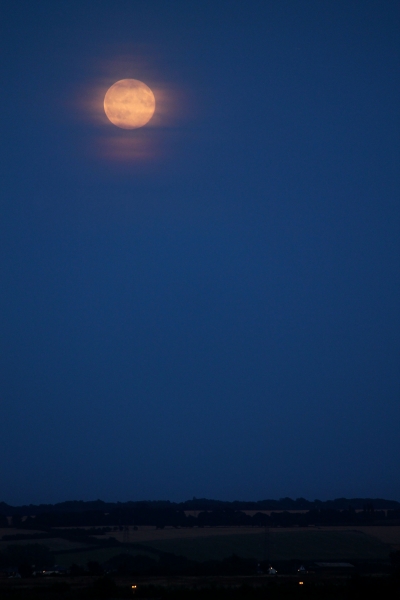
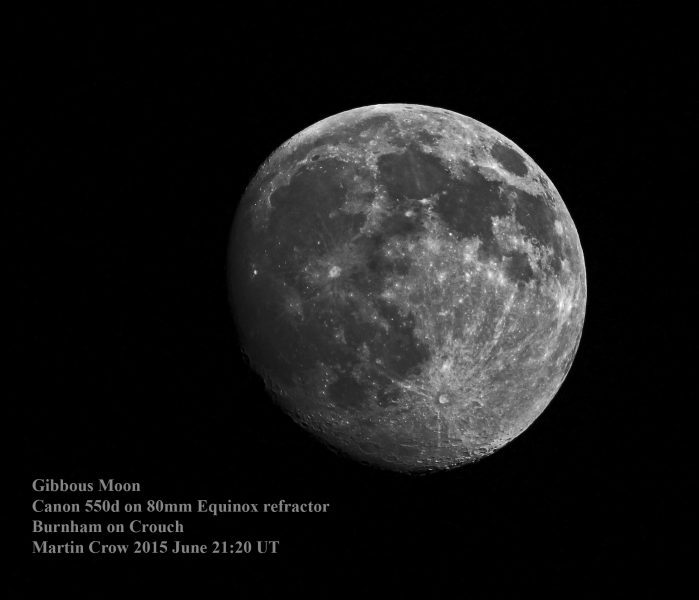
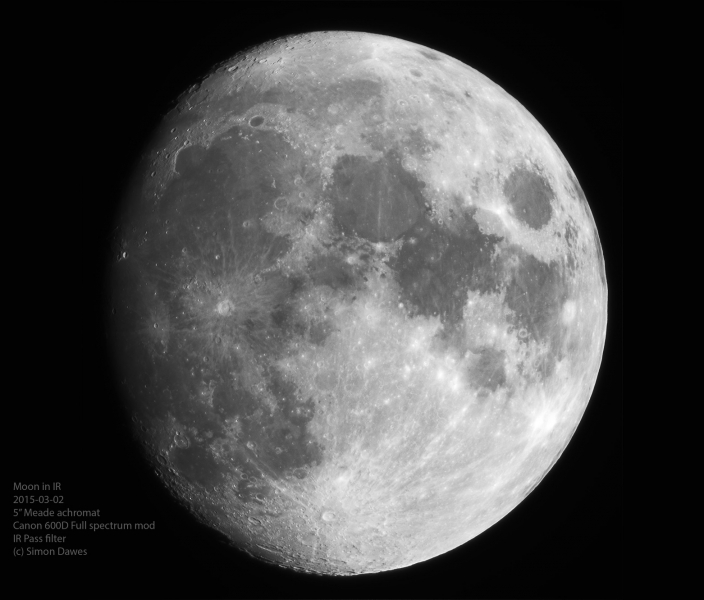
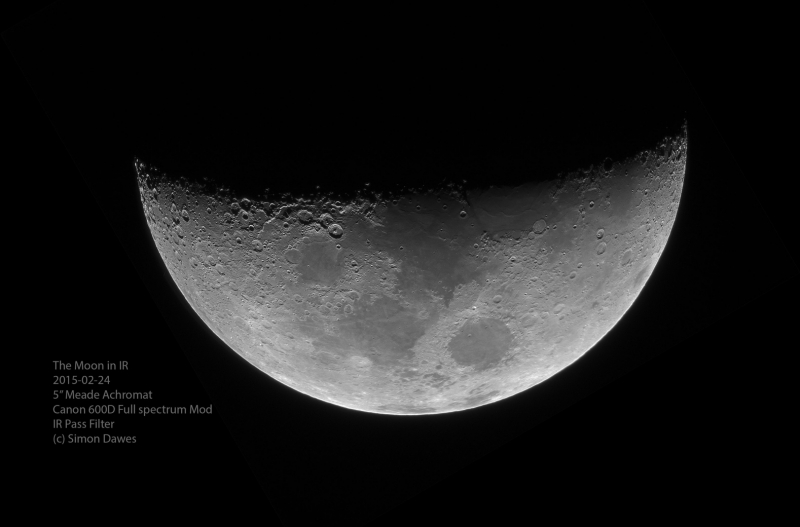
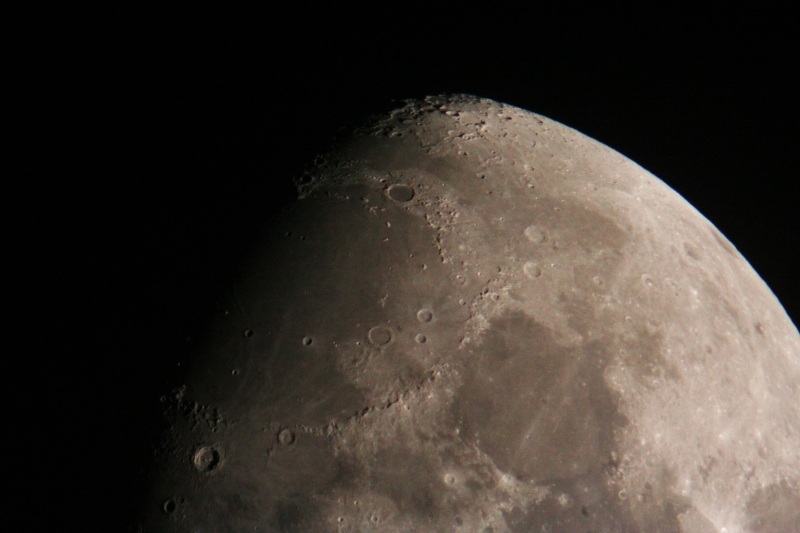
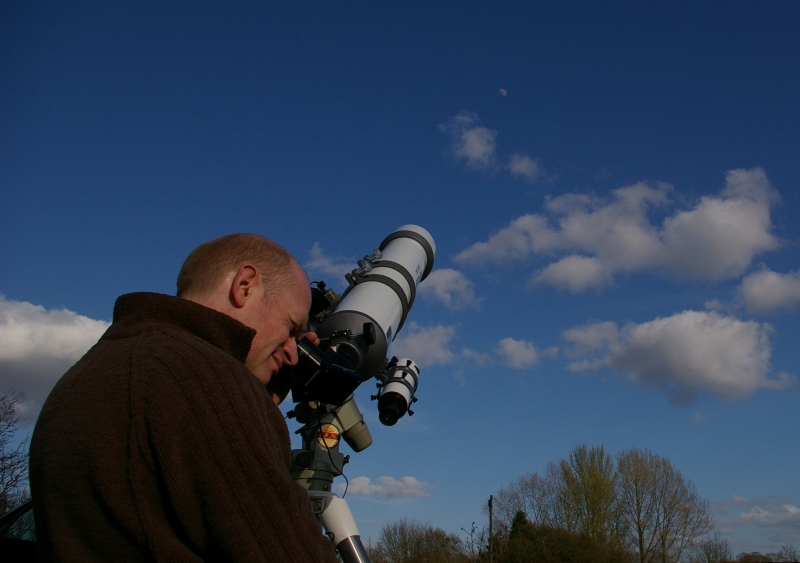
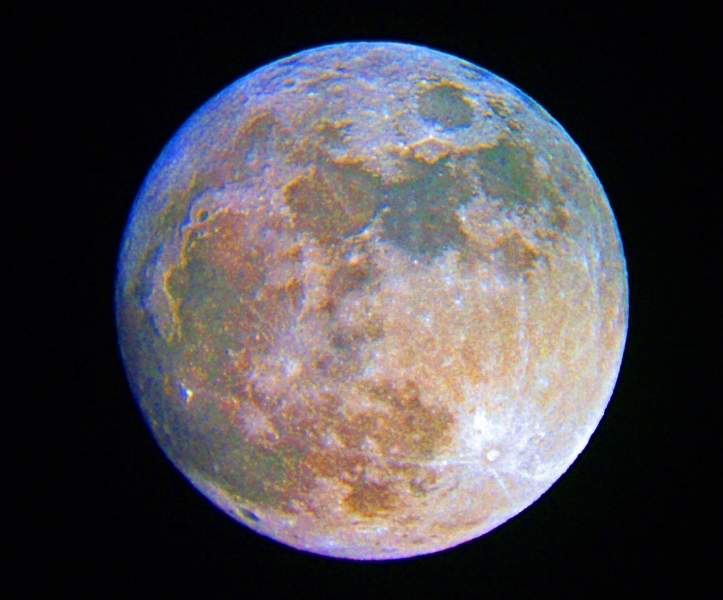
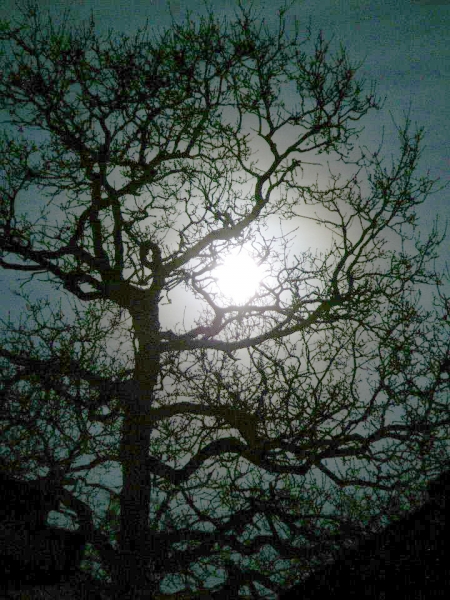
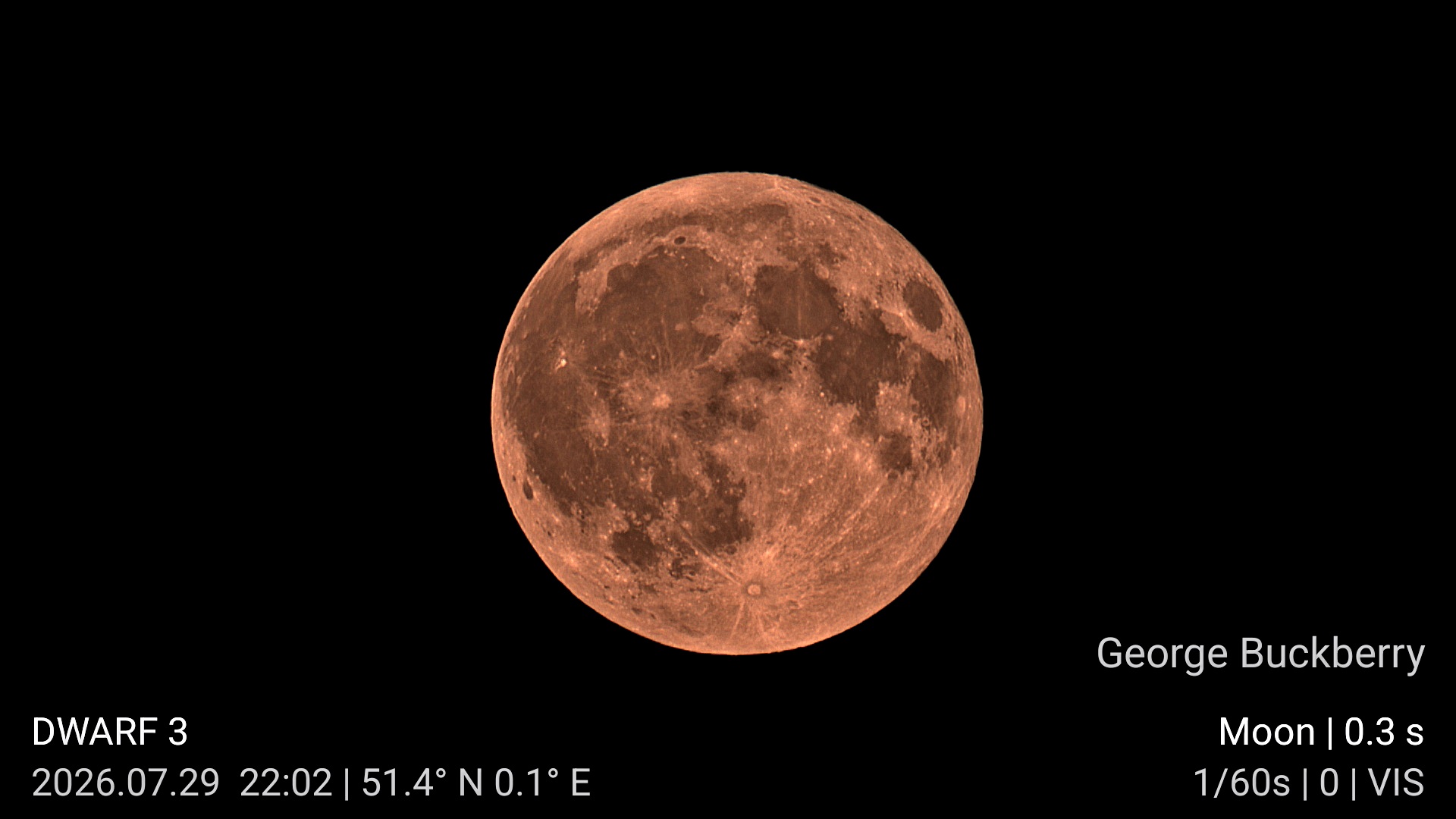
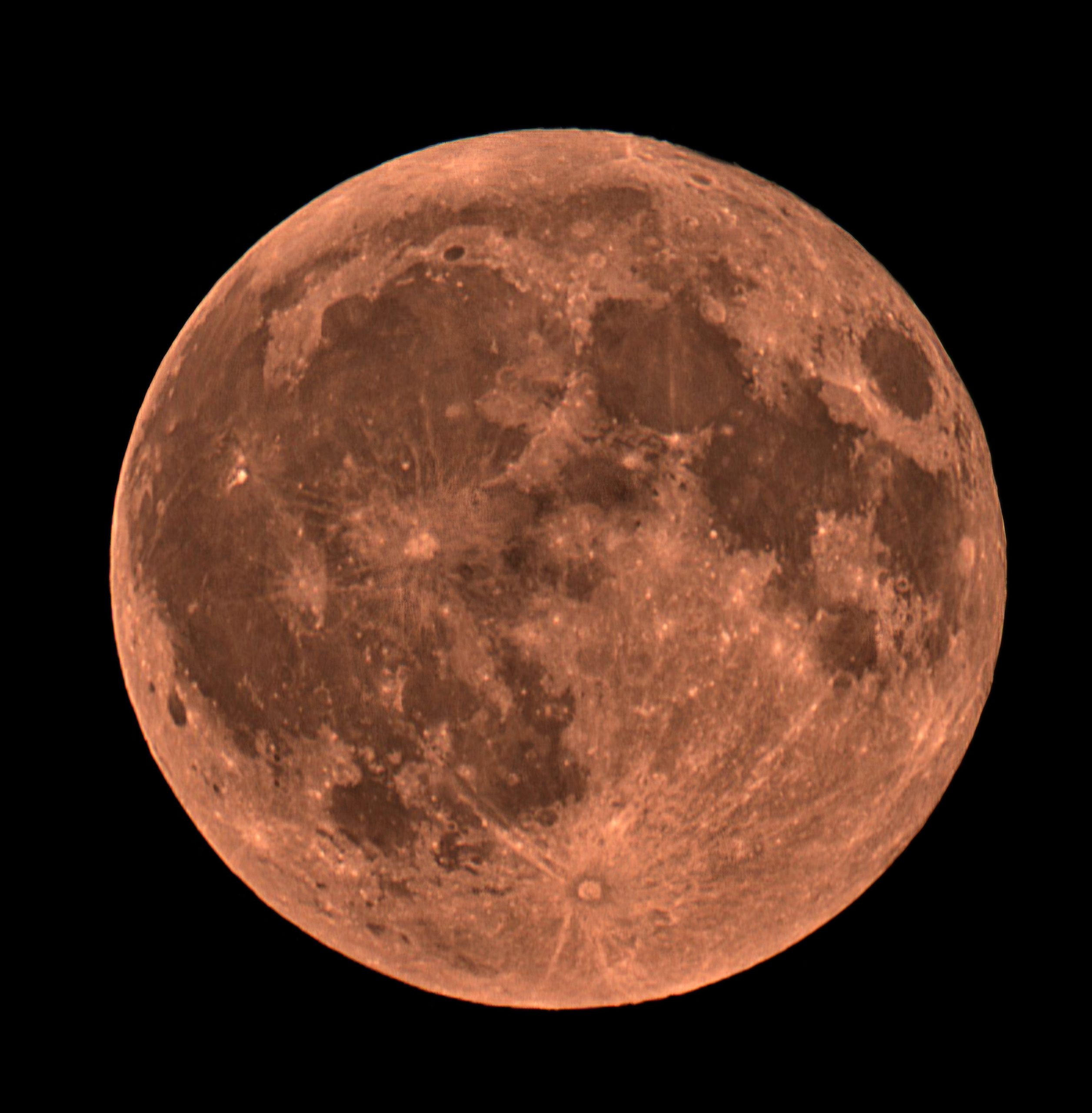
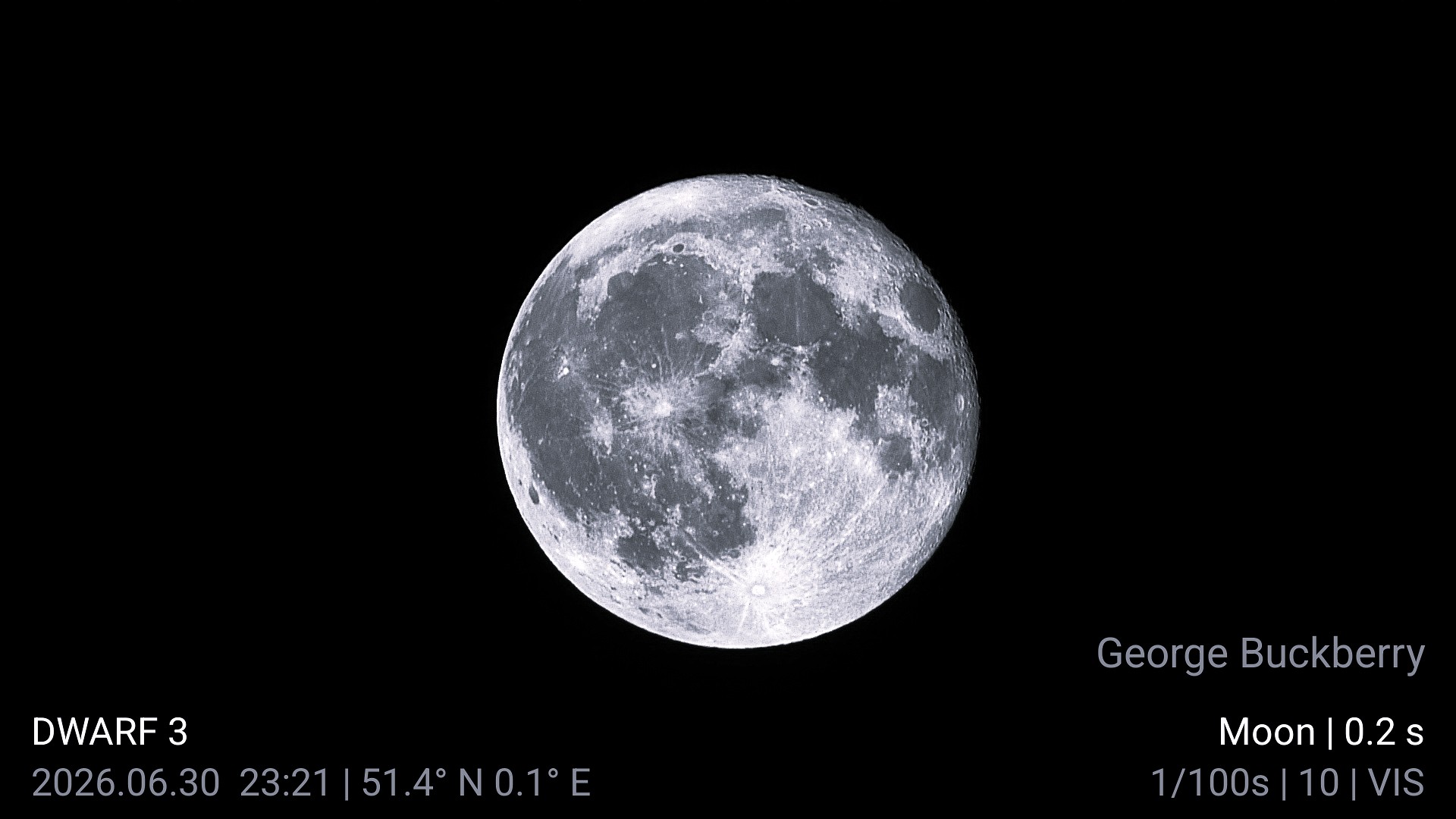
Full Moon – 29th July 2026
A super image of the Full Moon taken on the 29th July 2026 by member George Buckberry using a Dwarf 3 smartscope.
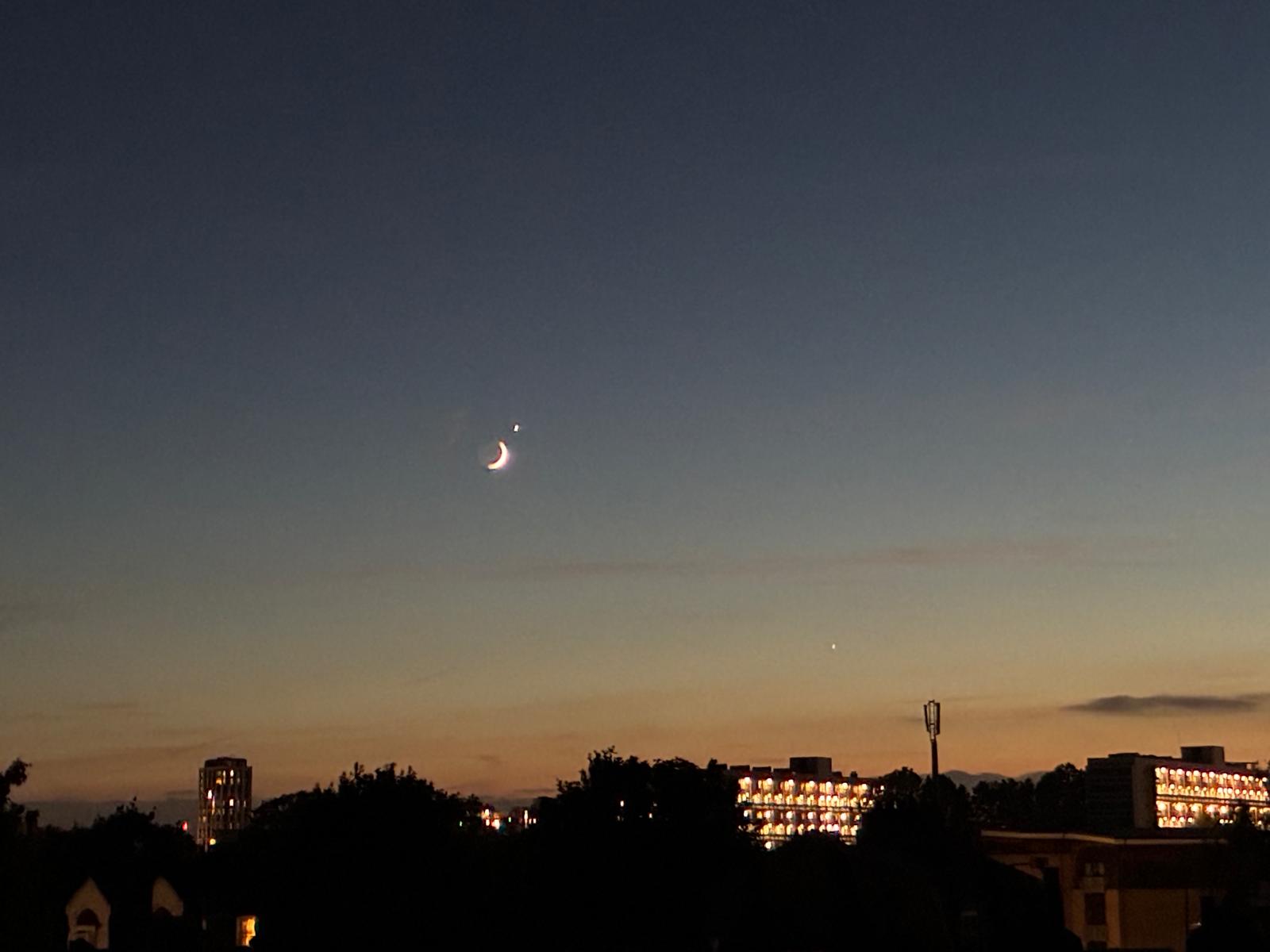
Conjunction of Venus with the Moon
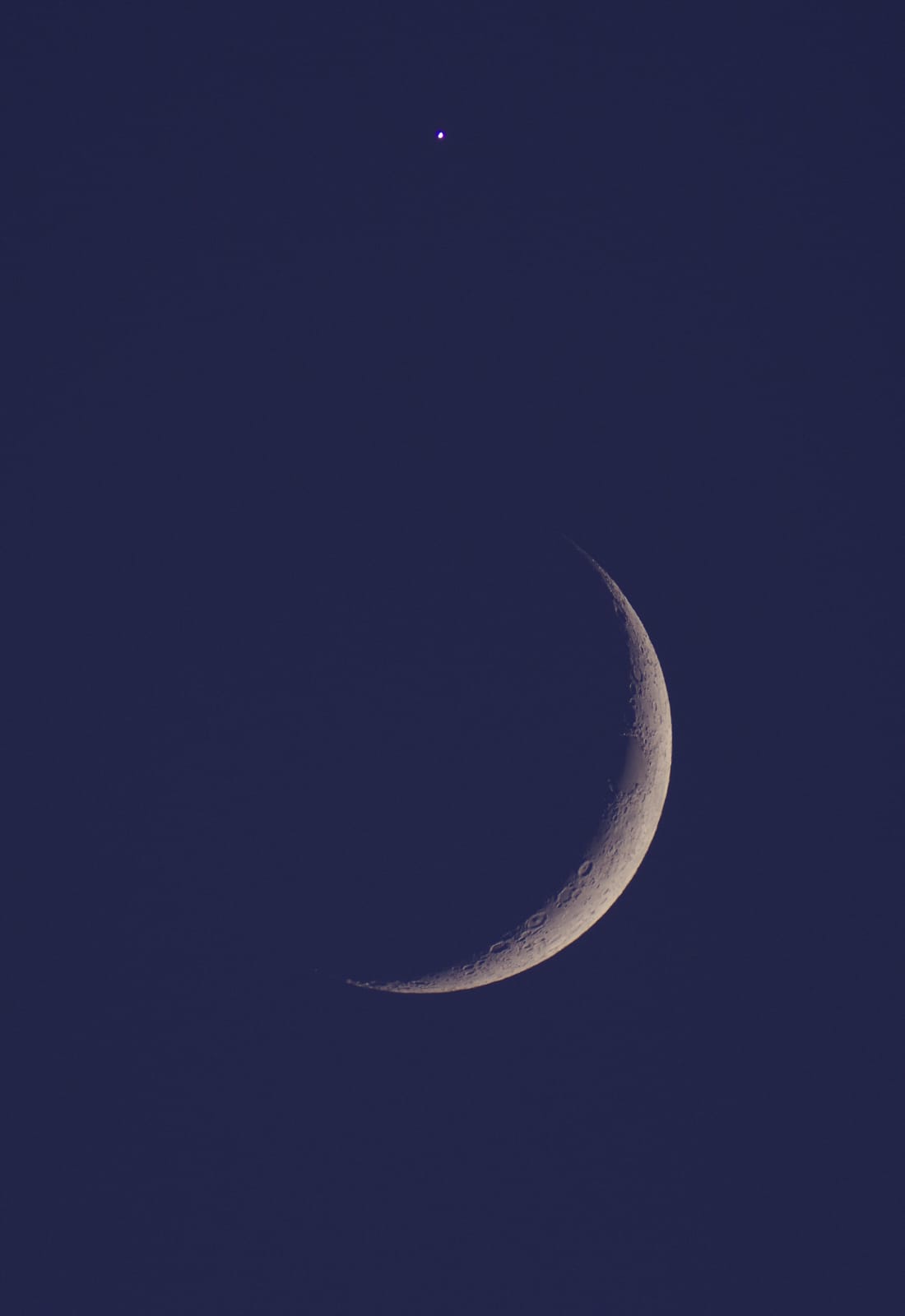
On the 17th June 2026 there was a beautiful conjunction of Venus with the crescent Moon. Several members of the society imaged the event and below is a selection of their fab images taken at different times in the evening. Venus is the dot northwards of the crescent Moon.
Image by Dan Stevens taken at 9.30pmish with a Seestar S30.
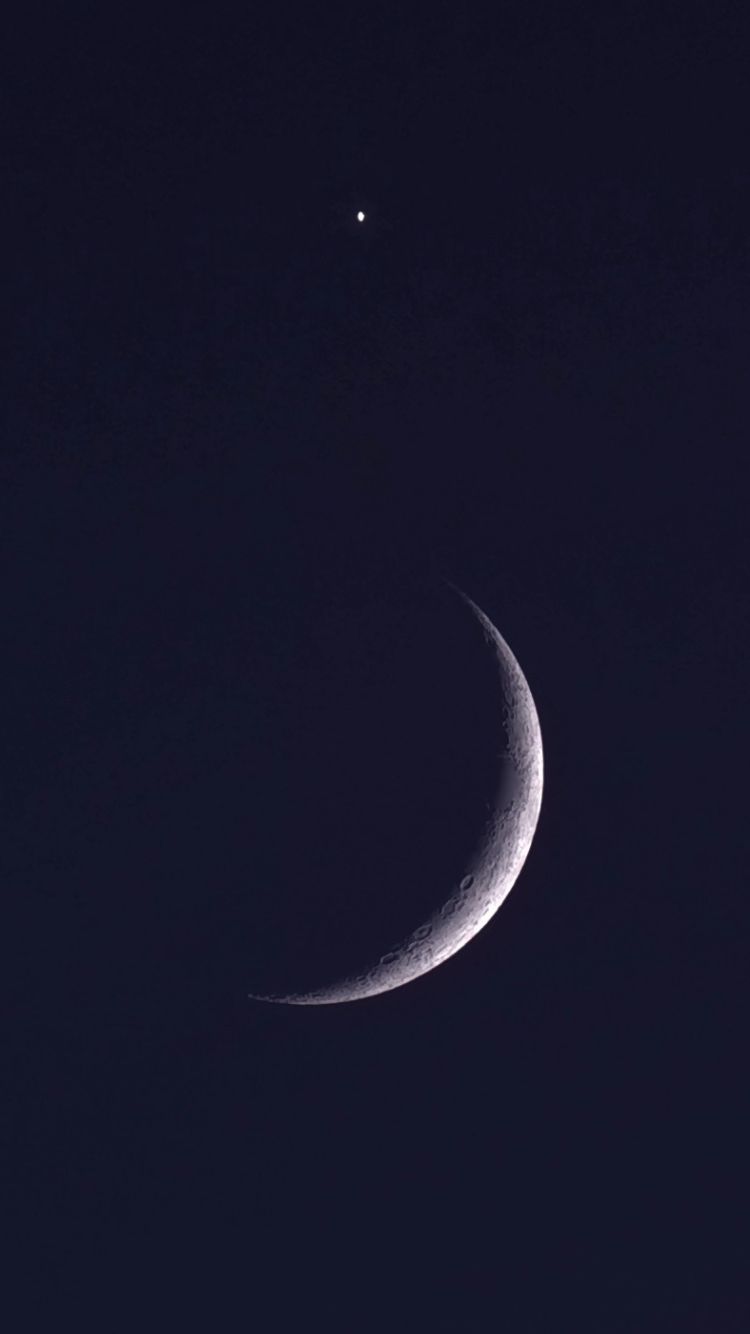
Image by Jim Burchell taken using a Pentax KP body attached to 102 mm F7 Altair Astro refactor. 1 /60 sec, Iso 200 on a Skywatcher EQ5 mount. Cropped in Snapseed.
Image taken from Dartford.
The images below are all point and shoot using various phone cameras.
Image by Simon Dawes from Bexley.
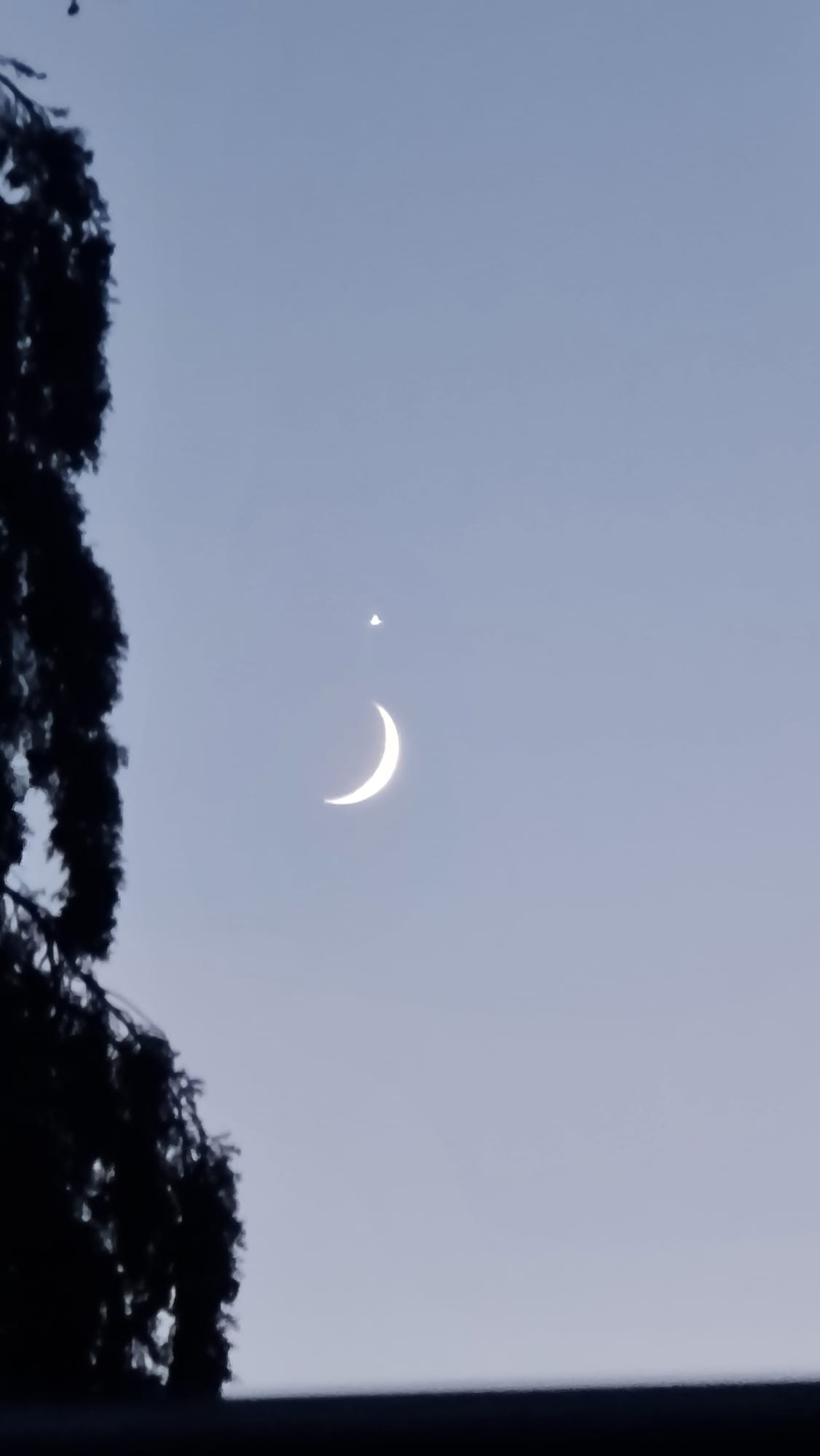
Image by Jo Southgate from Dartford.
NOTE: Jo has Jupiter in her image too. It is the dot which is at the 4 O Clock position from the Moon.
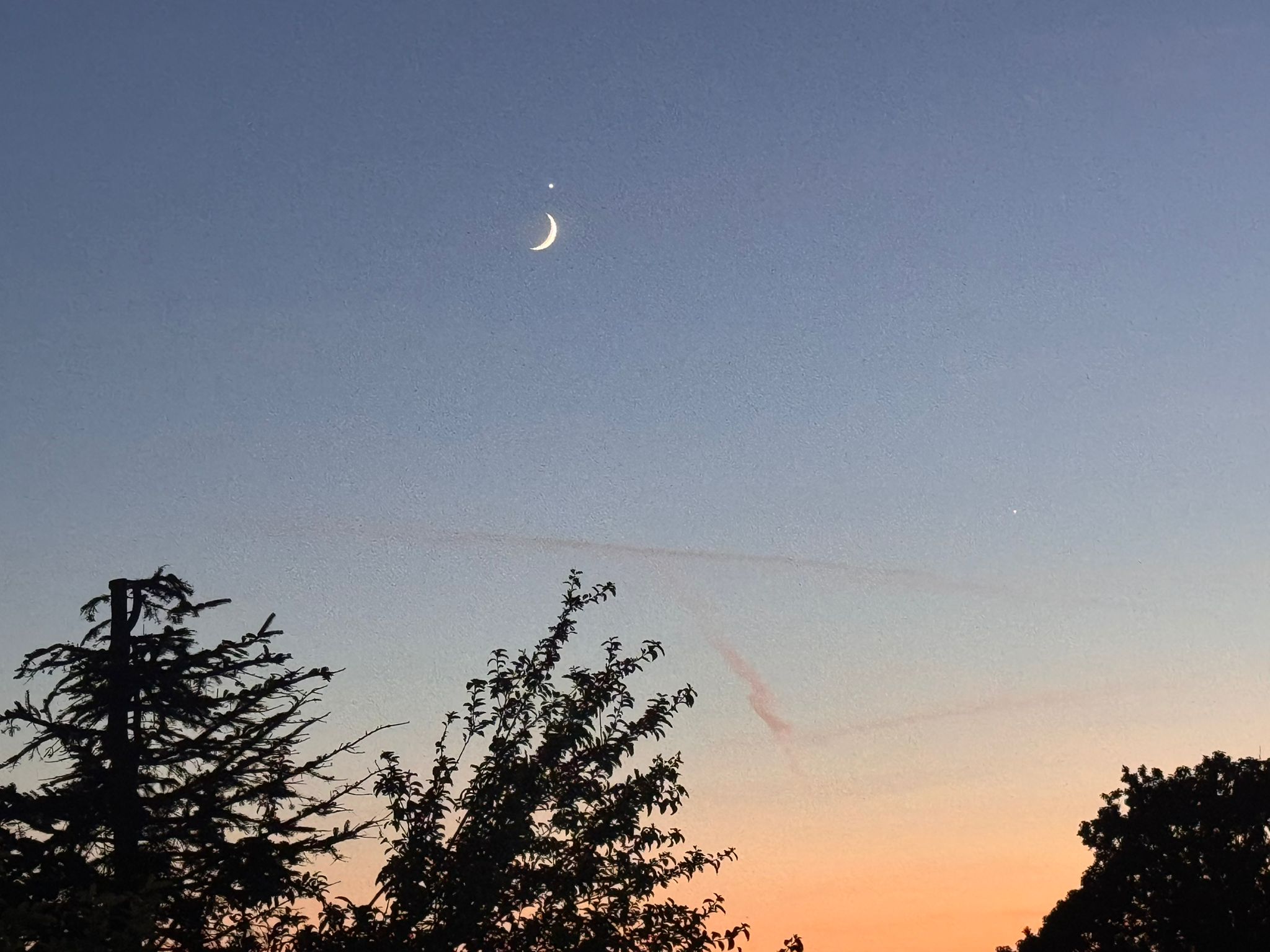
Image by Kevin Langford from Bexley.
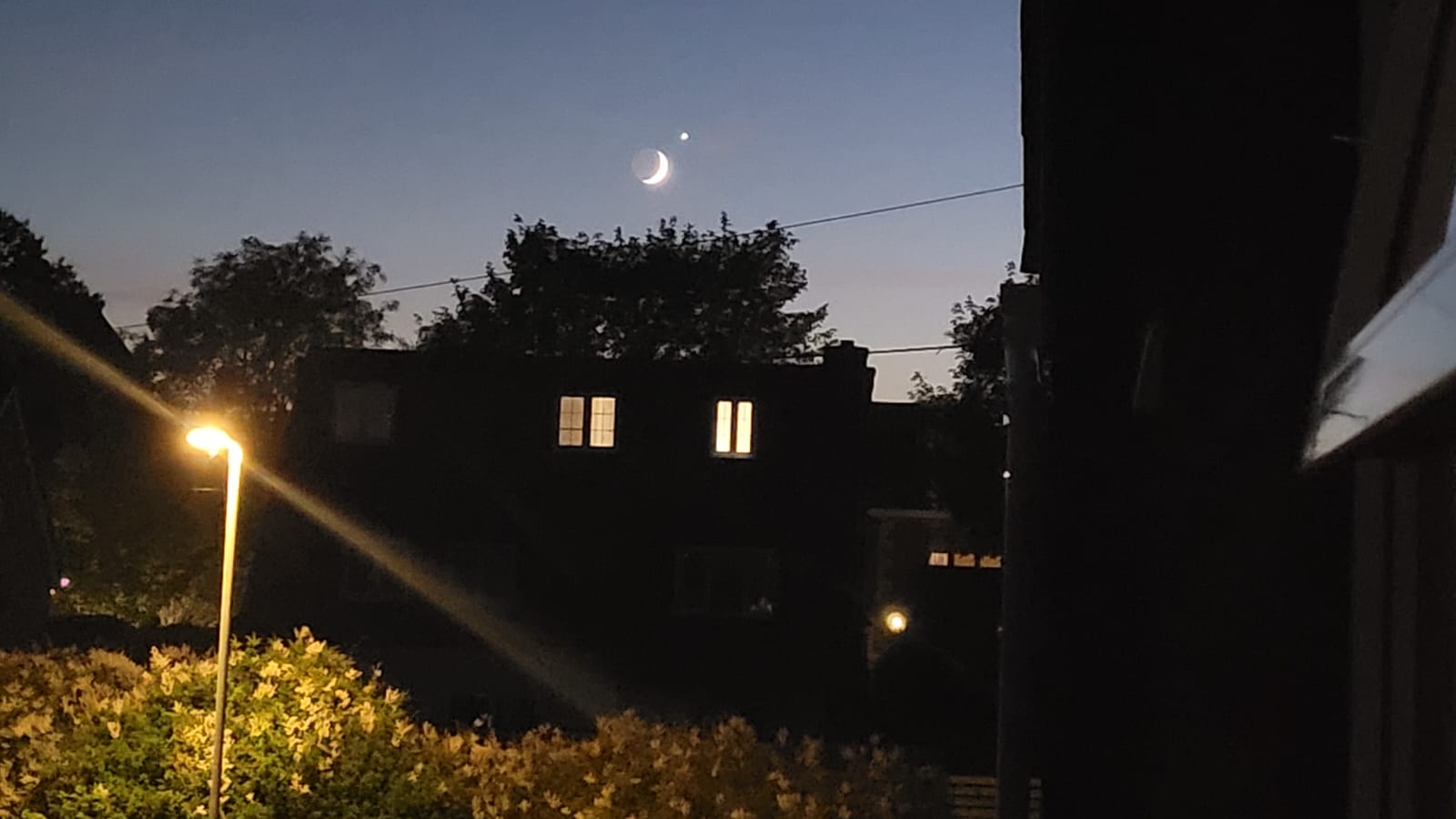
Image by Dominique Ferrand taken over London.
NOTE: Dominique has Jupiter in her image too. It is the dot which is at the 4 O Clock position from the Moon.
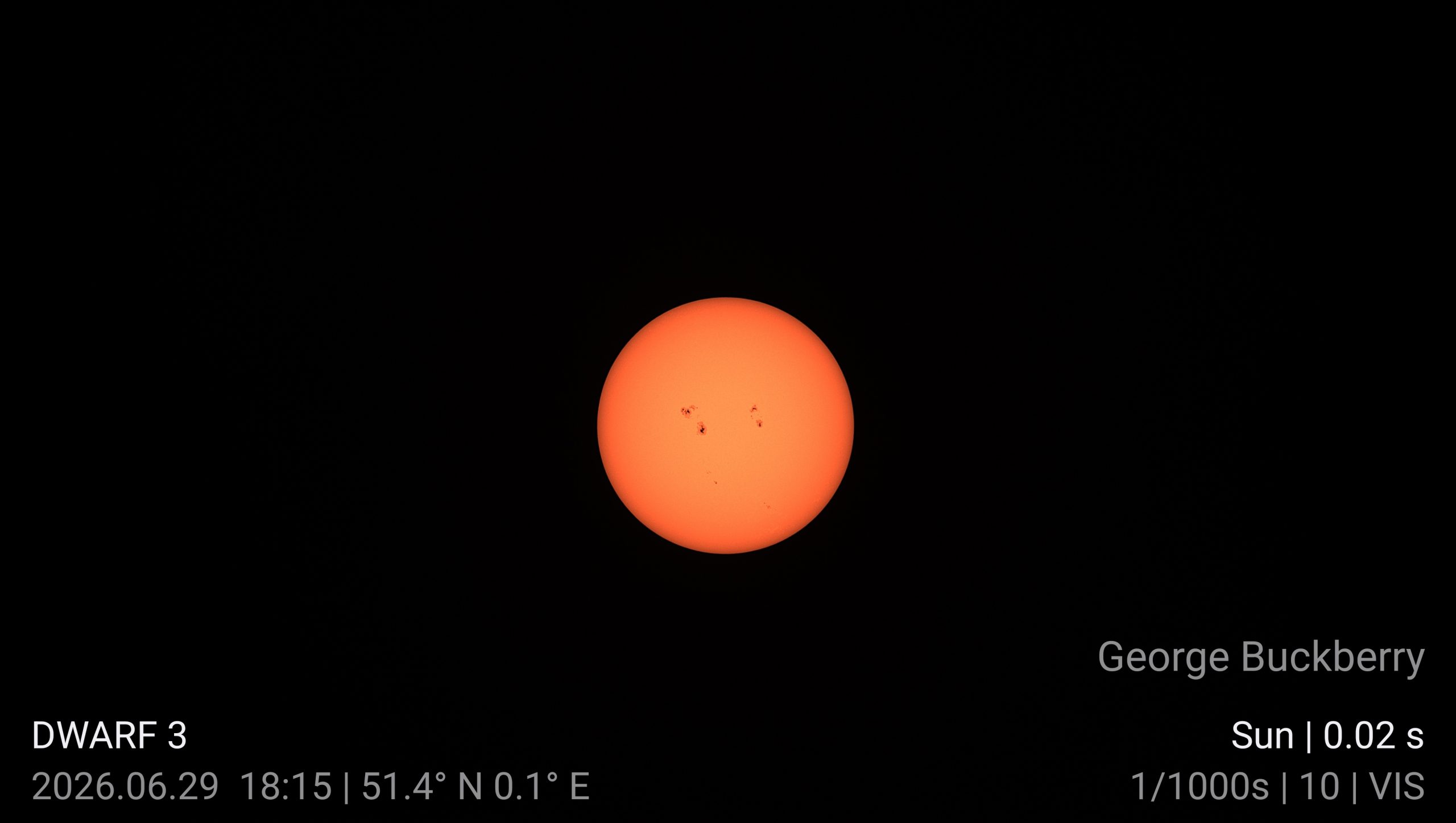
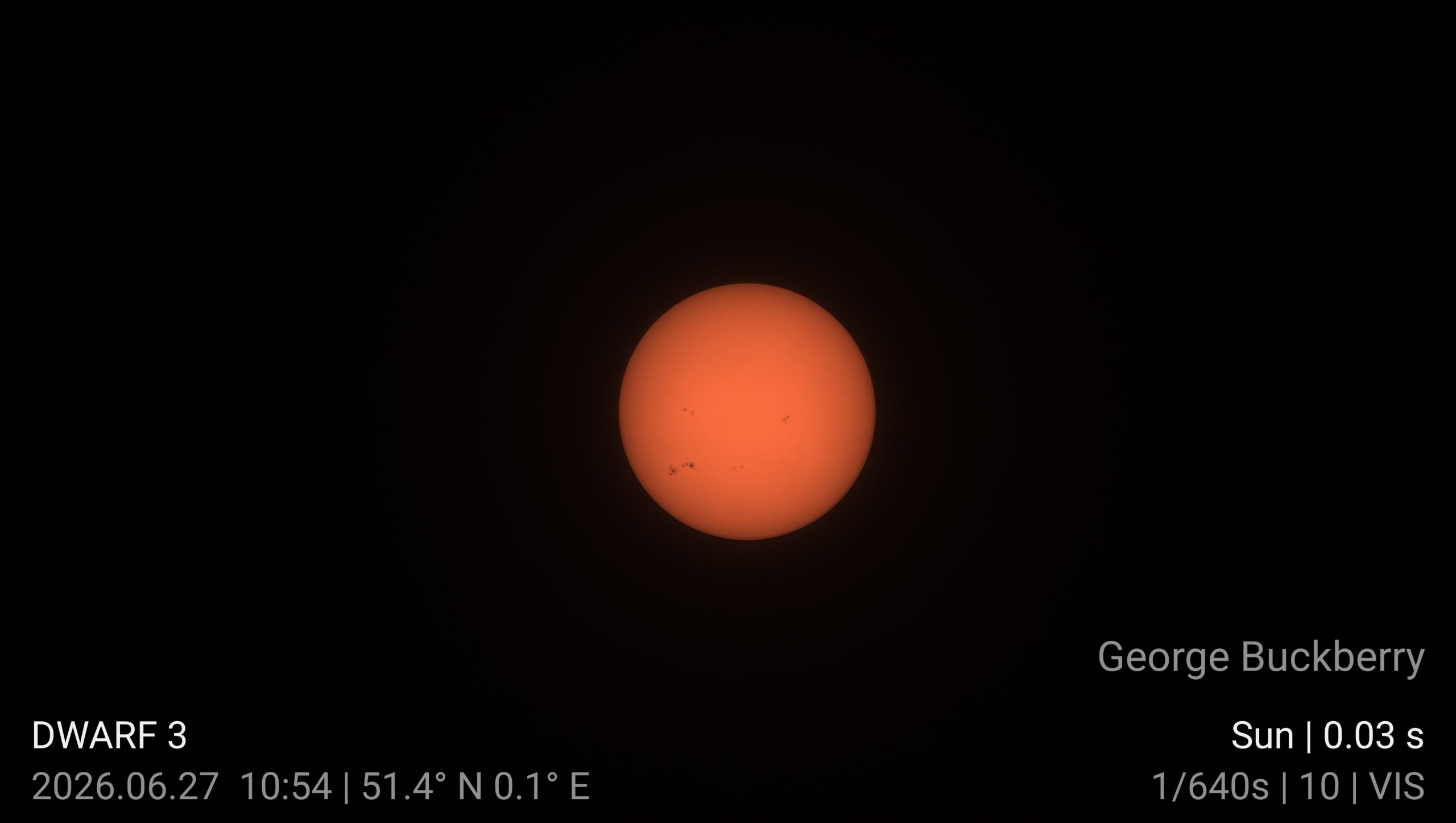
Latest images by George Buckberry
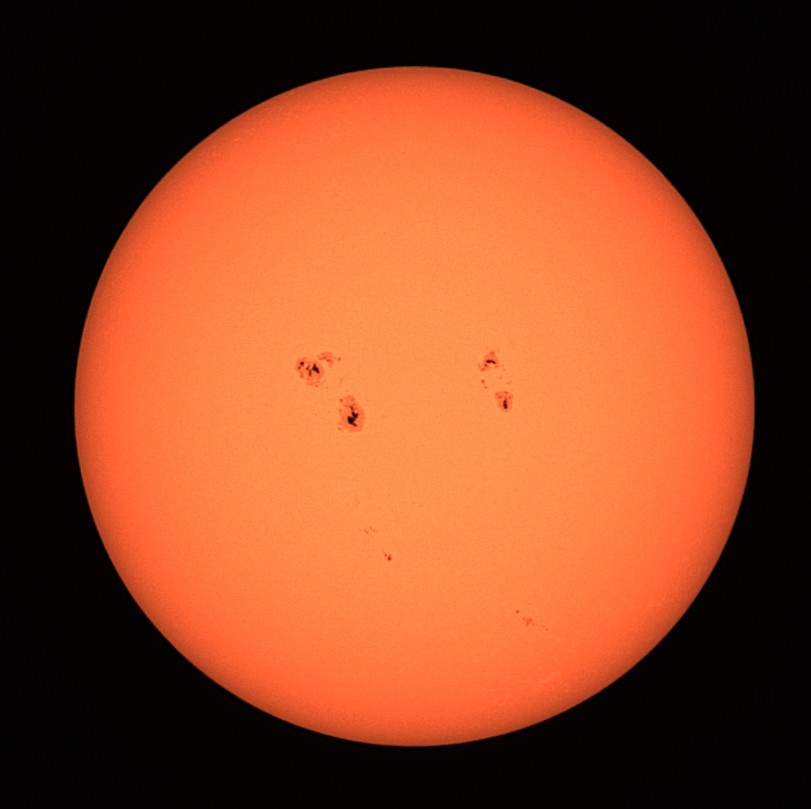
A selection of super images by member George Buckberry taken using a Dwarf smartscope using the new firmware update.
Note: 2 images have a cropped image too.
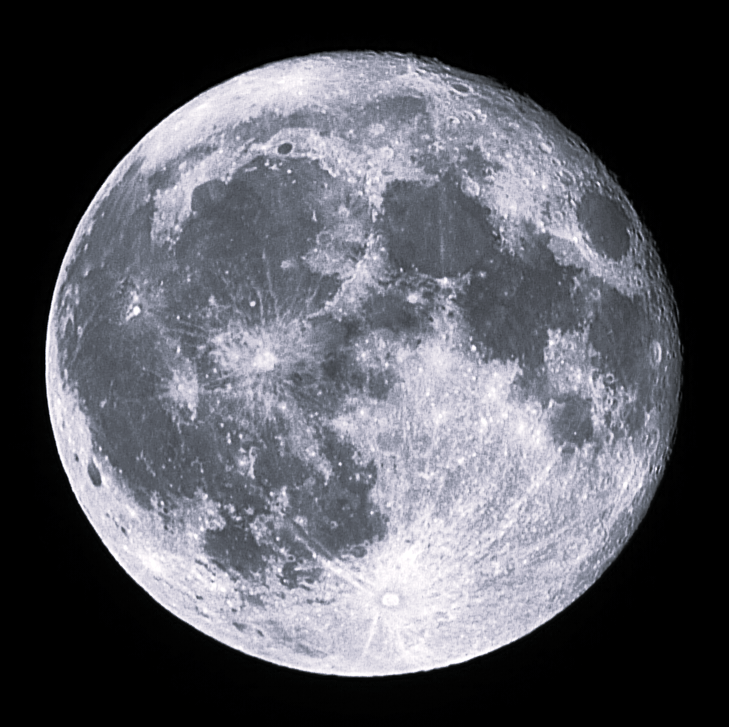
The Moon in glorious detail…
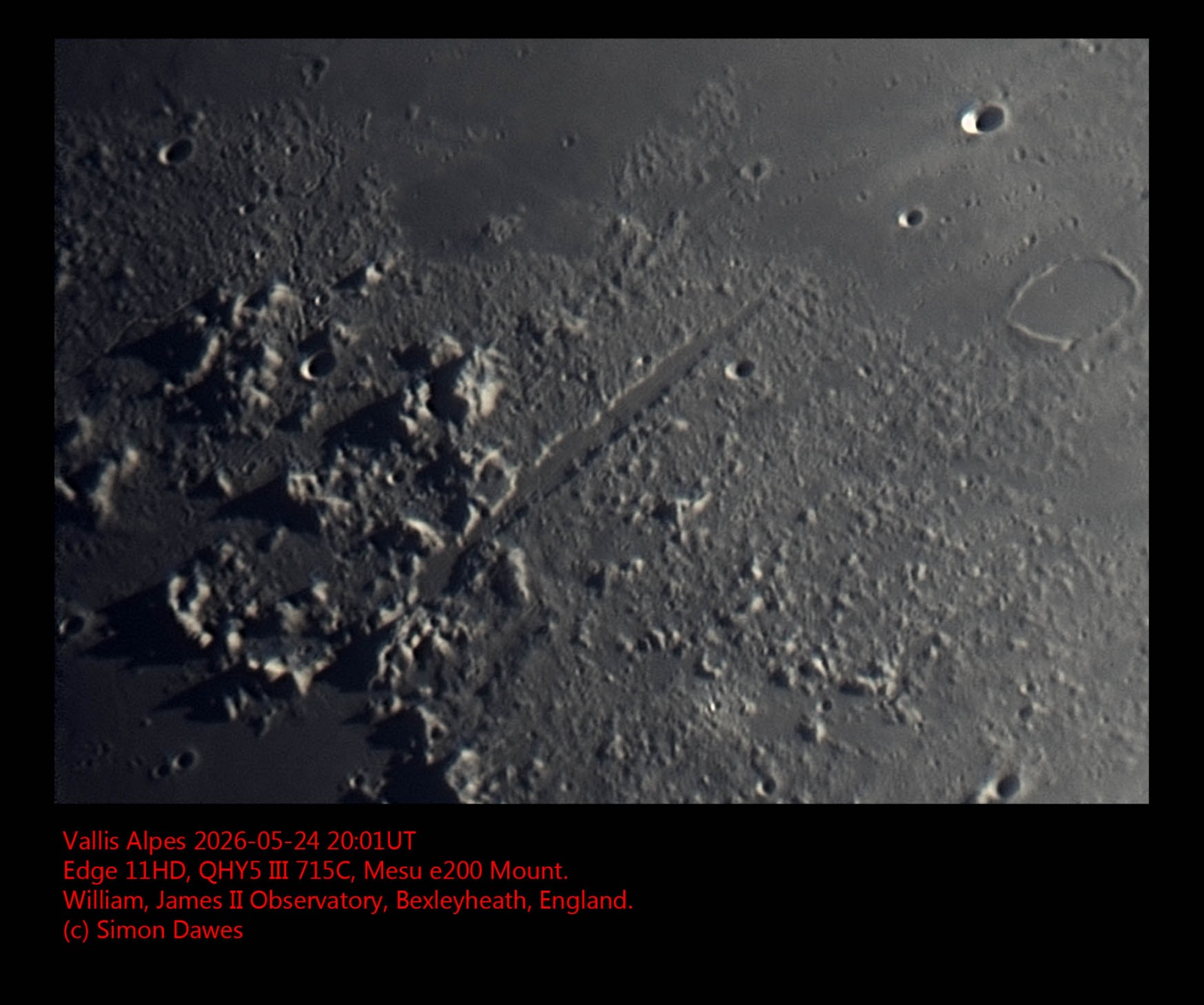
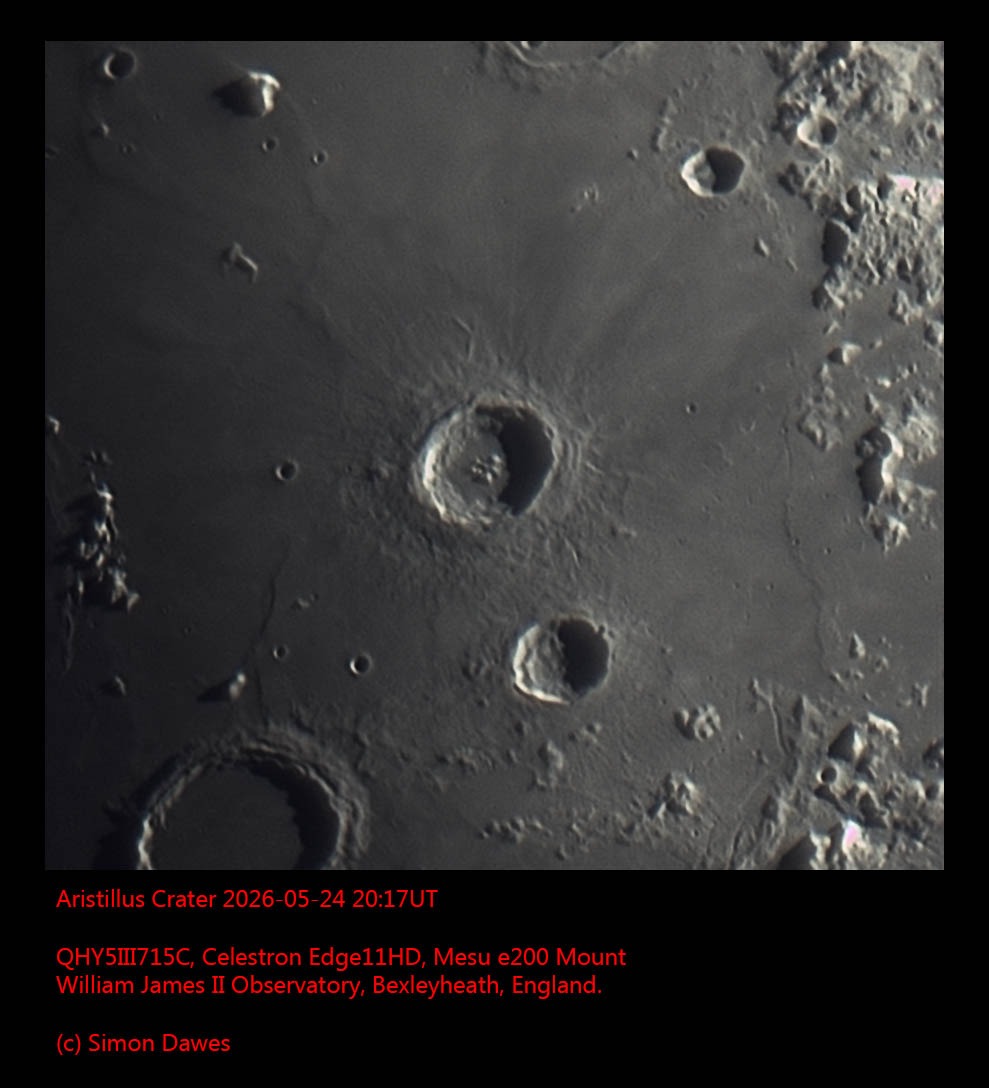
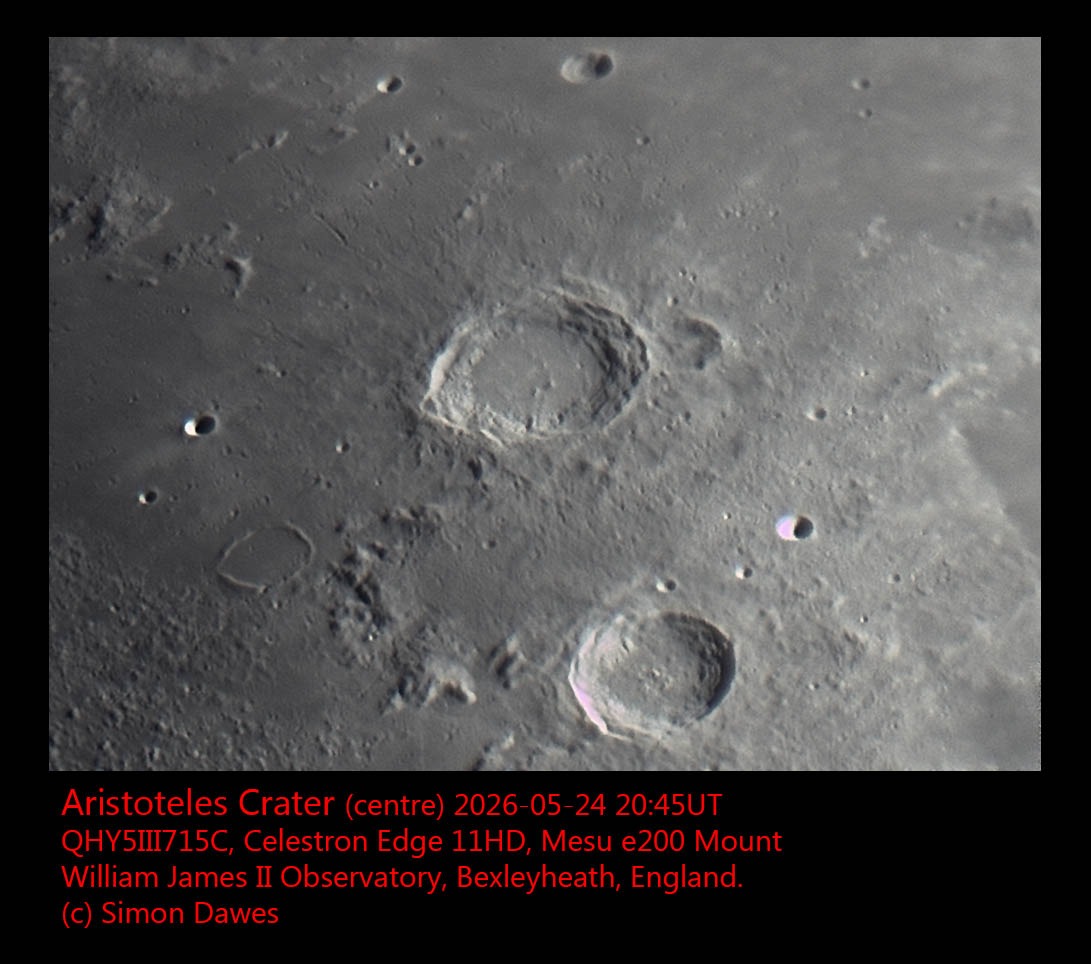
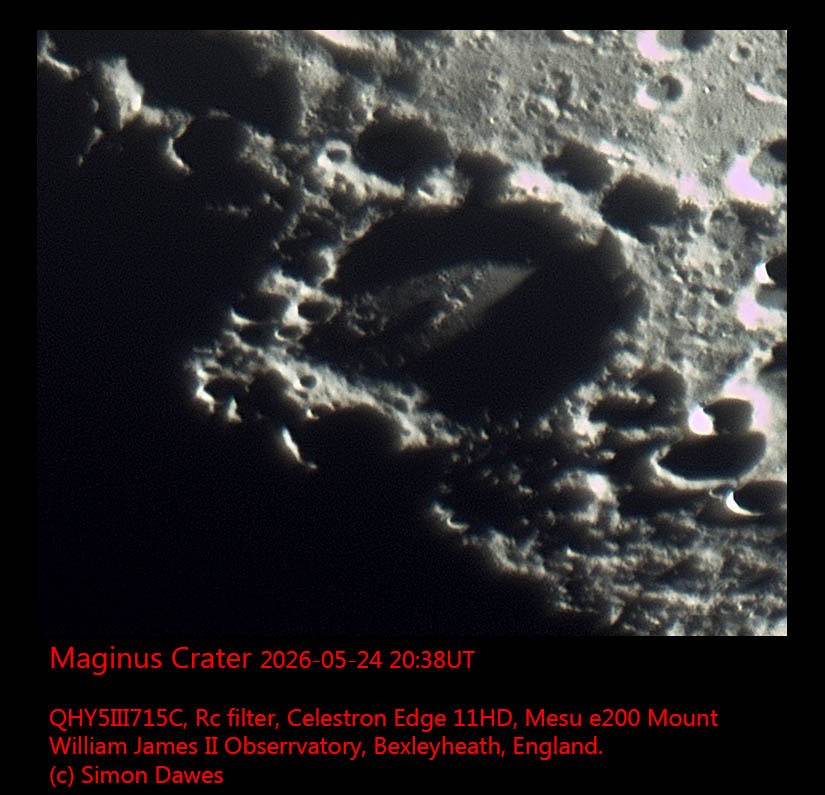
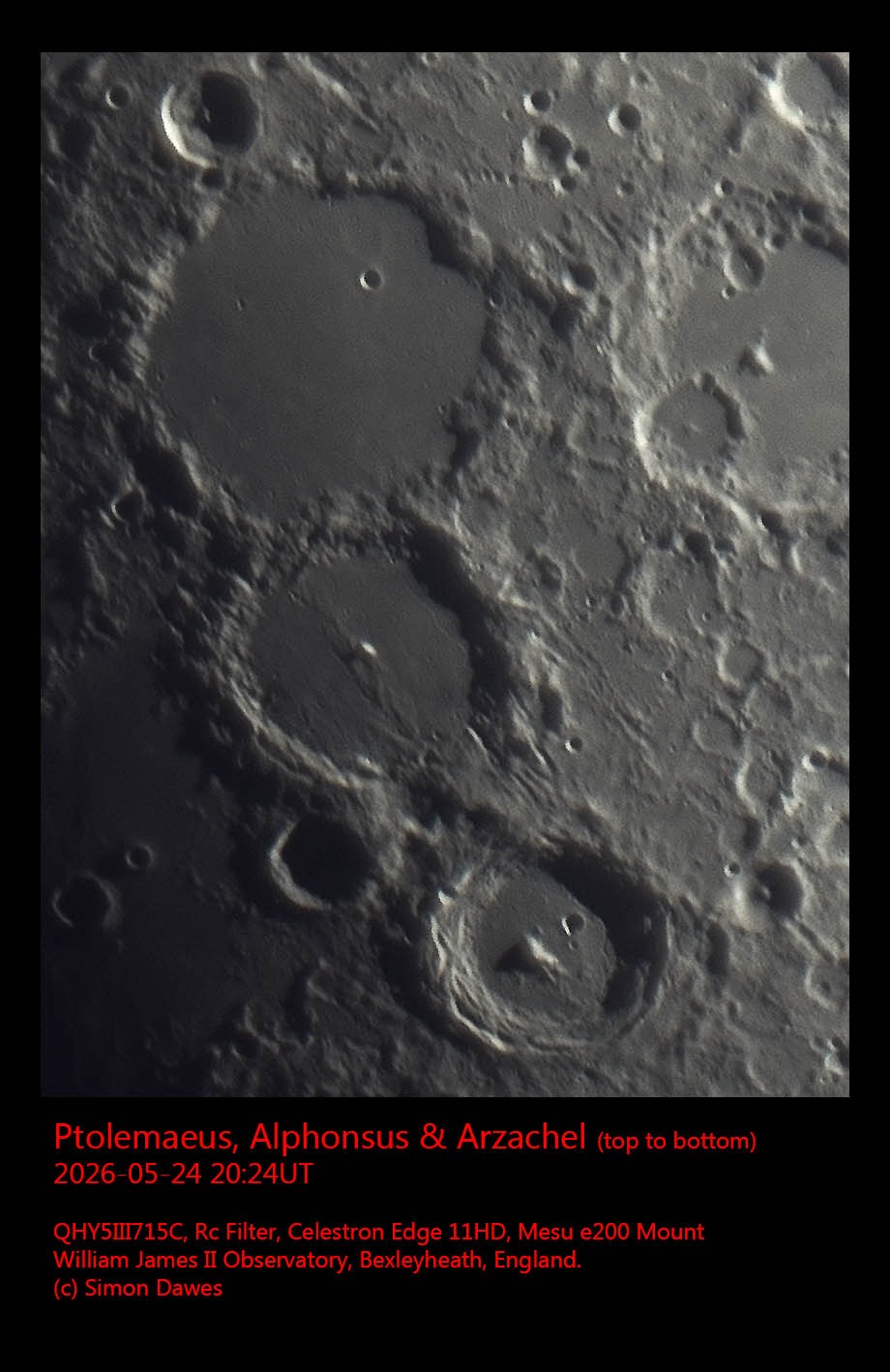
Below are a super selection of 15 images of the Moon taken by Simon Dawes from Bexley. Details of how and when Simon acquired the images are on the photos.
Vallis Alpes (Latin for “Alpine Valley”) is a lunar valley feature that bisects the Montes Alpes range. It extends 166 km from the Mare Imbrium basin, trending east-northeast to the edge of the Mare Frigoris. The valley is narrow at both ends and widens to a maximum width of about 10 km along the middle stretch. Ref:https://en.wikipedia.org/wiki/Vallis_Alpes
Centre of the image is Aristillus is a prominent lunar impact crater that lies in the eastern Mare Imbrium. To the south is the smaller crater Autolycus, while to the southwest is the large Archimedes. To the northeast are the craters Theaetetus and Cassini. Ref:https://en.wikipedia.org/wiki/Aristillus_(crater)
Aristoteles is a lunar impact crater that lies near the southern edge of the Mare Frigoris and to the east of the Montes Alpes mountain range. It was officially named in 1935 after the ancient Greek philosopher and astronomer Aristotle (383-322 B.C.) by the International Astronomical Union, using the classical form of his name.
To the immediate south of Aristoteles lies the slightly smaller crater Eudoxus, and these two form a distinctive pair for a telescope observer. An arc of mountains between these craters bends to the west before joining the walls. The smaller crater Mitchell is directly attached to the eastern rim of Aristoteles. To the west is the low, flooded feature Egede. Ref:https://en.wikipedia.org/wiki/Aristoteles_(crater)
Maginus is an ancient lunar impact crater located in the southern highlands to the southeast of the prominent crater Tycho. It is a large formation almost three quarters the diameter of Clavius, which lies to the southwest. Ref:https://en.wikipedia.org/wiki/Maginus_(crater)
Ptolemaeus is an ancient lunar impact crater close to the center of the near side, named for Claudius Ptolemy, the Greco-Roman writer, mathematician, astronomer, geographer and astrologer. It measures approximately 154 kilometers in diameter.
To the south-southwest, Ptolemaeus is joined to the rim of the crater Alphonsus by a section of rugged, irregular terrain, and these form a prominent chain with Arzachel to the south. Ref:https://en.wikipedia.org/wiki/Ptolemaeus_(lunar_crater)
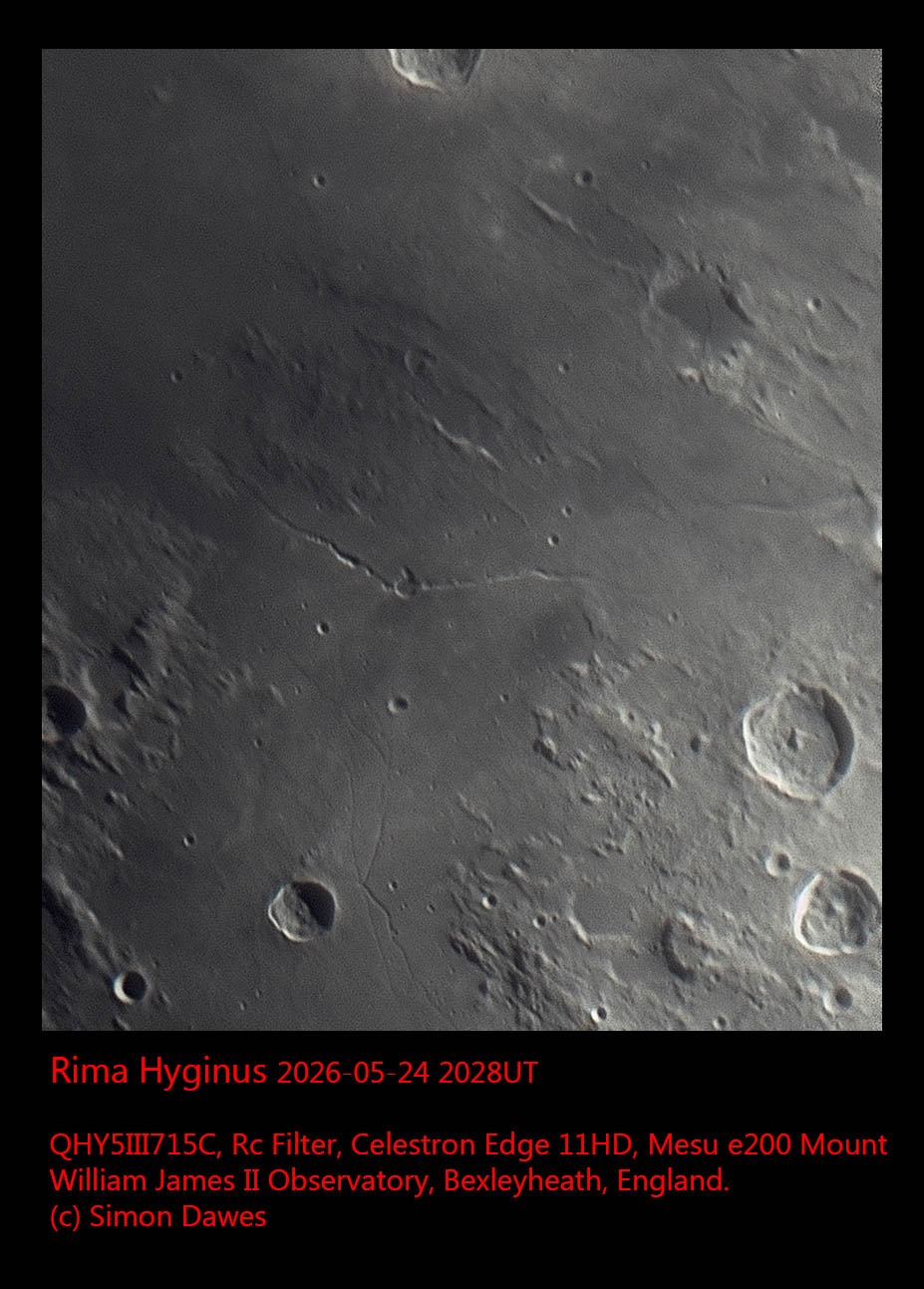
Hyginus is a lunar caldera located at the east end of the Sinus Medii. It was named after ancient Roman astronomer Gaius Julius Hyginus. Its rim is split by a 220 kilometer-long rille, Rima Hyginus, that branches to the northwest and to the east-southeast. The crater is deeper than the rille, and lies at intersection of the rille’s branches. Together, the crater and the rille form a prominent feature in an otherwise flat surface. Smaller craters along the length of the rille may have been caused by the collapse of an underlying structure.
Hyginus is one of the few craters on the Moon that were not created as a result of an impact, and is instead believed to be volcanic in origin. Ref:https://en.wikipedia.org/wiki/Hyginus_(crater)
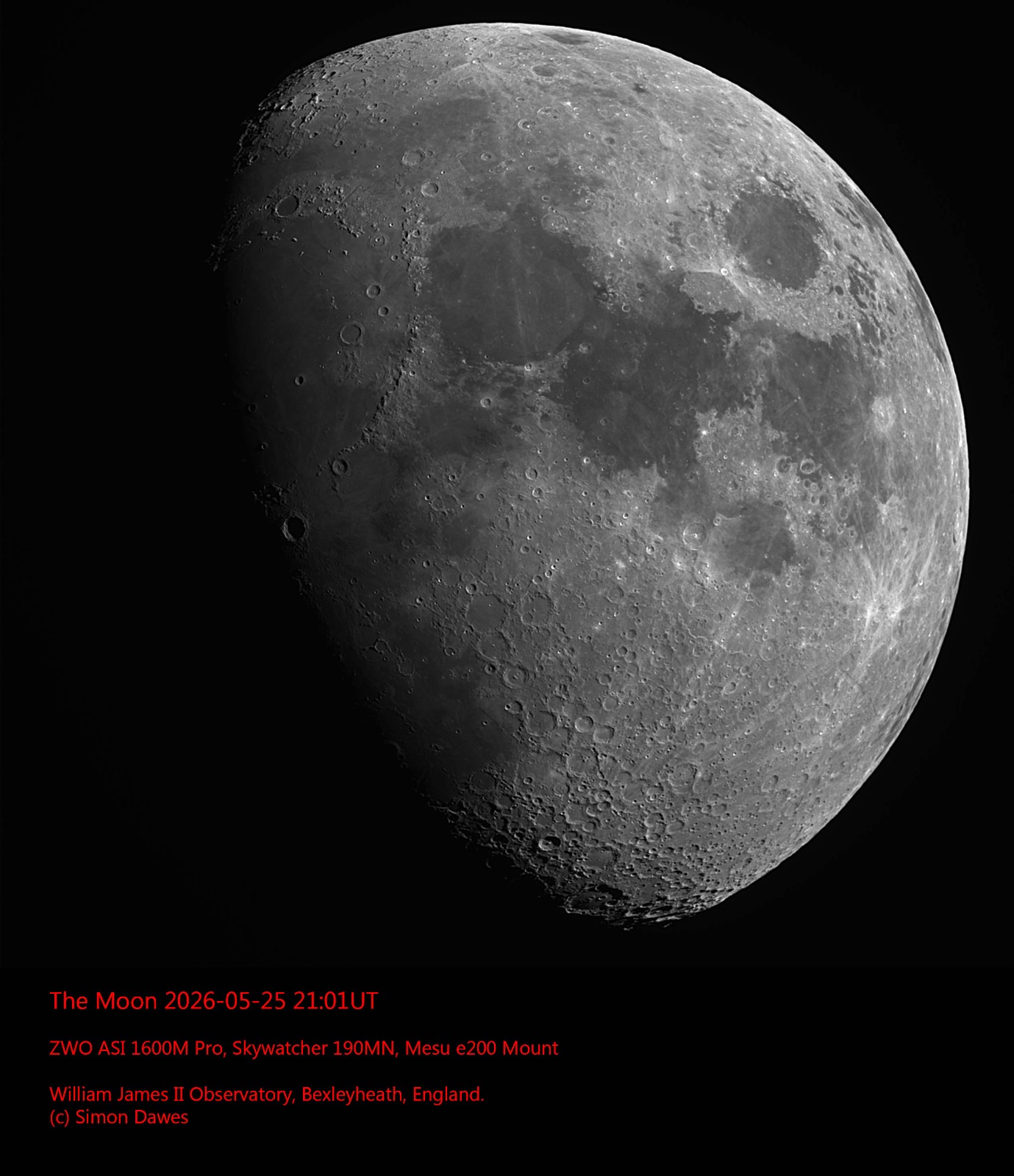
On Monday, May 25, 2026 the Moon was in its
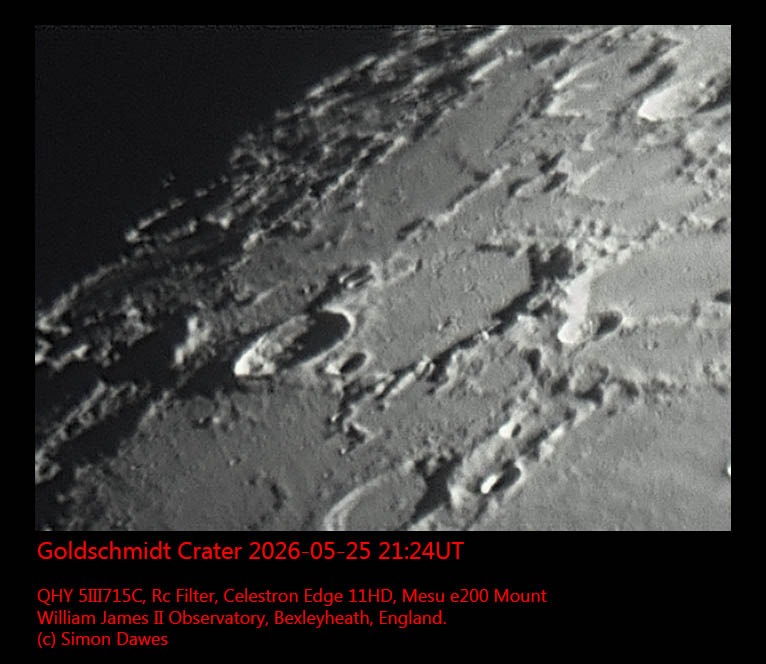
Goldschmidt is a large lunar impact crater of the variety commonly termed a walled plain. Ref:https://en.wikipedia.org/wiki/Goldschmidt_(crater)
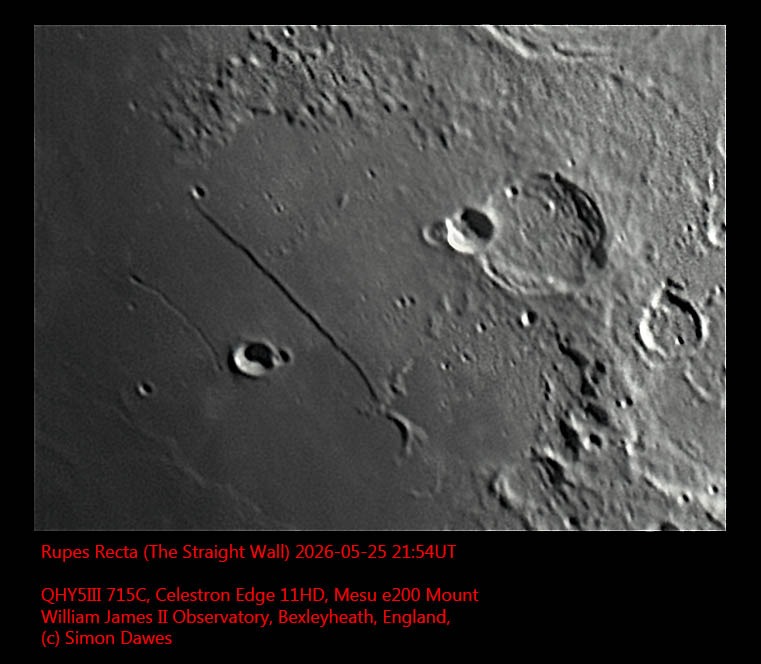
Rupes Recta is a linear fault on the Moon, in the southeastern part of the Mare Nubium. The name is Latin for straight cliff, although it is more commonly called the Straight Wall. This is the best-known escarpment on the Moon. Ref:https://en.wikipedia.org/wiki/Rupes_Recta
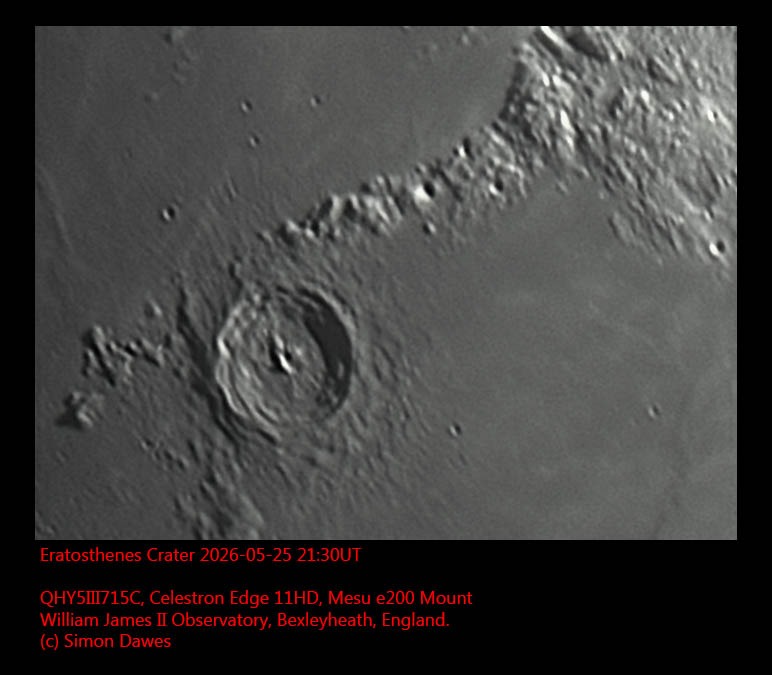
Eratosthenes crater is a relatively deep lunar impact crater that lies on the boundary between the Mare Imbrium and Sinus Aestuum mare regions. It forms the western terminus of the Montes Apenninus mountain range. It is named after ancient Greek astronomer Eratosthenes of Cyrene, who estimated the circumference of the Earth, and the distance from the Earth to the Sun.
The crater has a well-defined circular rim, terraced inner wall, central mountain peaks, an irregular floor, and an outer rampart of ejecta. Ref:https://en.wikipedia.org/wiki/Eratosthenes_(crater)
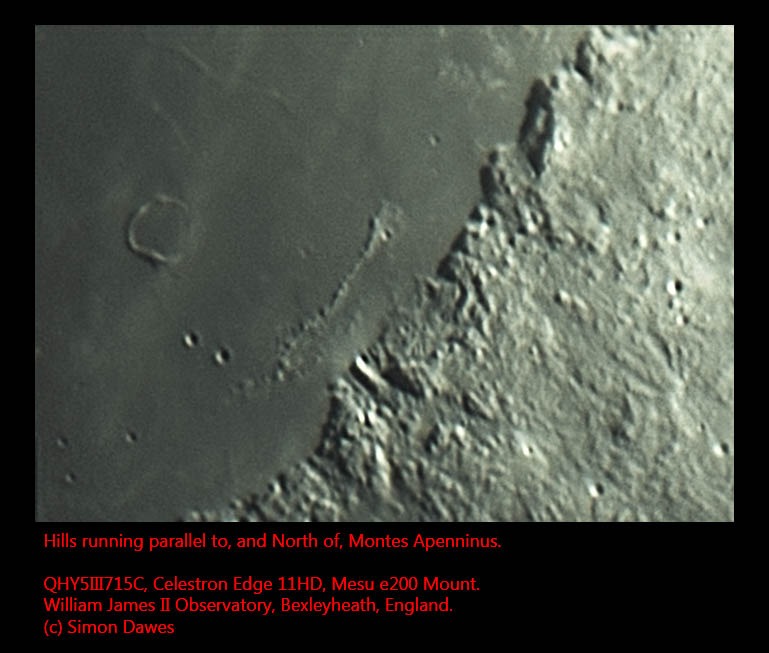
Montes Apenninus are a rugged mountain range on the northern part of the Moon‘s near side. They are named after the Apennine Mountains in Italy. Montes Apenninus is the most prominent remnant of the outer ring of the Imbrium basin. Ref:https://en.wikipedia.org/wiki/Montes_Apenninus
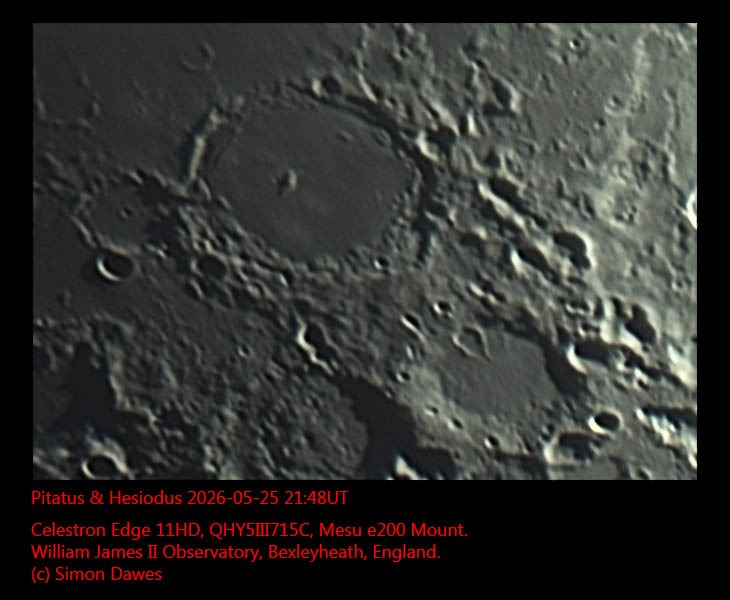
Hesiodus is a lunar impact crater located on the southern fringes of Mare Nubium, to the northwest of the crater Pitatus. It was named after the ancient Greek poet Hesiod. Ref:https://en.wikipedia.org/wiki/Hesiodus_(crater)
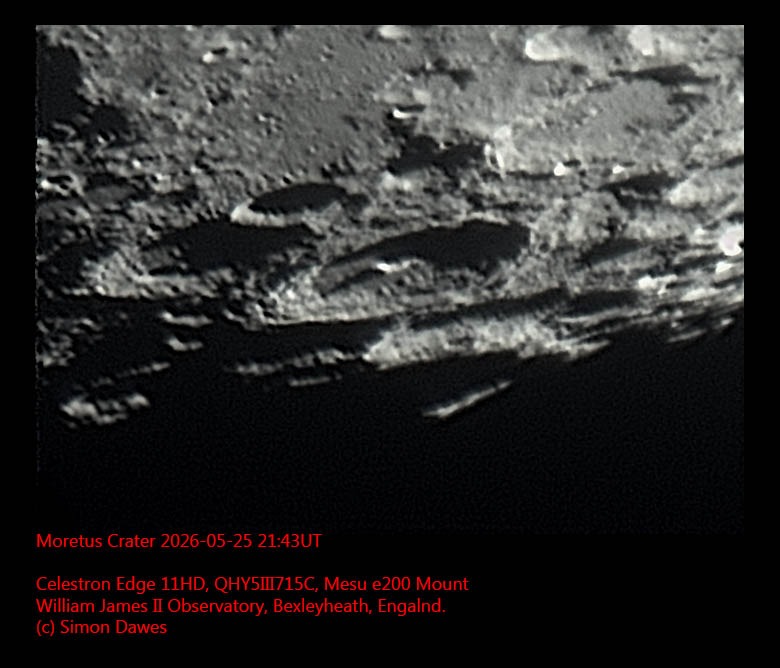
Moretus is a lunar impact crater located in the heavily cratered highland region near the south pole of the Moon.
South of Moretus, the crater Short is located, while to the north is Cysatus. To the northwest lies Gruemberger, and Curtius is located to the northeast. Due to the location near the lunar limb, the crater appears oblong because of foreshortening. The crater is named after the 17th-century Flemish mathematician and geometer Theodorus Moretus.
On the lunar geologic timescale, this formation dates to the Imbrian period. Ref:https://en.wikipedia.org/wiki/Moretus_(crater)
Clavius is one of the largest crater formations on the Moon and the second largest crater on the visible near side (very close in size to Deslandres). It dates to the Nectarian period of the lunar geologic timescale. This crater is located in the rugged southern highlands of the Moon, to the south of the prominent ray crater Tycho. It is named for the Jesuit astronomer Christopher Clavius. Ref:https://en.wikipedia.org/wiki/Clavius_(crater)

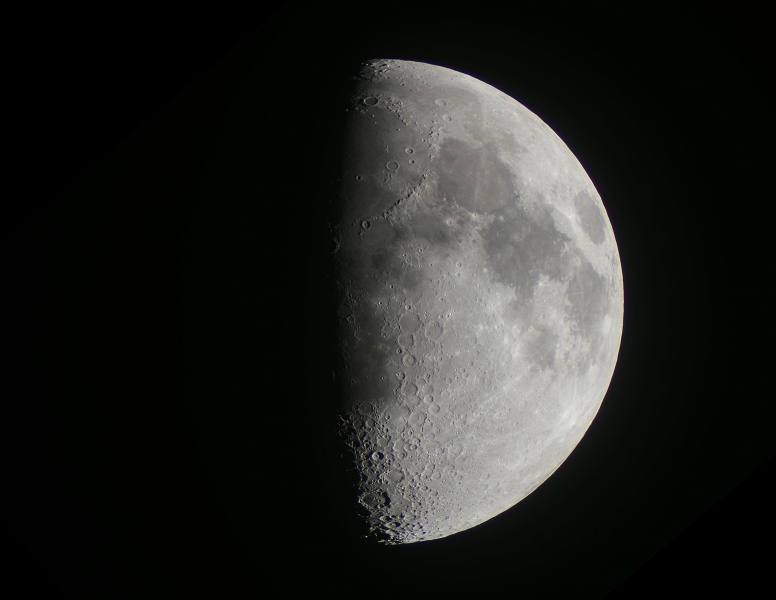
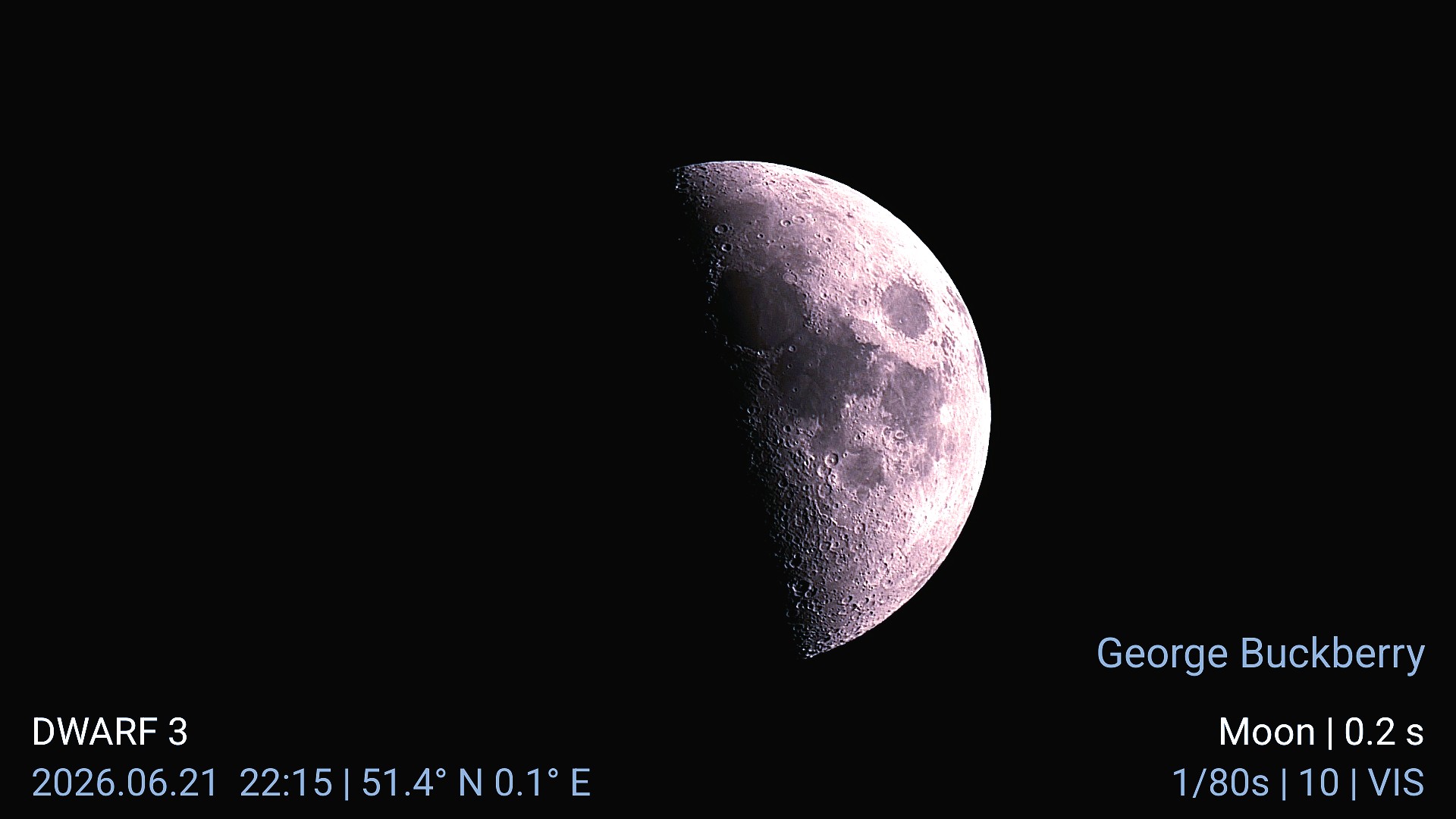
The Moon
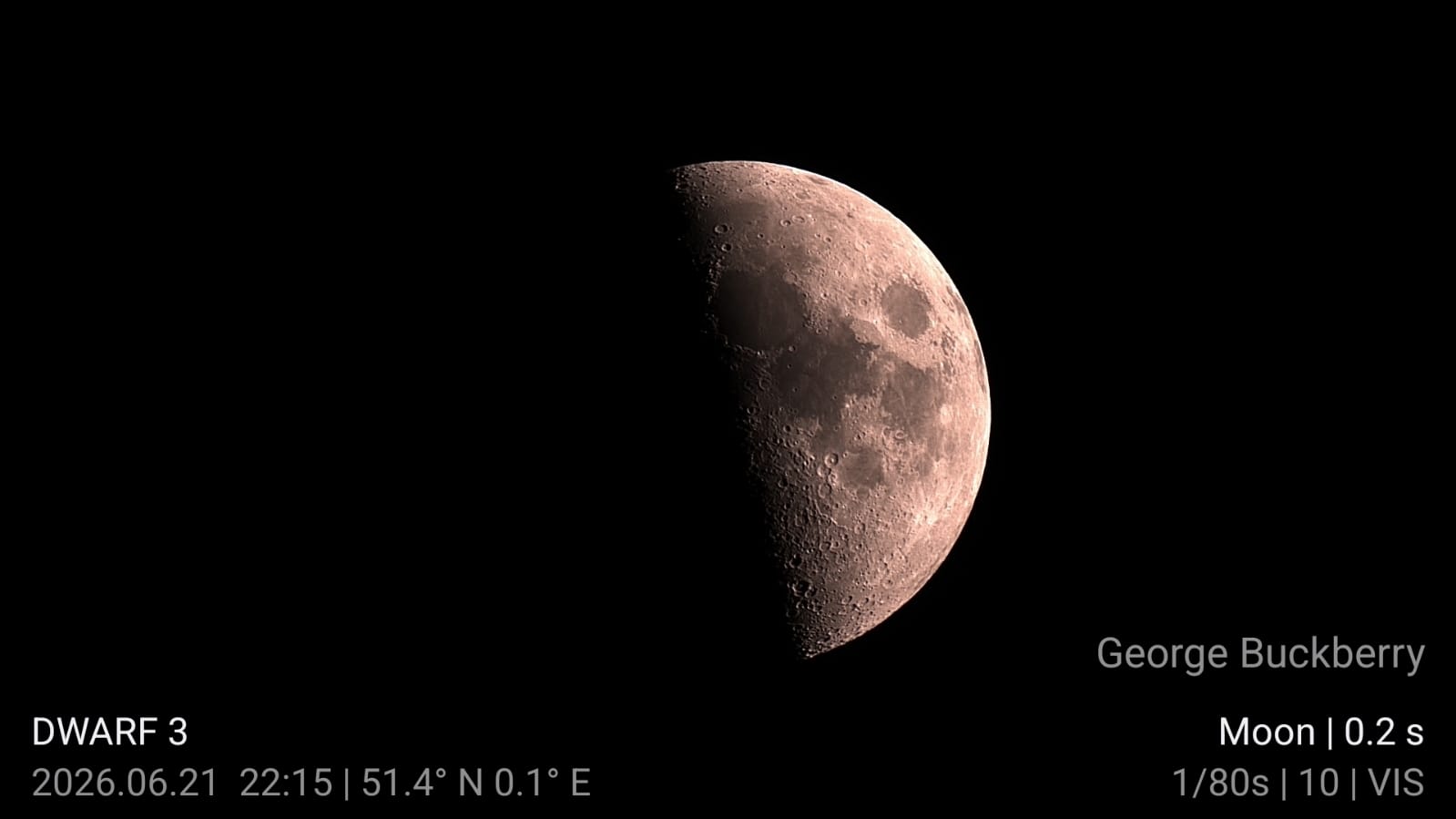
A super image of the Moon taken by George Buckberry on the 21st June 2026. The Moon was in the First Quarter phase with 51.59% illumination and 7.53 days old.
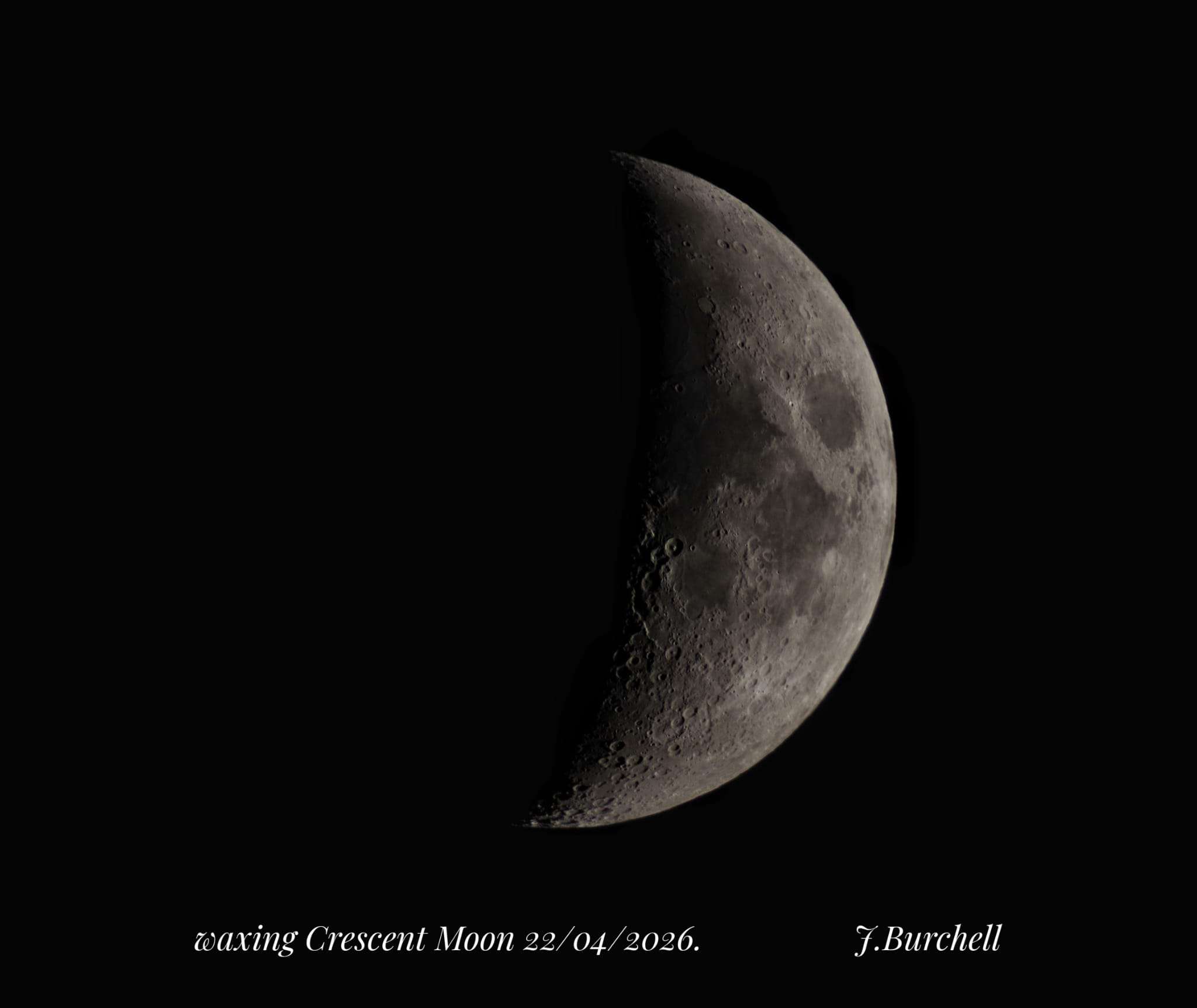
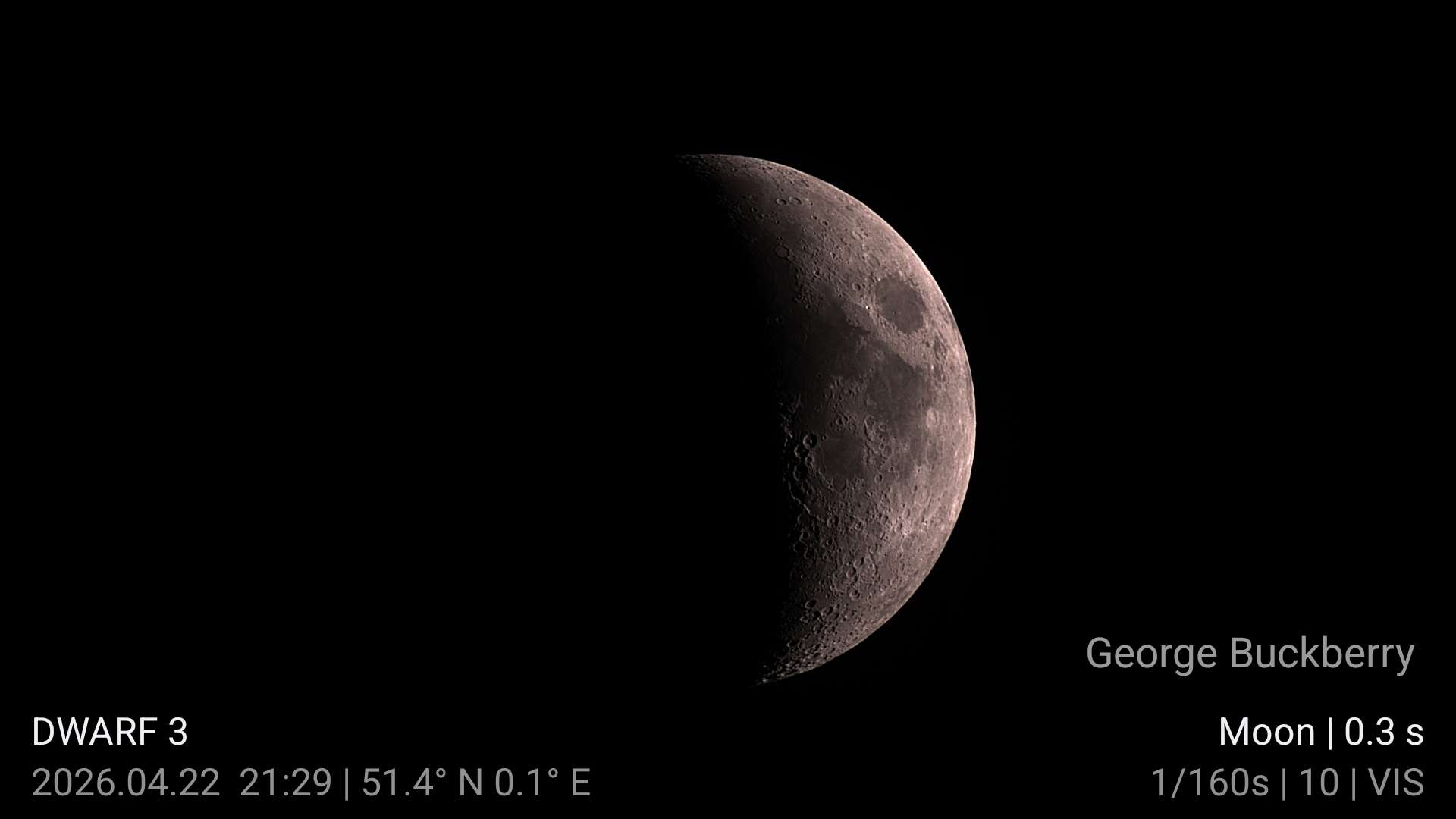
The Moon – 22nd April 2026
The Moon taken on the 22nd April 2026 by Jim Burchell and George Buckberry.
Jim took his image using a Seestar S50 smartscope and George took his using a Dwarf3 smartscope.
On April 22, 2026, the moon was in a Waxing Crescent phase, with approximately 31 to 35% illumination and 5.5 days old after the New Moon.
The Moon – 22nd March 2026
Four great images of the Waxing Crescent Moon taken on the 22nd March 2026. The Moon had an illumination of about 15% – this is the percentage of the Moon illuminated by the Sun.
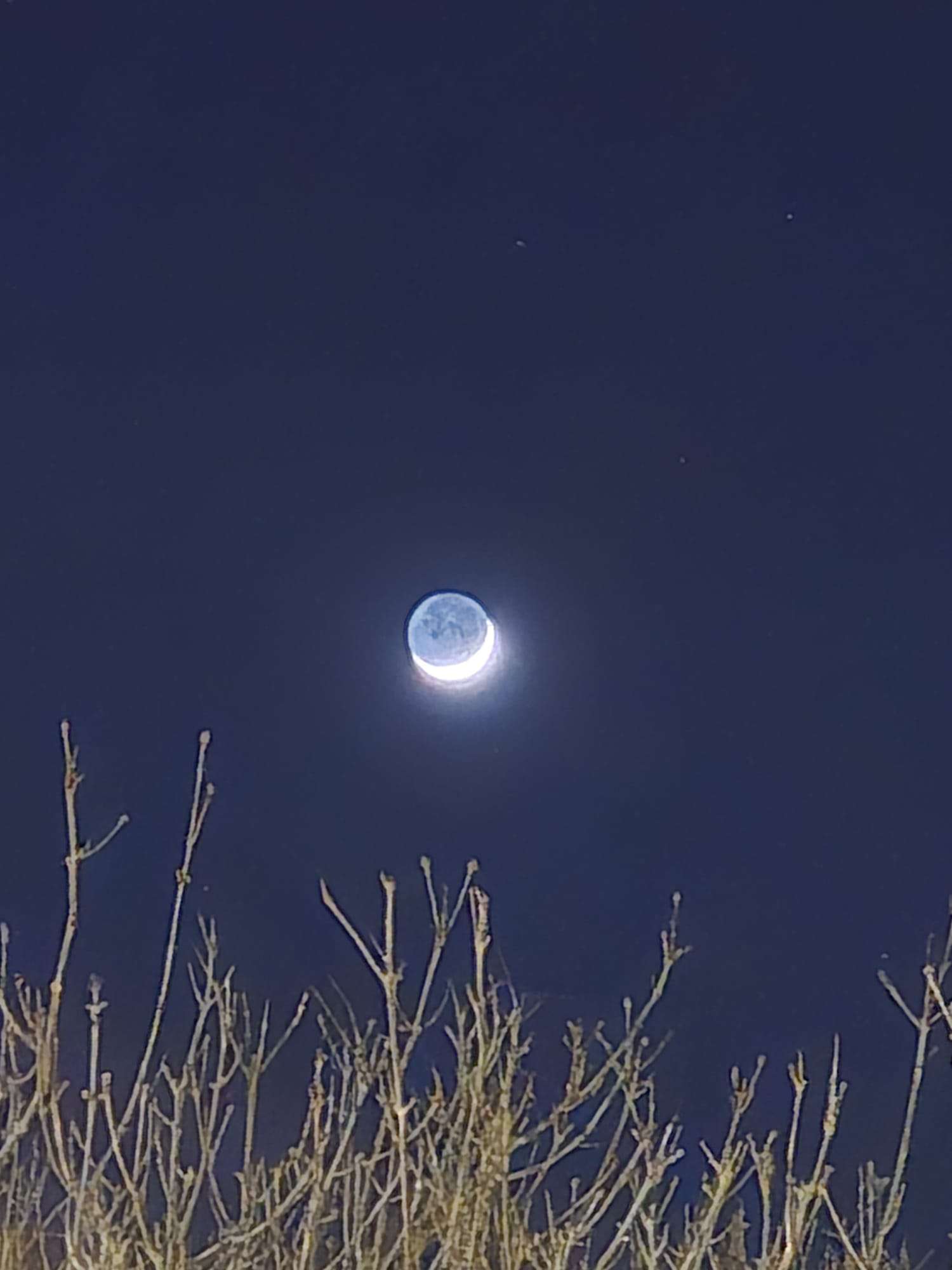
This image was taken by member George Buckberry using a Samsung smart phone set in normal mode. You can clearly see detail of the Moon in the Earthshine.
Earthshine is the faint sunlight reflected from Earth that illuminates the otherwise dark portion of the crescent Moon.
For more info about Earthshine follow the link below.
https://www.skyatnightmagazine.com/advice/skills/earthshine-moon-what-is-how-see-it
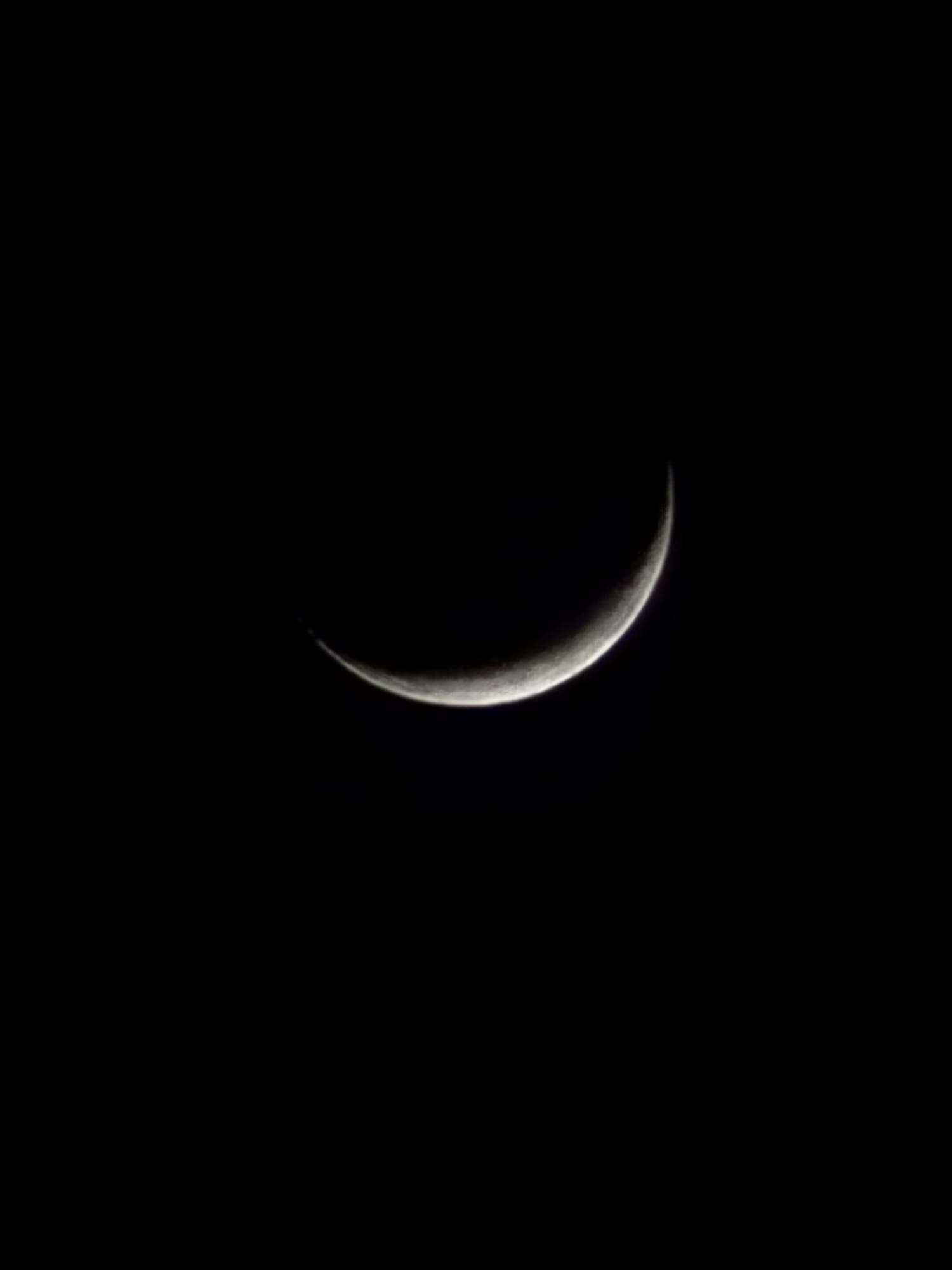
The Moon taken again using a Samsung smart phone by George Buckberry but this time set in dark mode cleary showing the waxing crescent.
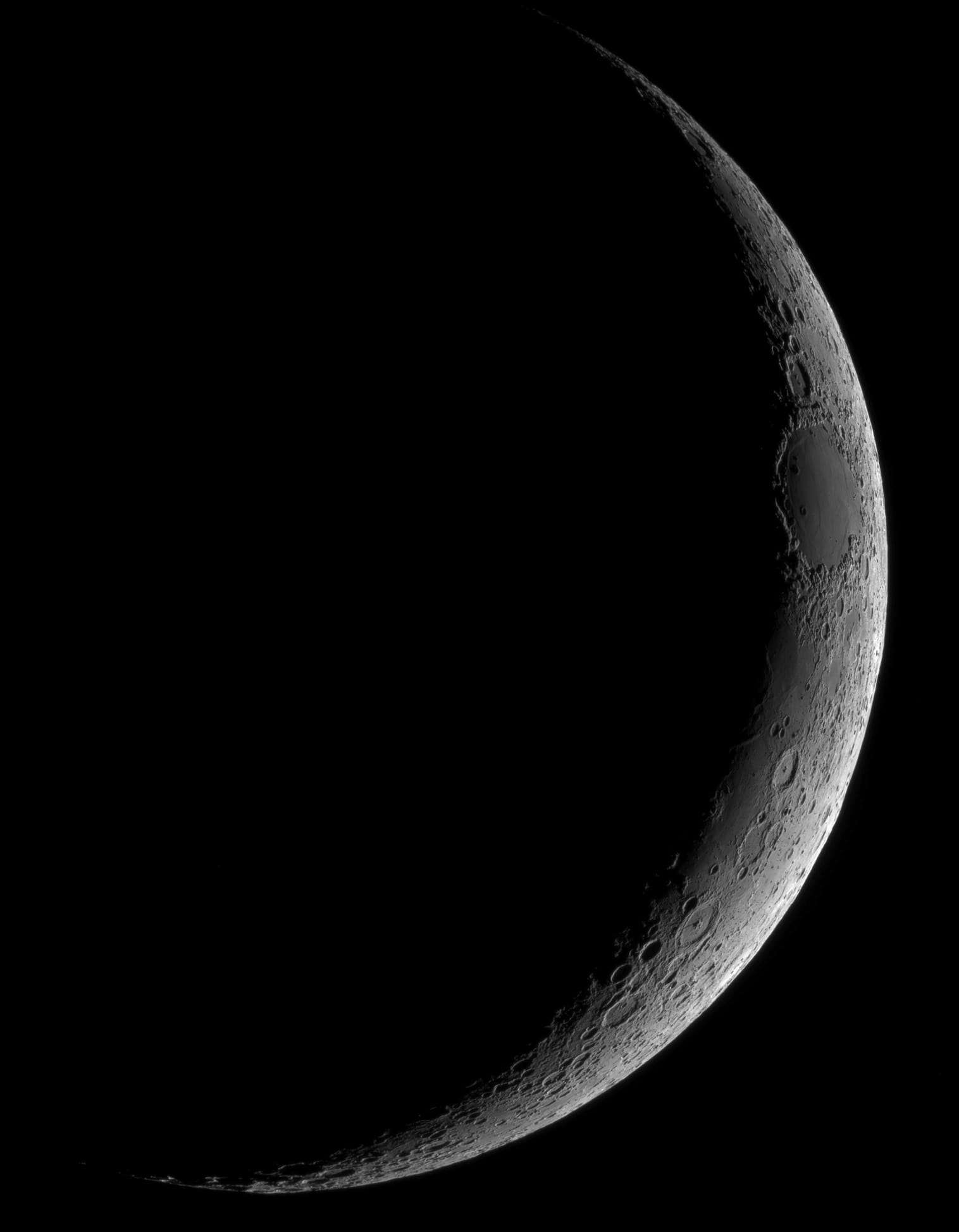
The Moon by Neil Webster.
Neil acquired the image using an AA 115mm APO, EQ6 R, ZWO ASI290MM, and R/IR filter.
3 frames: each 90s x 33fps (best 20% selected).
Processed using Firecapture, AutoStakkert, PS, and Microsoft ICE

Mare Crisium on the Waxing Crescent Moon by Neil Webster – It’s lovely to see some detail of the crater.
Sun & Moon by George Buckberry
The Moon & Sun by member George Buckberry; both taken using a Dwarf 3 smart scope.


Lunar Corona
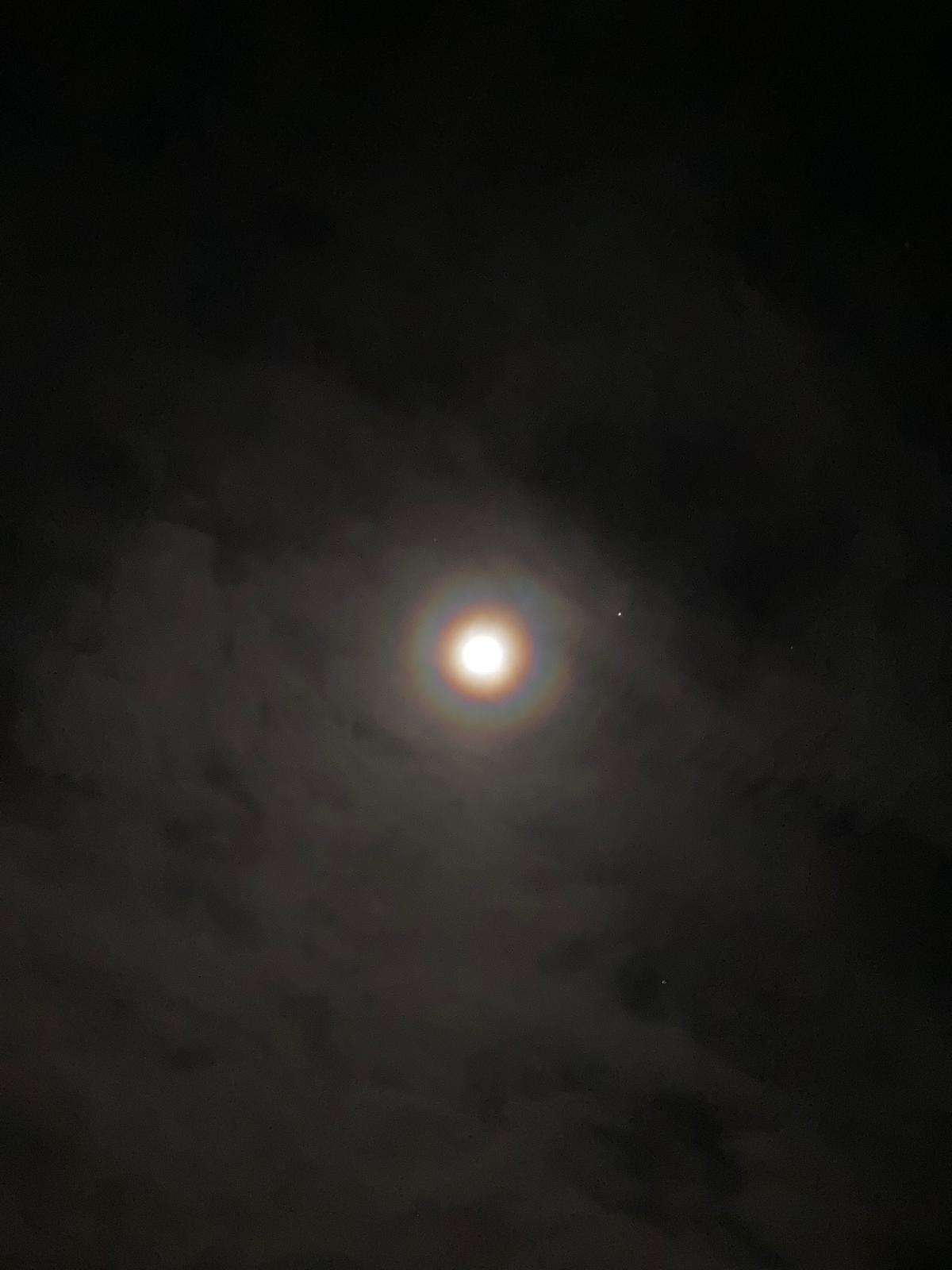
A great image of a Lunar Corona and Jupiter taken by member Gary Hunt on the 27th February 2026.
Jupiter is the dot on the right hand side of the Moon at the 2 o’clock position.
February’s Moon images
A great selection of Moon images taken by members during the month of February.
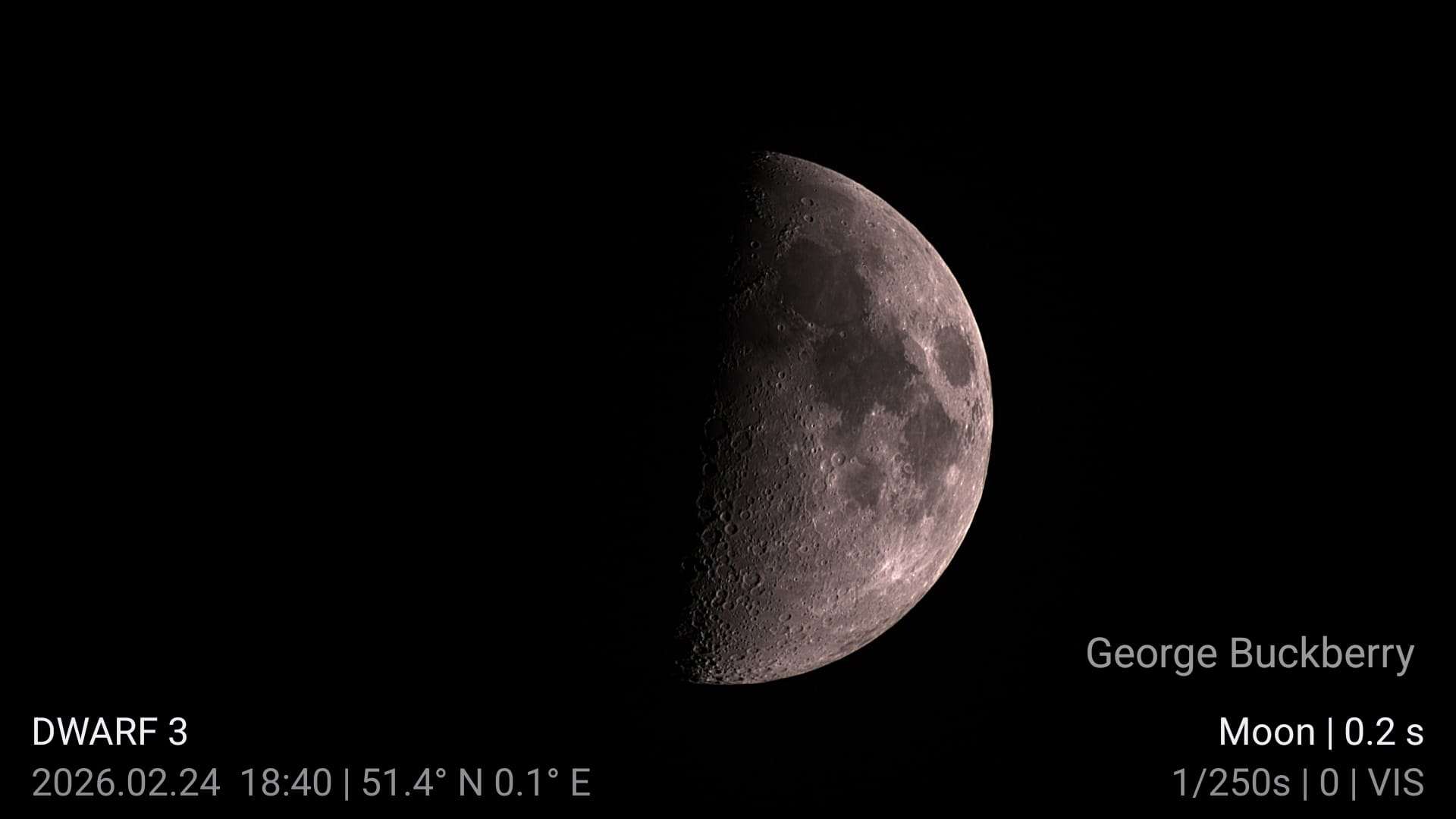
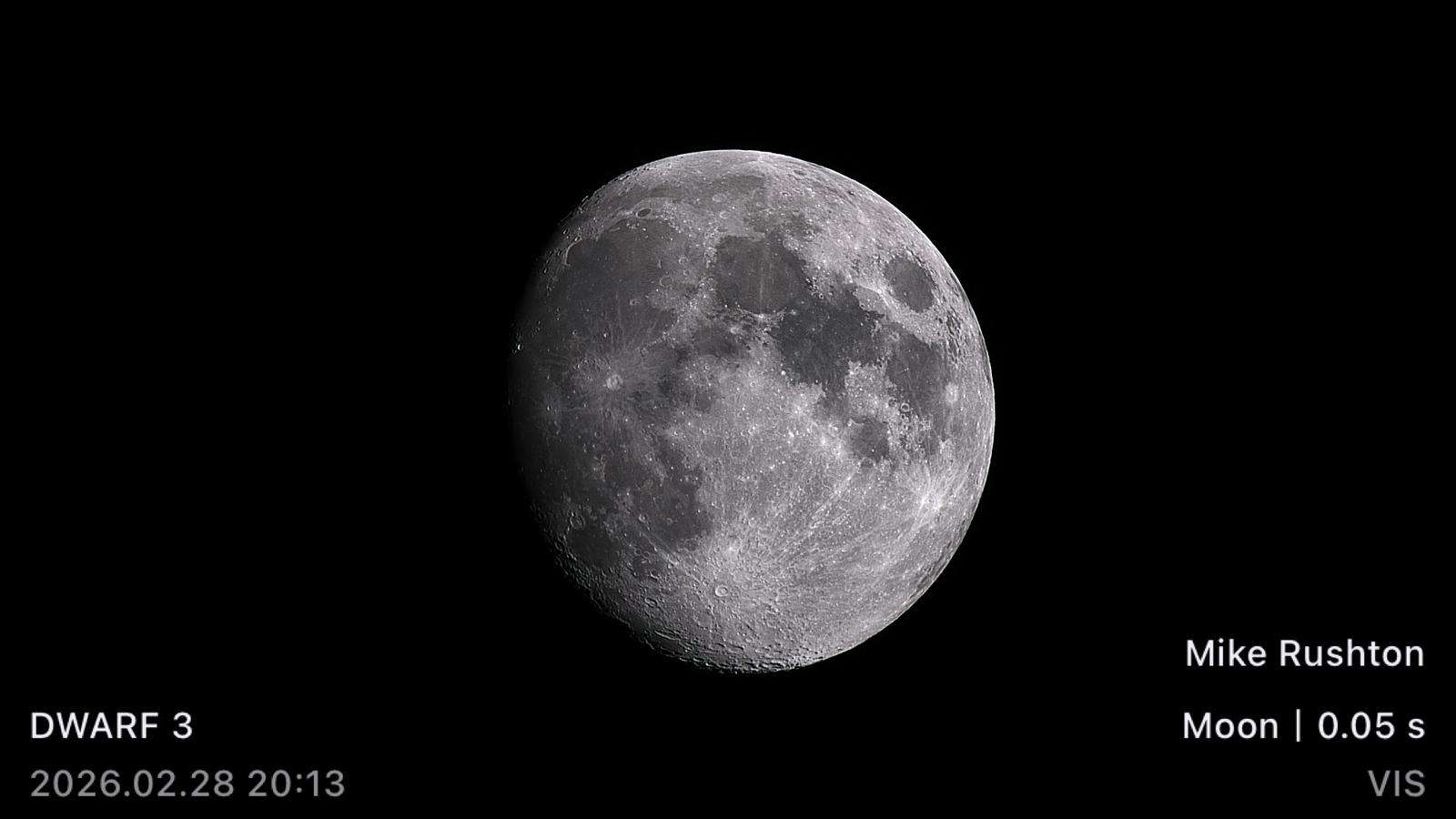
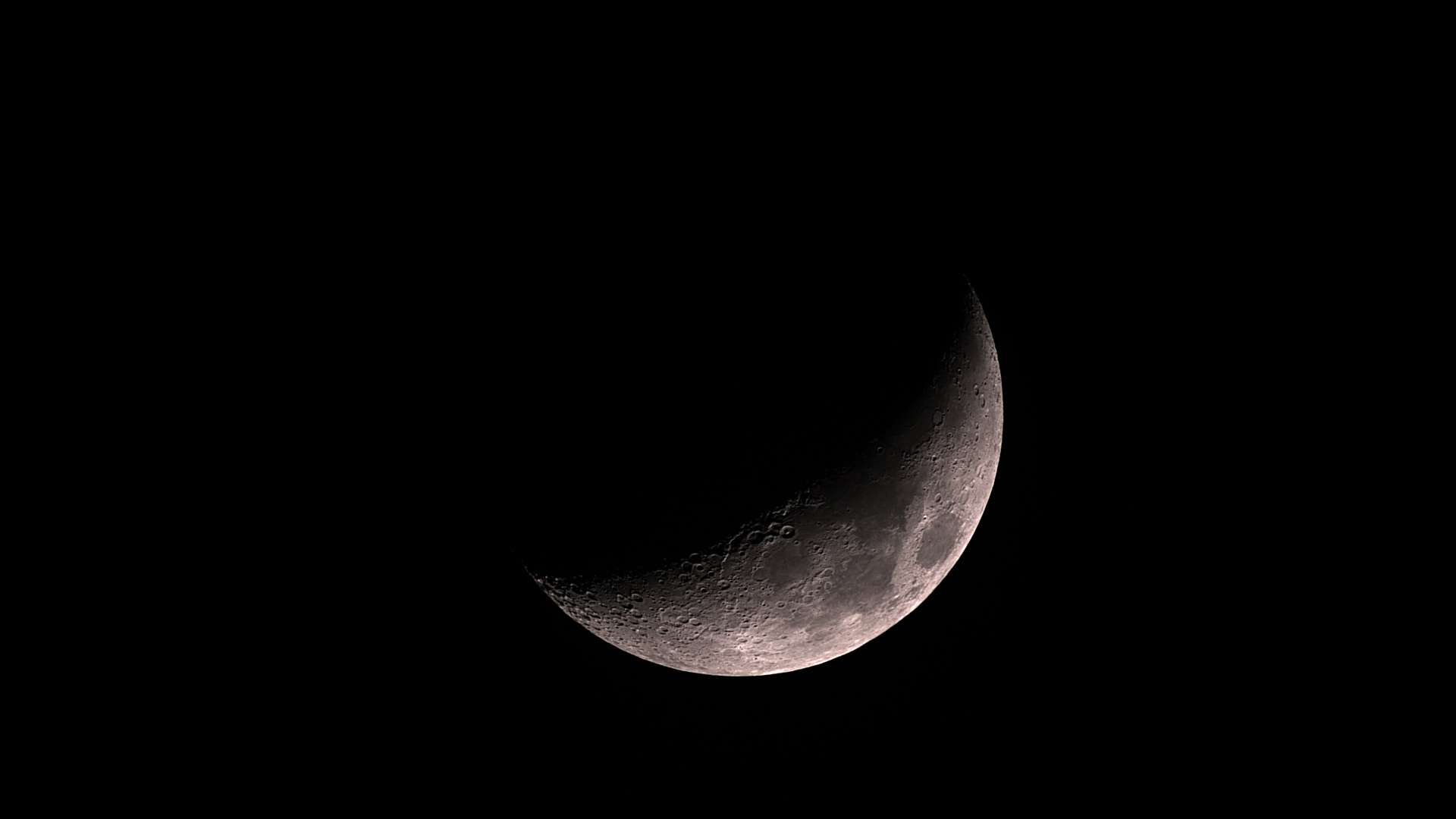
Crescent Moon taken on the 22nd February 2026 by John Archer using a Dwarf3 smart scope.
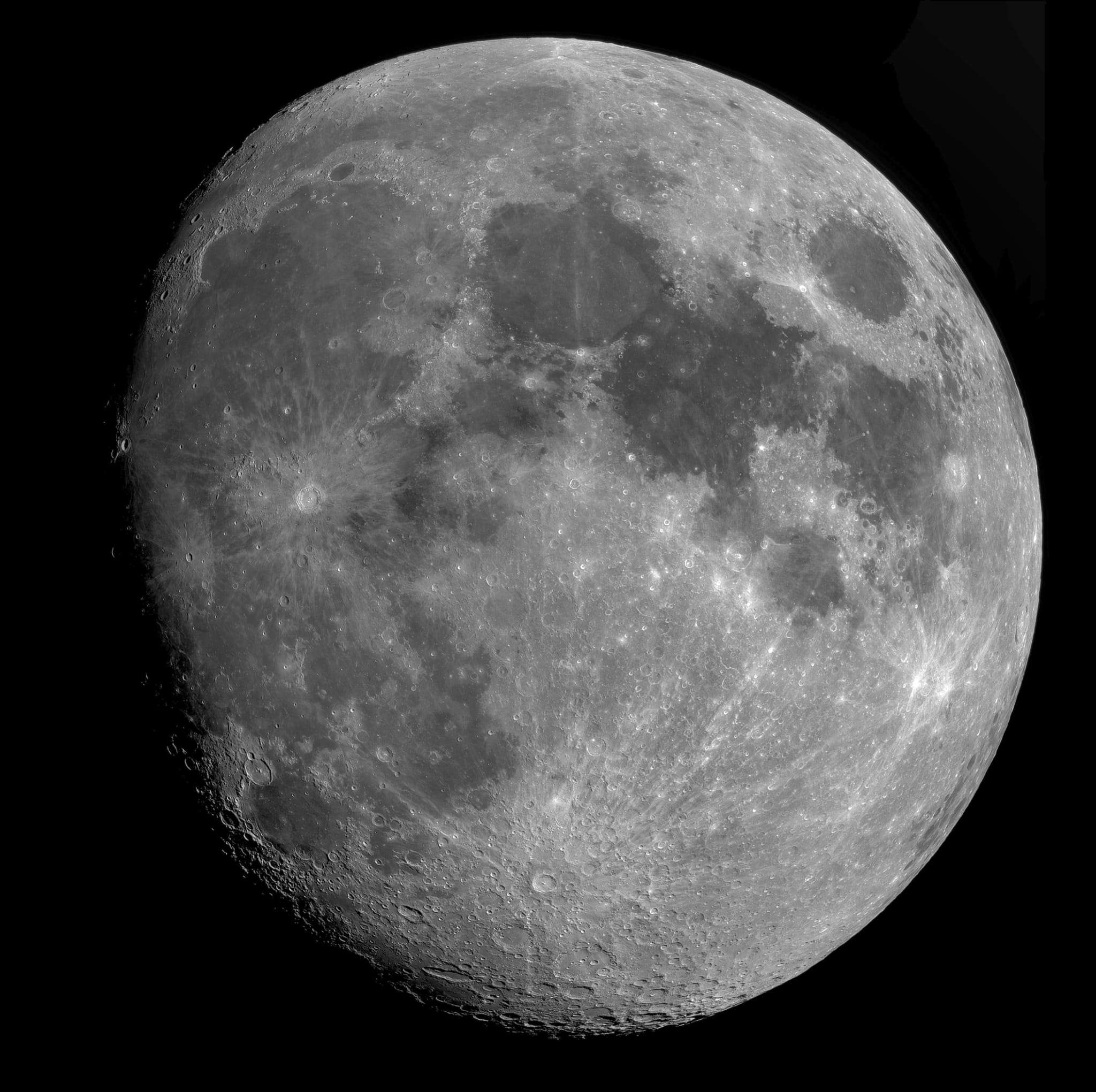
Waxing Gibbous Moon by Neil Webster taken on the 28/02/2026.
The Moon was 11.38 days old and 92.1% illuminated. Neil used a AA 115mm APO, EQ6 R, ZWO ASI290MM and R/IR Filter to acquire the image.
6 frames. Each 90s x 32fps. Stitched in Microsoft ICE Firecapture, AutoStakkert and Photo Shop.
The Moon
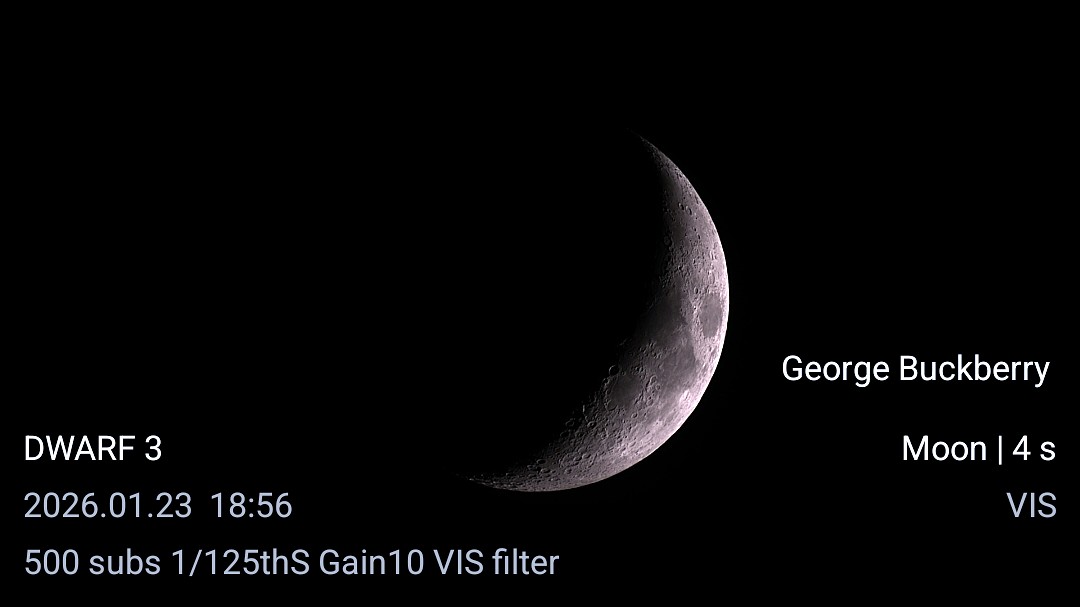
Two great images of the Moon taken by George Buckberry using a Dwarf3 smart scope.
A Waxing Crescent Moon on the 23rd January 2026. 22.8% illuminated. Ref:https://theskylive.com/moon/2026-01-23
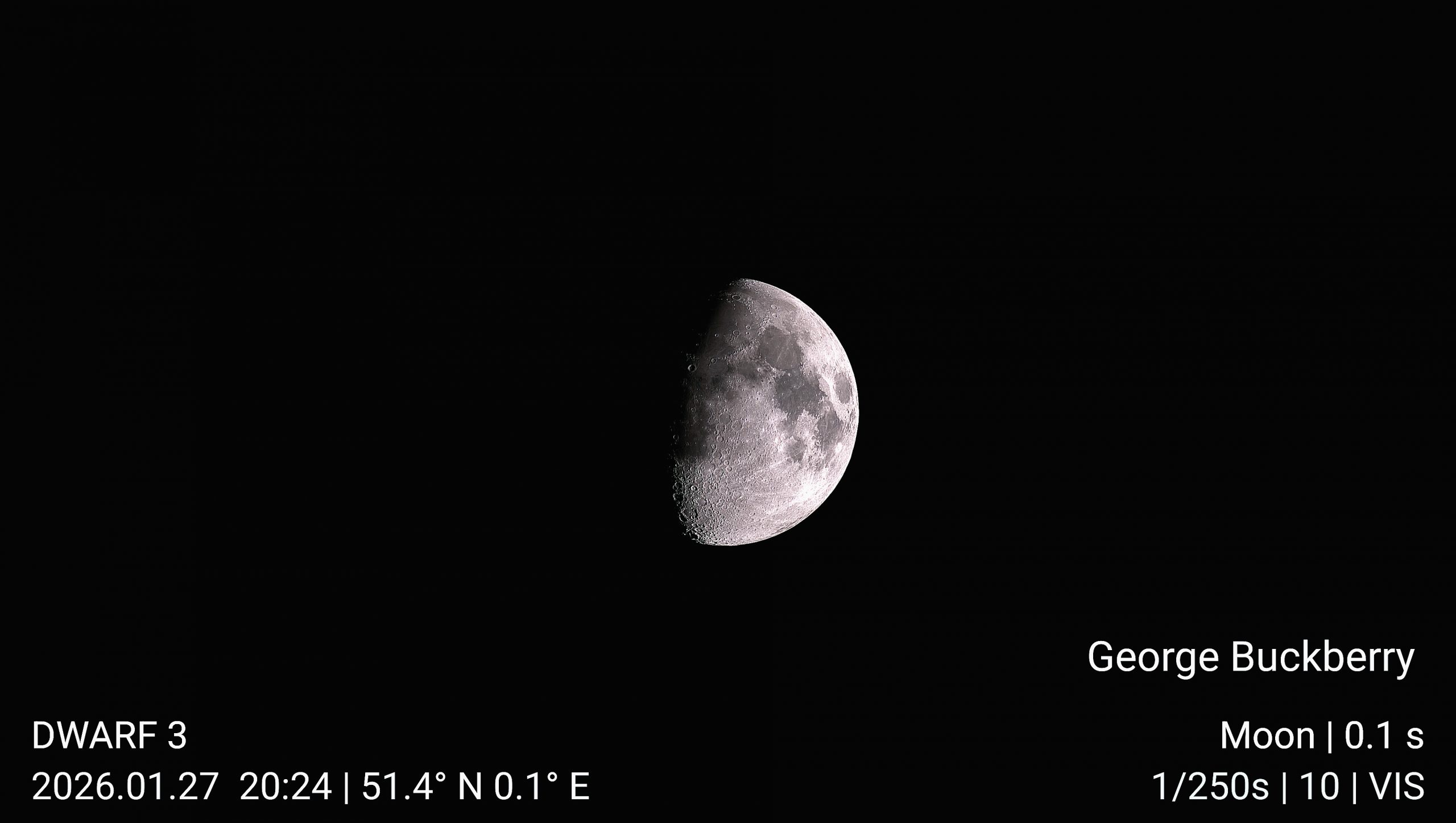
A Waxing Gibbous Moon on the 27th January 2026. 65% illuminated. Ref:https://theskylive.com/moon/2026-01-27
The Sun & Full Moon – 3rd Jan 2026
The 3rd of Jan 2026 saw the 1st Full Moon of the year and several members got out their scopes and cameras and took some lovely images of the Moon. Some members also took the opportunity to image the Sun that day too.
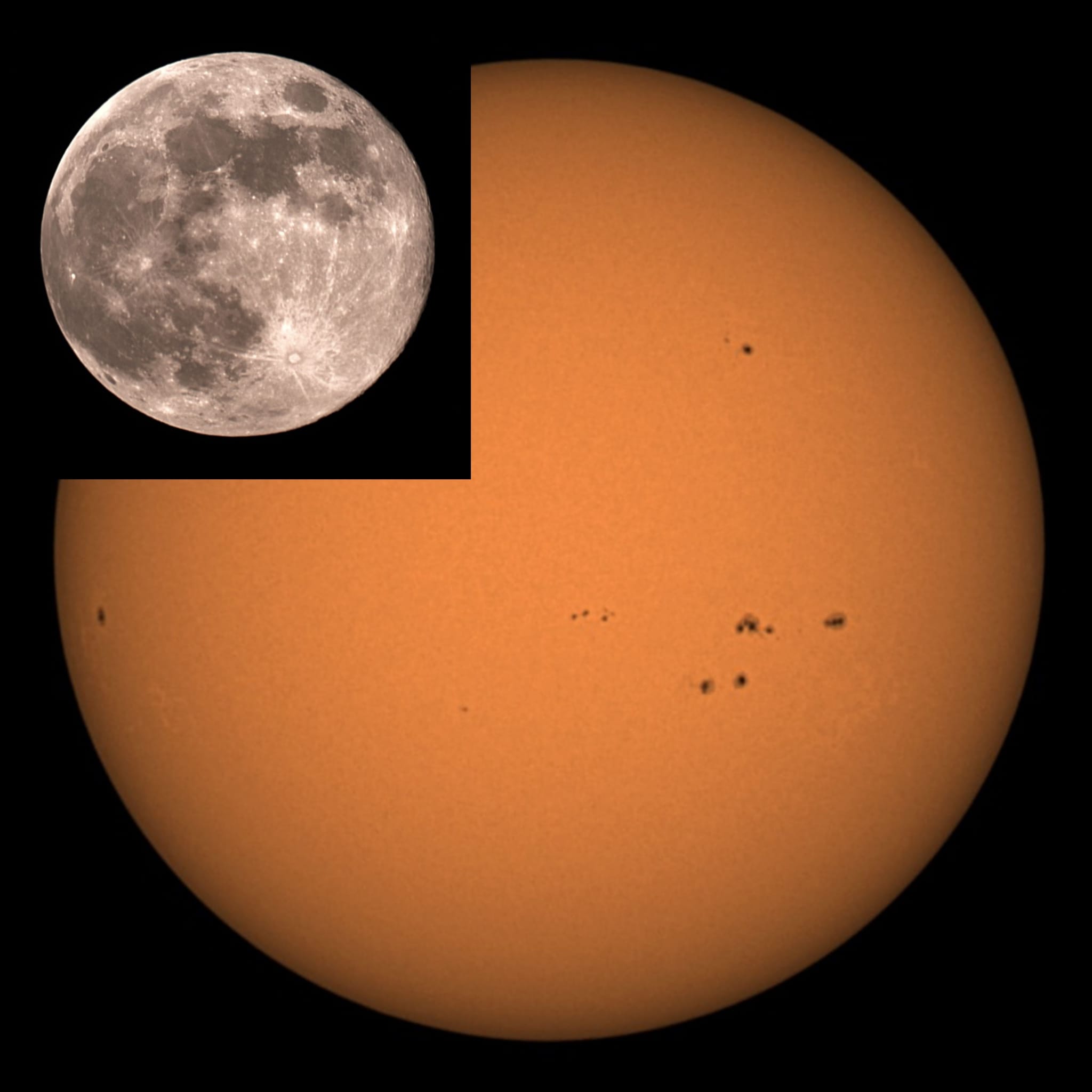
Sun & Full Moon by Honor Wheeler.
Taken using a Dwarf3 smart scope taken from Dartford.
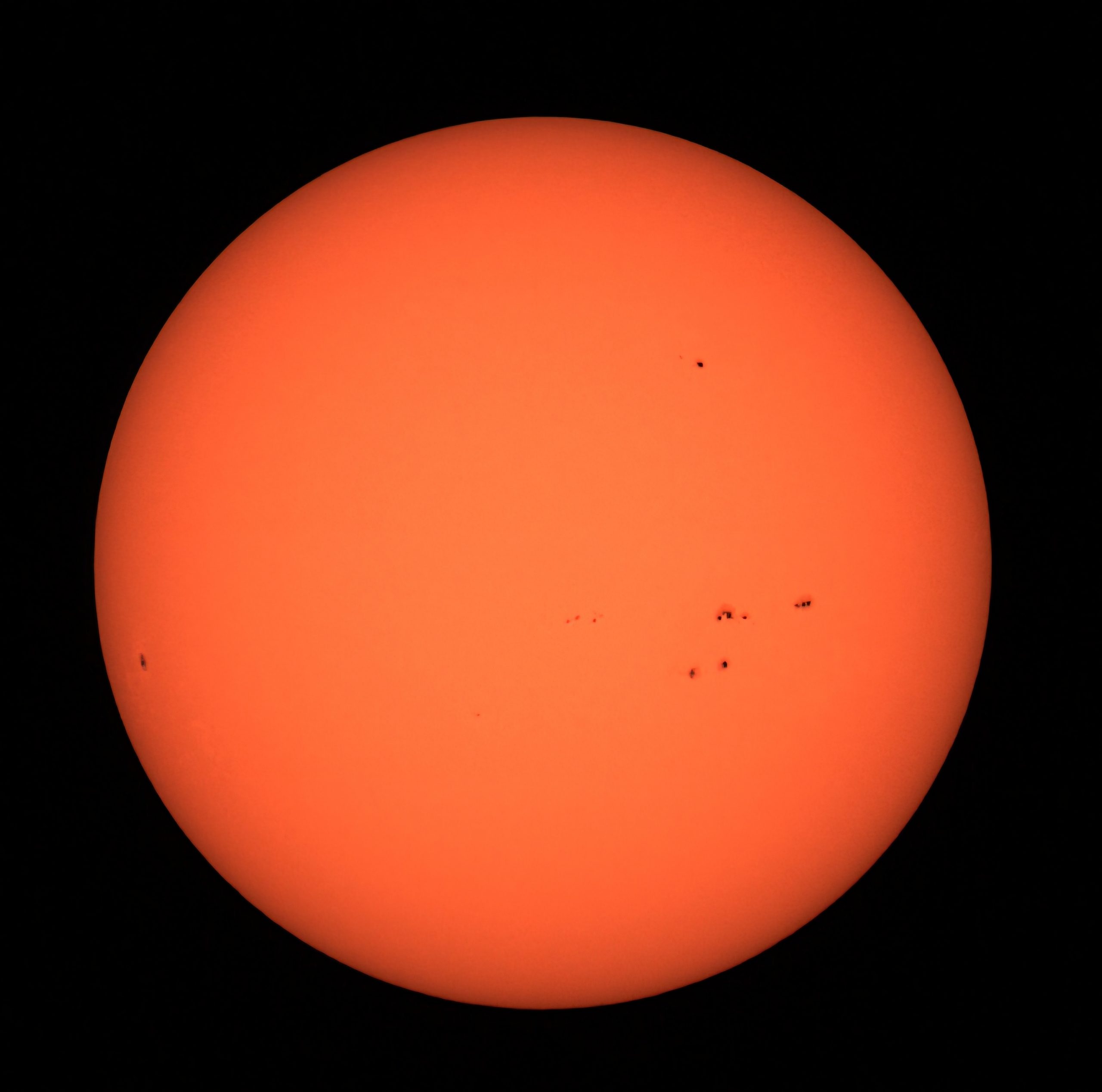
The Sun by George Buckberry.
Taken using a Dwarf3 smart scope taken from Hextable.
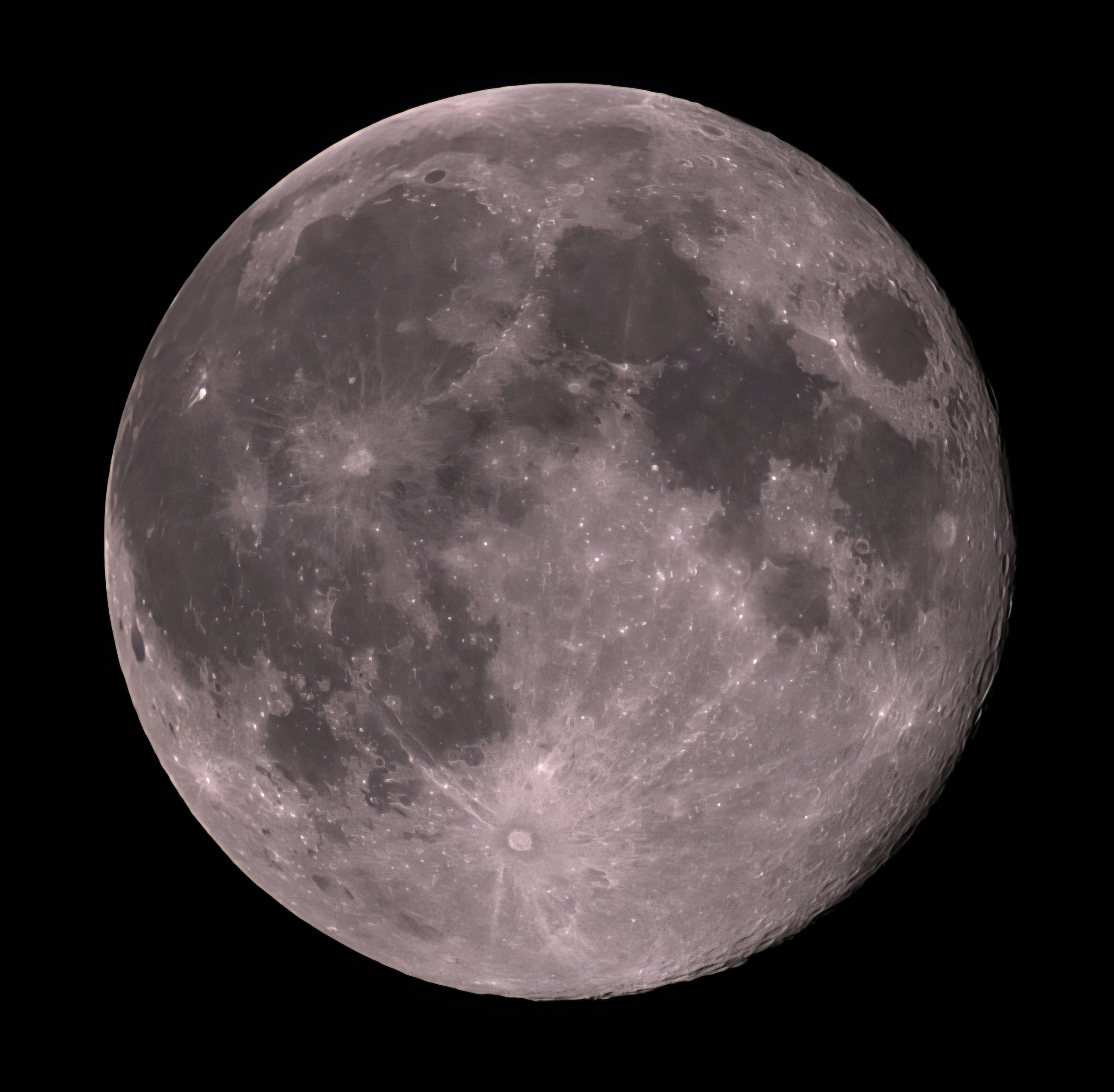
The Full Moon by George Buckberry.
Taken using a Dwarf3 smart scope taken from Hextable.
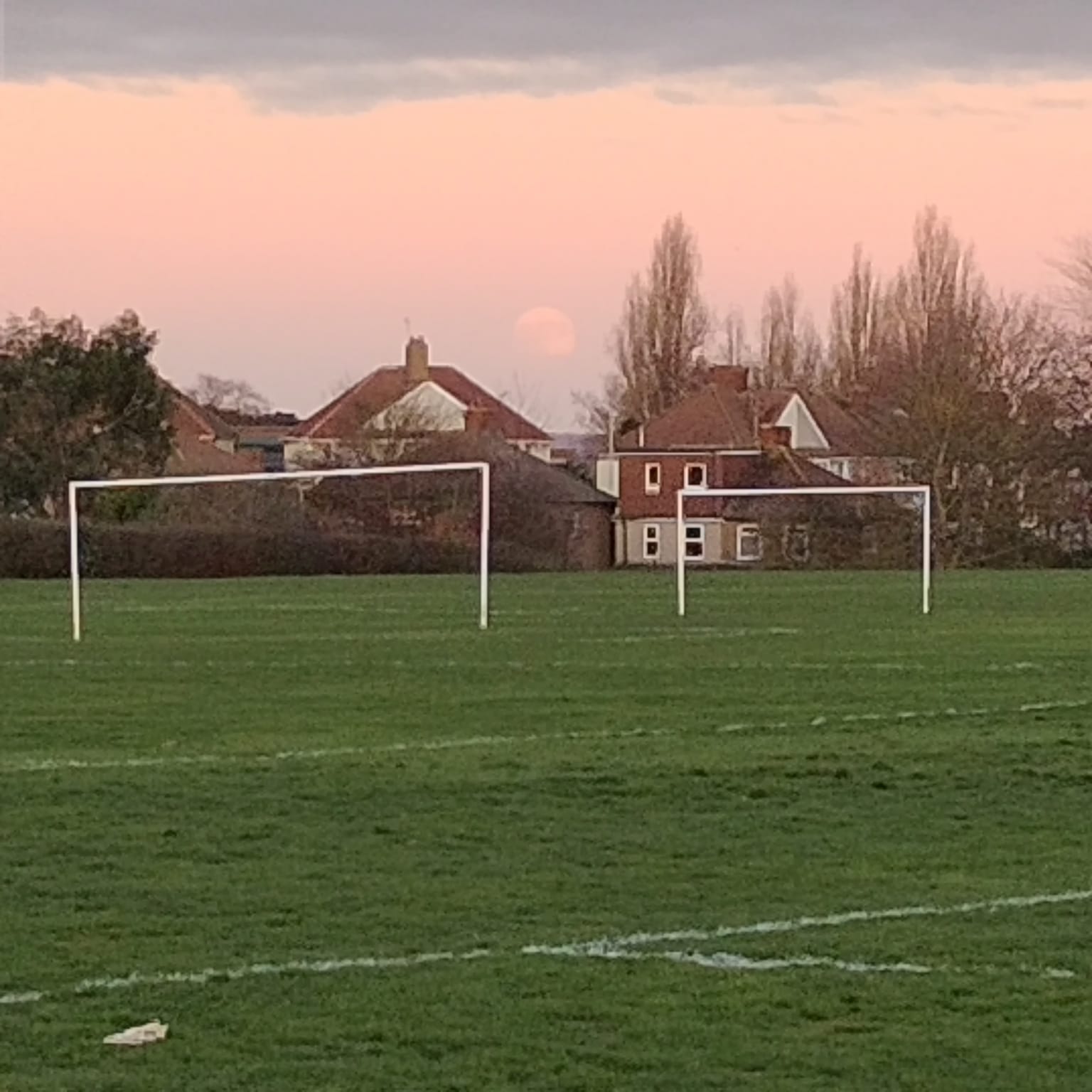
Full Moon rising by John Howarth taken from Bexleyheath.
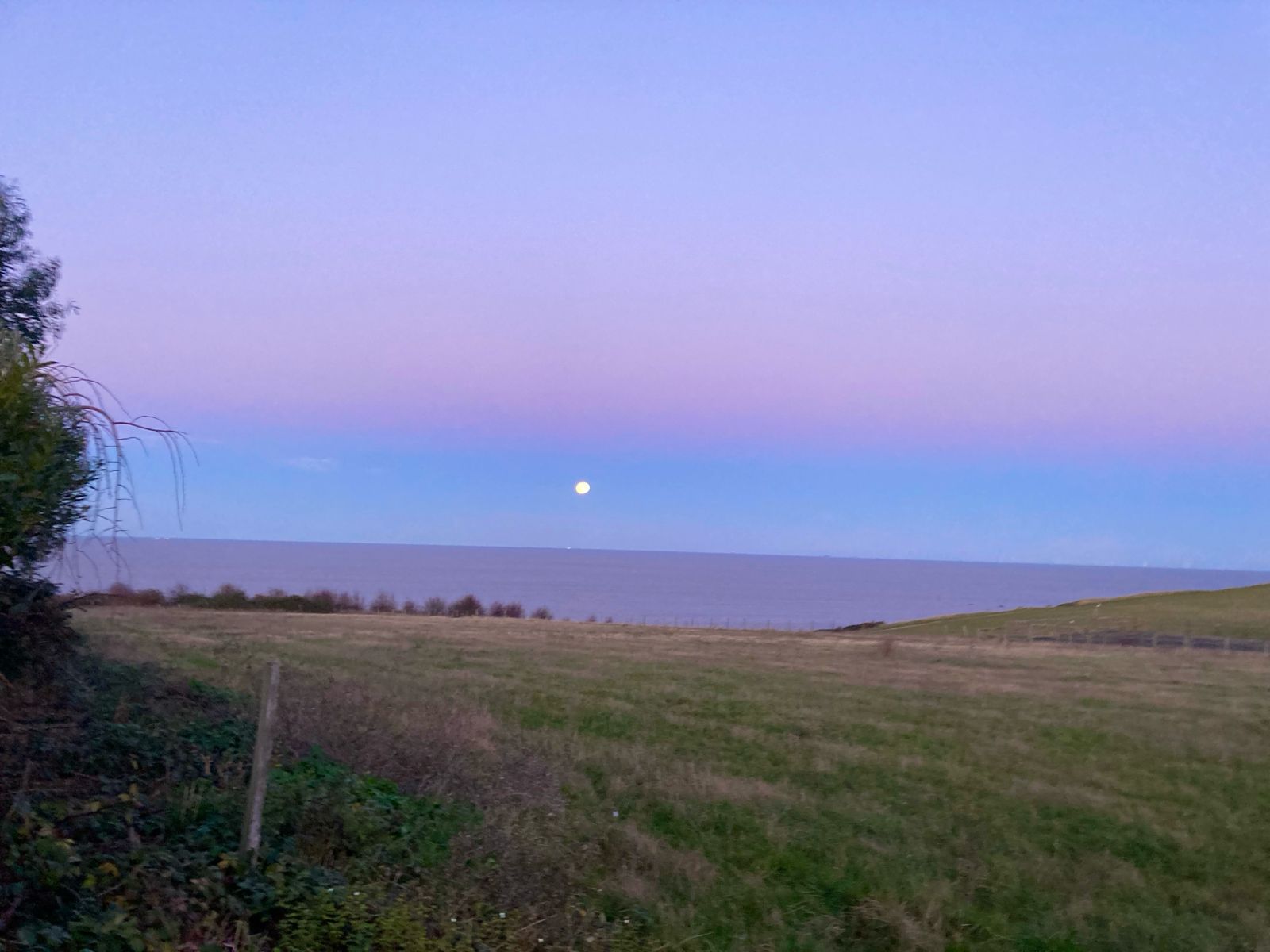
Full Moon rising by Gary Hunt taken from the Isle of Sheppey.
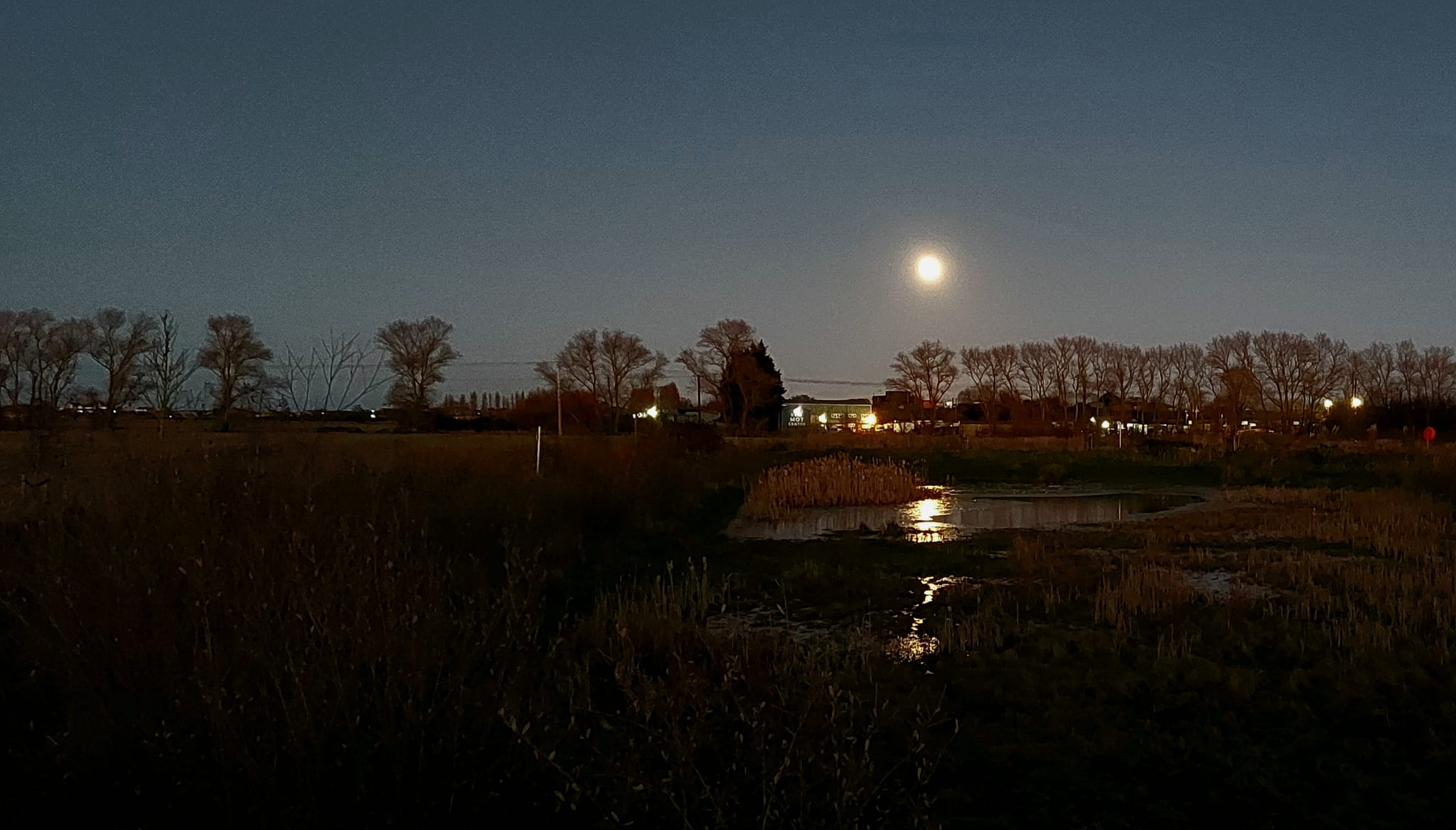
Full Moon rising by Kevin Smith taken from Deal, Kent.
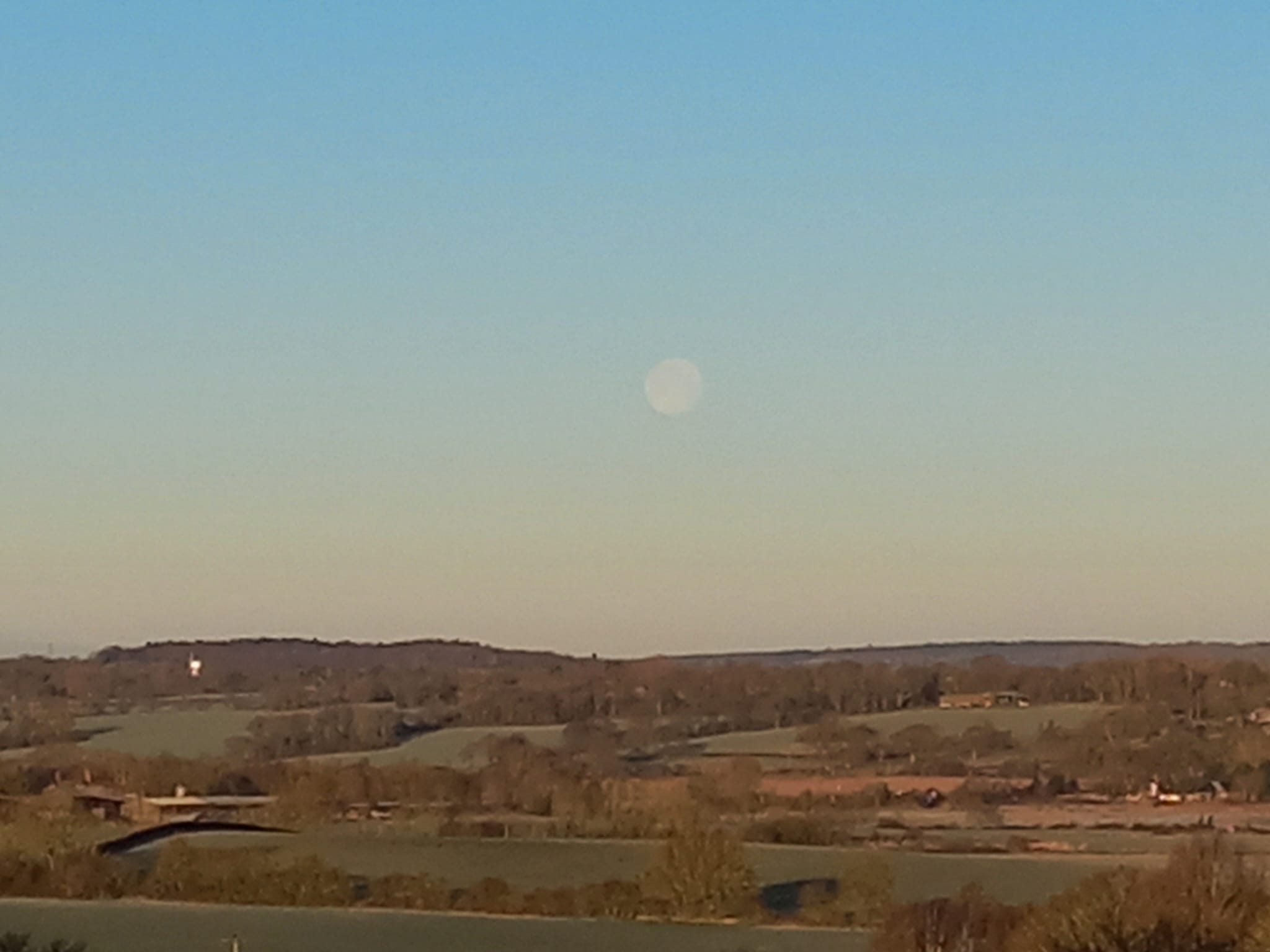
Full Moon rising by John Archer taken from East Sussex.
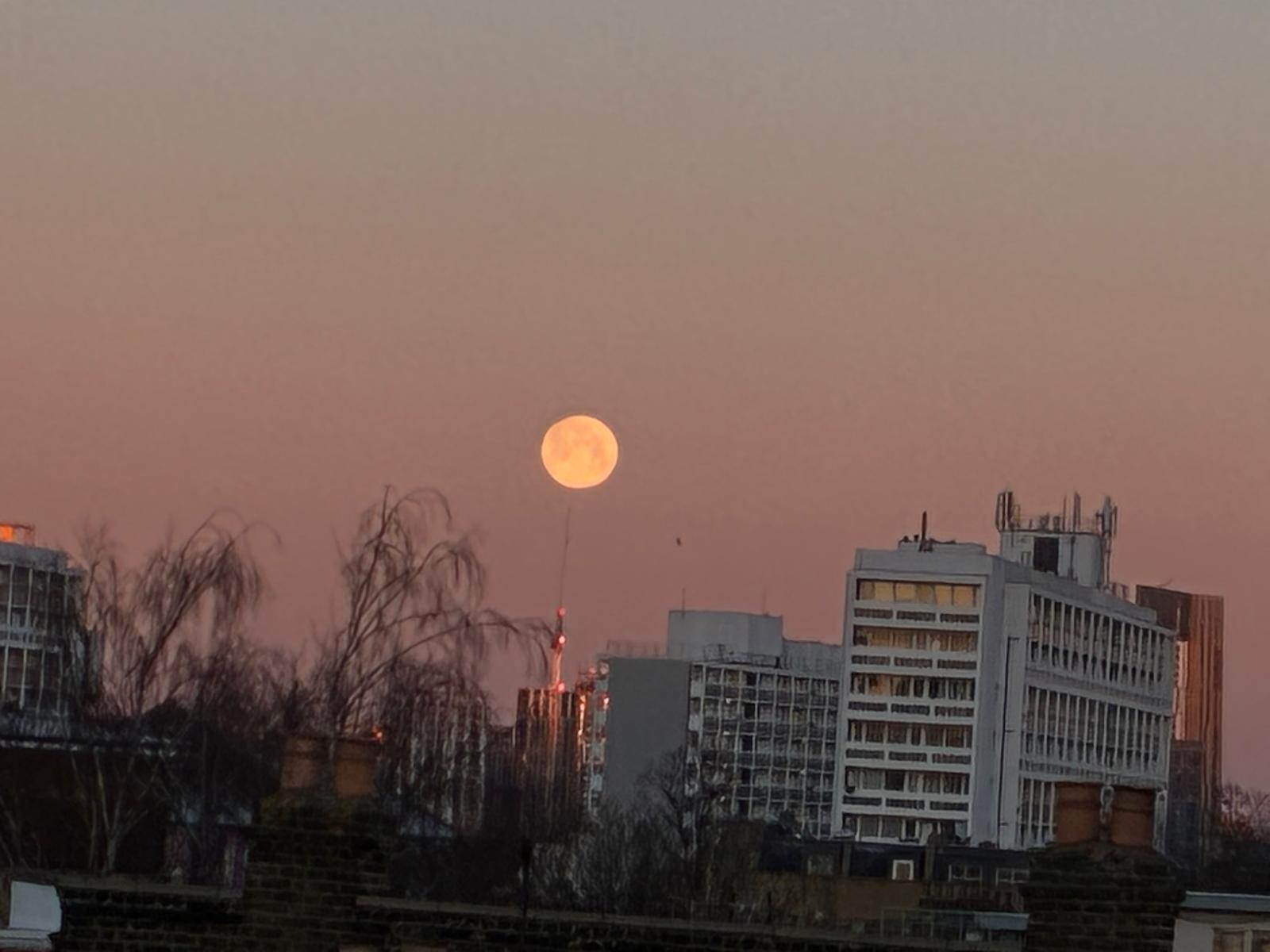
Full Moon by Dominique Ferrand taken from London.
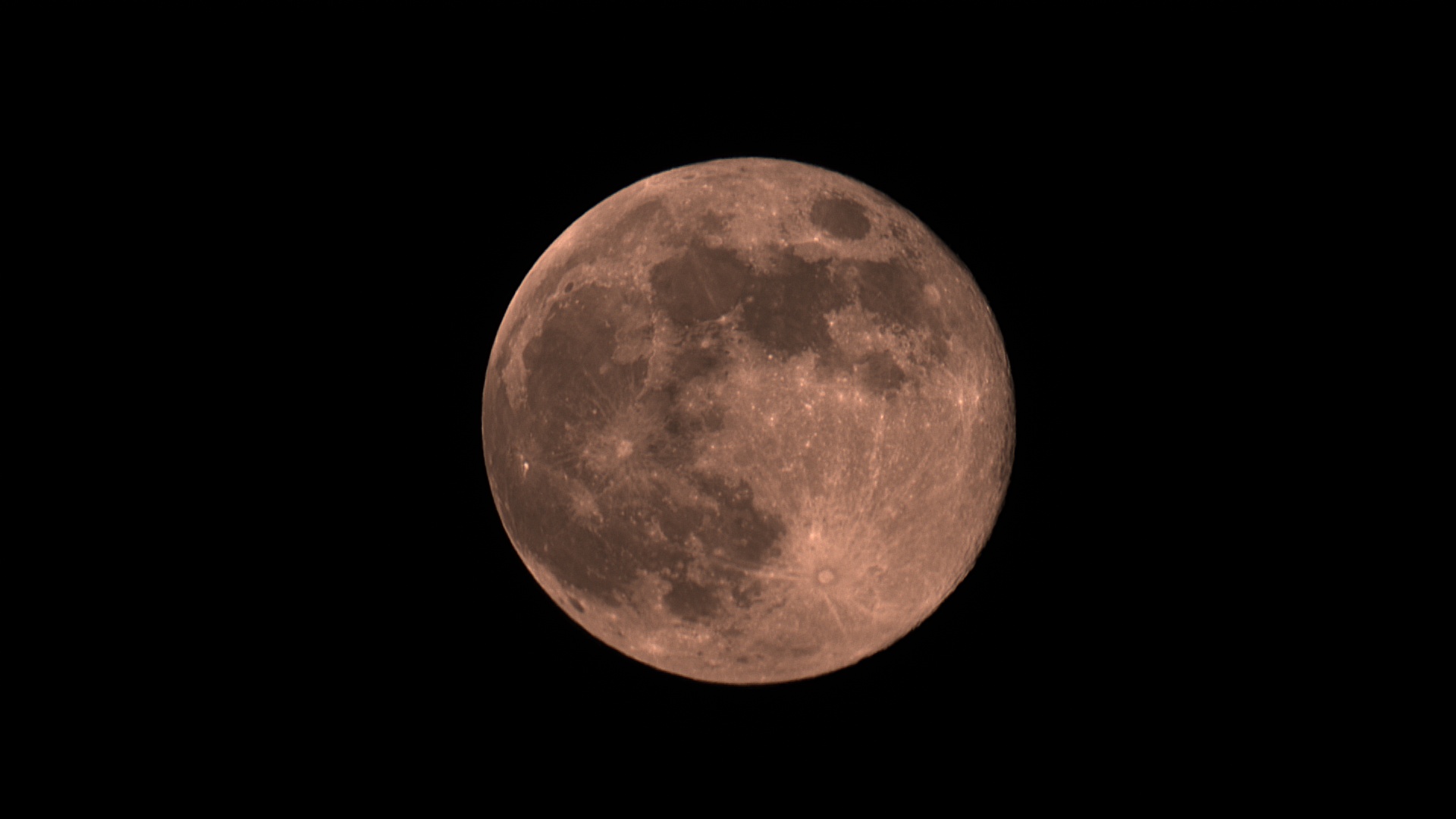
Full Moon by John Archer taken from East Sussex.
Taken using a Dwarf3 smart scope. The photo is made up of a stack of 20 images.
The Sun & Moon – 31st Dec 2025
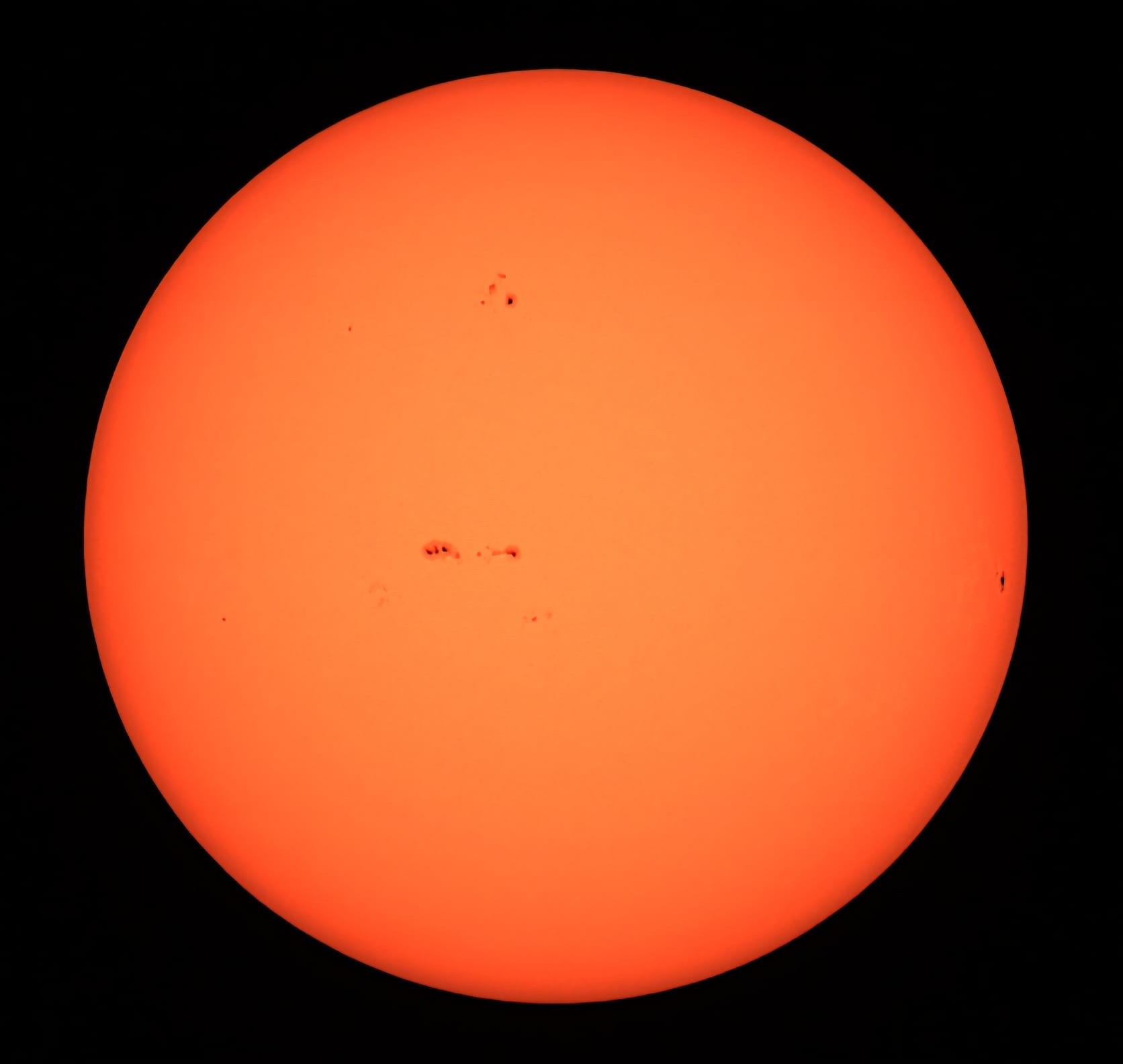
The Sun & a Waxing Gibbous Moon (89.7% illuminated and 11.64 days old) taken on the last day of the year 2025.
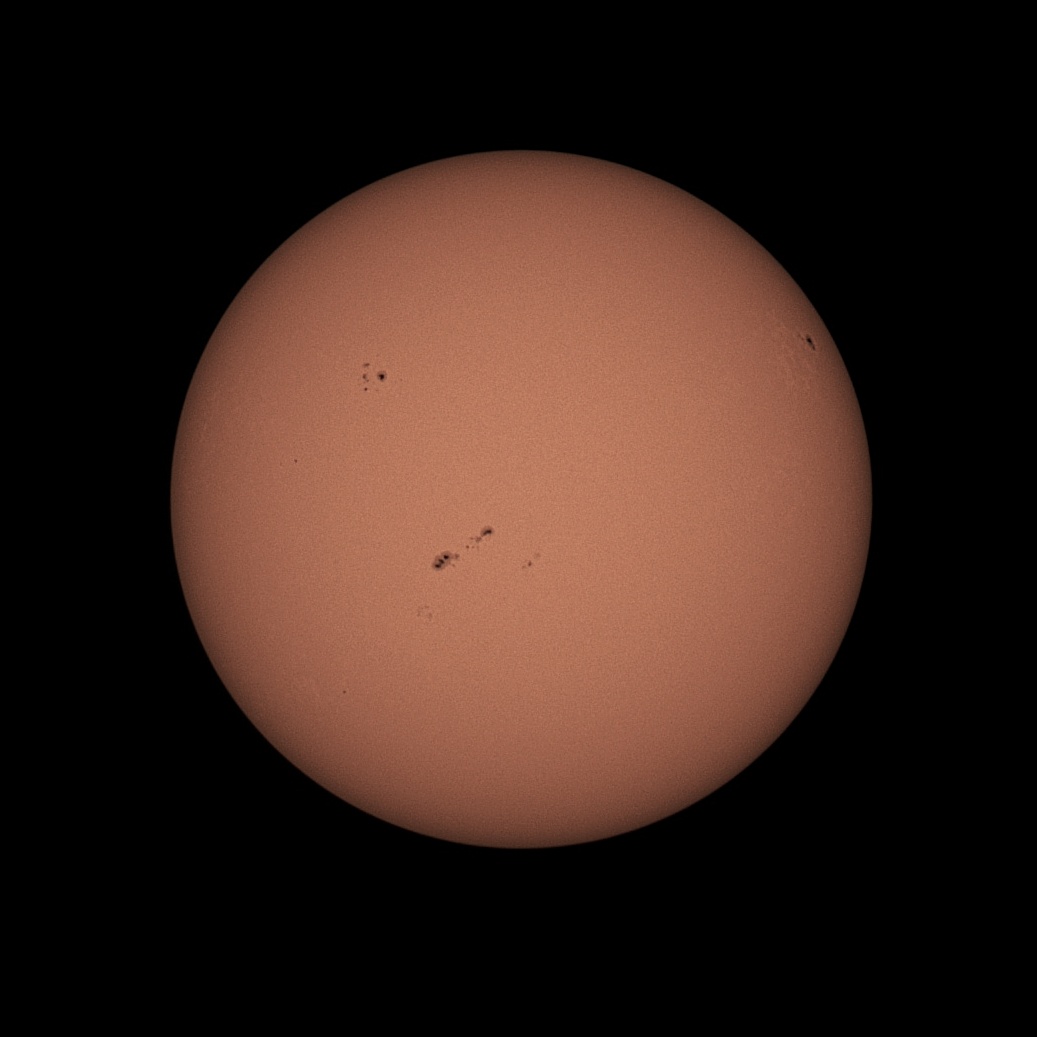
The Sun by Honor Wheeler taken from Dartford using a Dwarf3 smartscope. 50 stacked images and processed in Snapseed.
The Sun taken by George Buckberry from Hextable using a Dwarf3 smart scope.
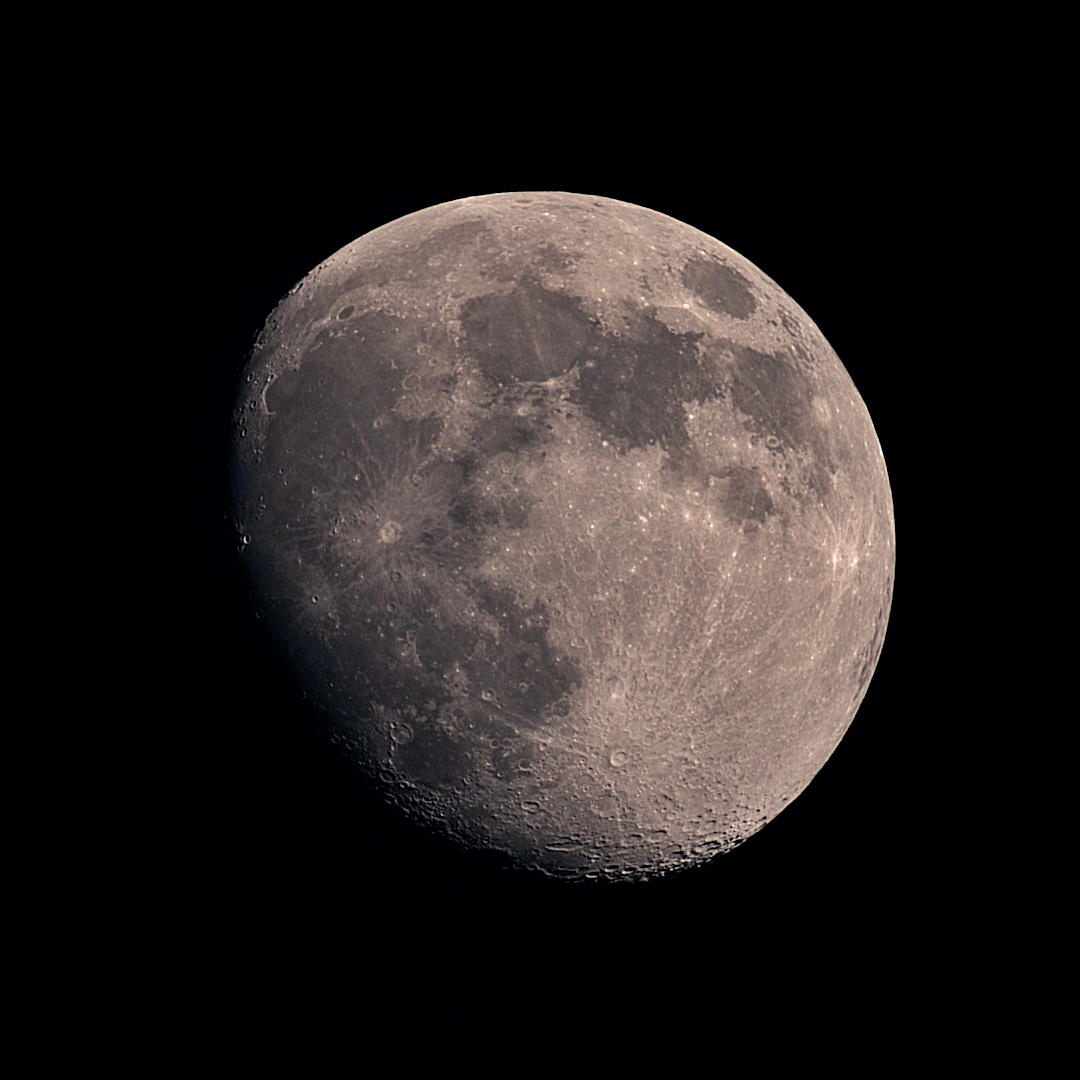
The Moon taken by Honor Wheeler from Dartford using a Dwarf 3 smartscope. 50 stacked images and processed in Snapseed.
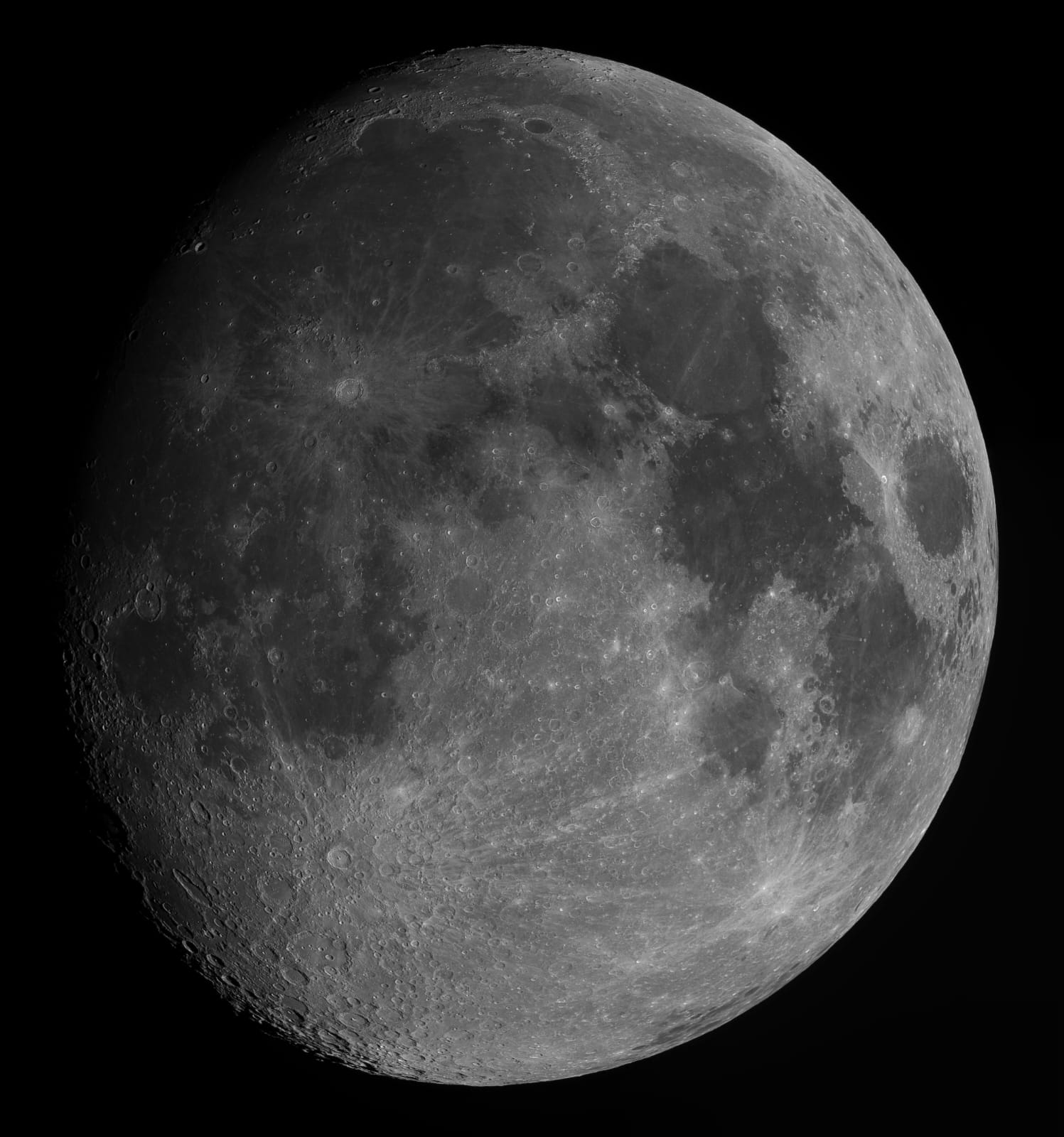
The Moon taken by Neil Webster from St Mary’s Platt.
The image is made up of 6 frames: each 90s x 33fps (20% selected by AS). Neil used a AA 115 APO, EQ6 R, ZWO ASI290MM and R-IR Filter to capture the images and then processed them using Firecapture, AutoStakkert, Photoshop and Microsoft ICE.
Congratulations
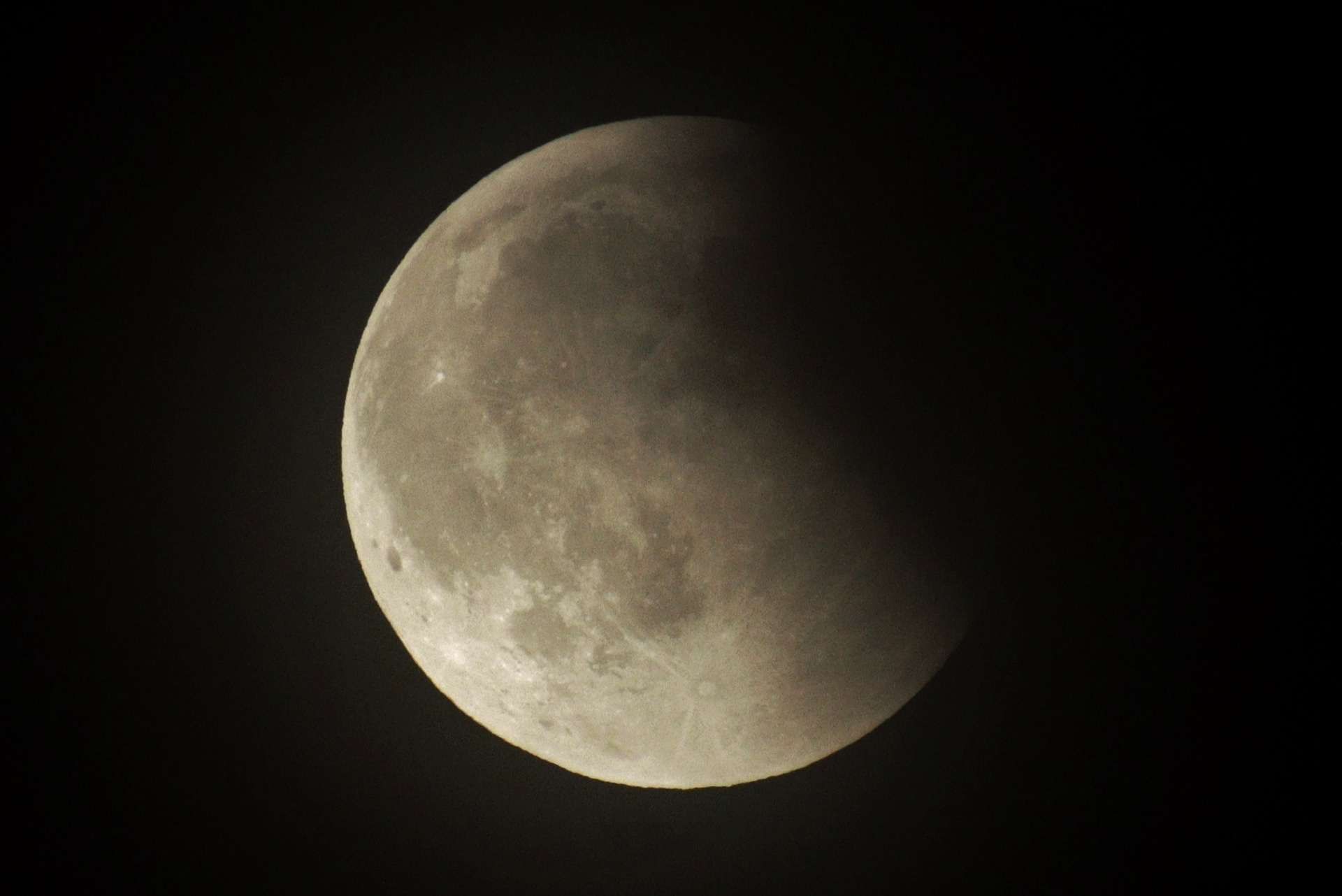
Congratulations to Honor Wheeler for her superb Lunar Eclipse image taken on the 7th September 2025 being shown at the BAA (British Astronomical Association) Society Meeting sky notes and in their Lunar section too!
Honor acquired the image using a Canon M6II, 18-400mm lens, set at ISO1000, F6.3, and 1/500sec
The last Supermoon of 2025
A fabulous selection of Supermoon images taken on the 4th/5th December 2025. The year 2025 featured a rare series of three consecutive supermoons: the October 7th Harvest/Hunter Moon, the November 5th Beaver Moon, and the December 4th Cold Moon, where the Moon appears larger and brighter than usual. These supermoons occur when a full moon coincides with the Moon being at or near its closest point to Earth in its orbit.
For more information about the term ‘Supermoon’ and where Full Moon names originate; check out the following sites/pages: https://en.wikipedia.org/wiki/Supermoon
https://www.almanac.com/full-moon-names
https://www.timeanddate.com/astronomy/moon/full-moon-names.html
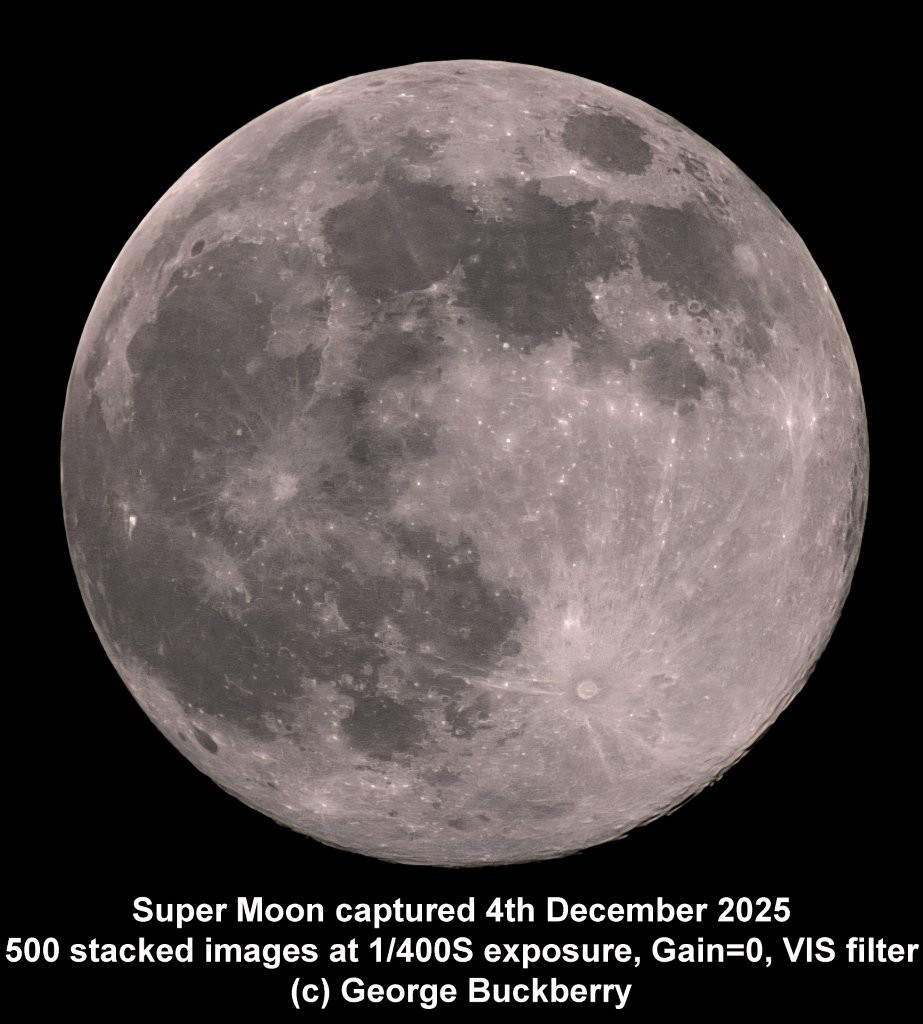
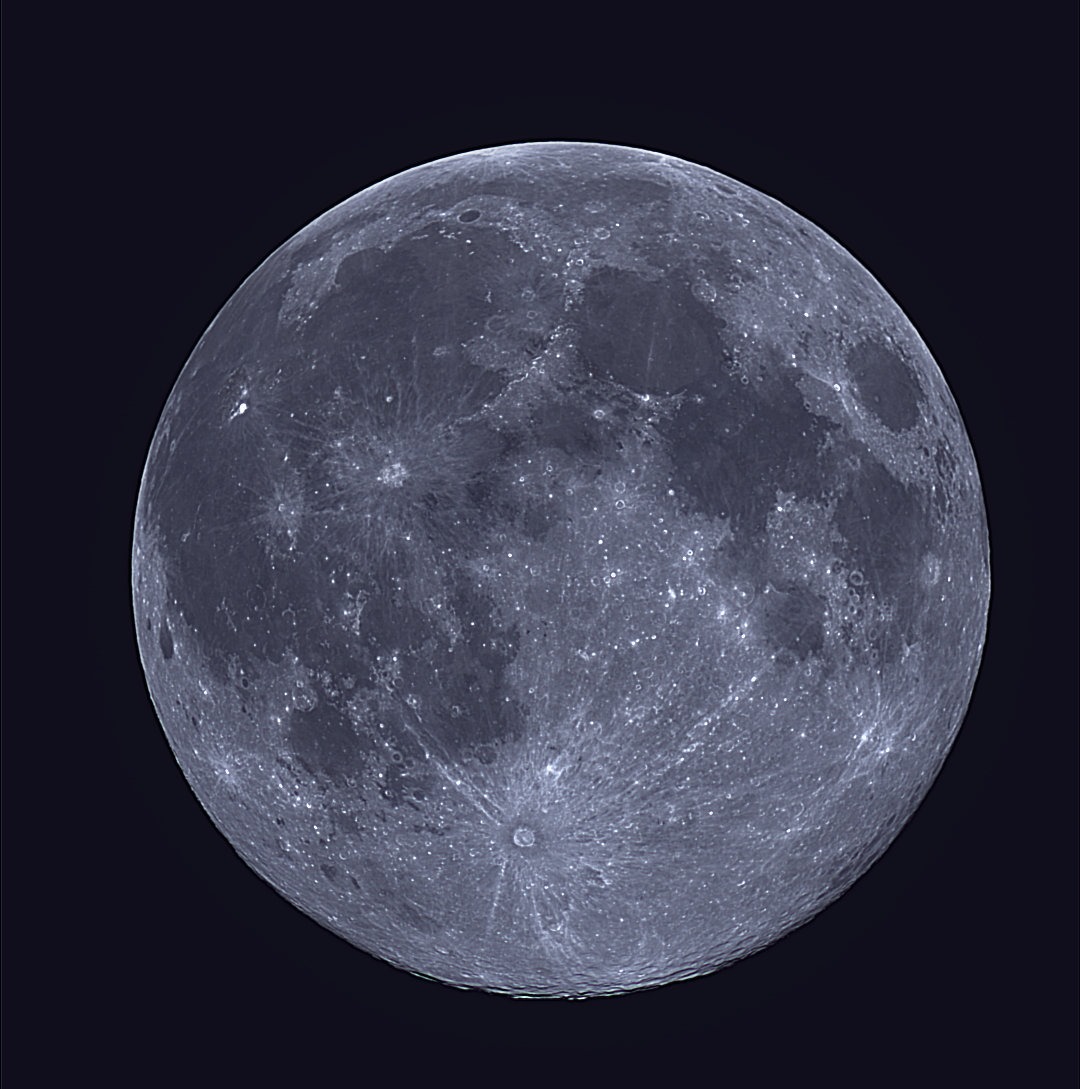
George used a Dwarf3 smartscope to take this image.
The Moon by Diane Clarke taken using a Seestar 50 smartscope.
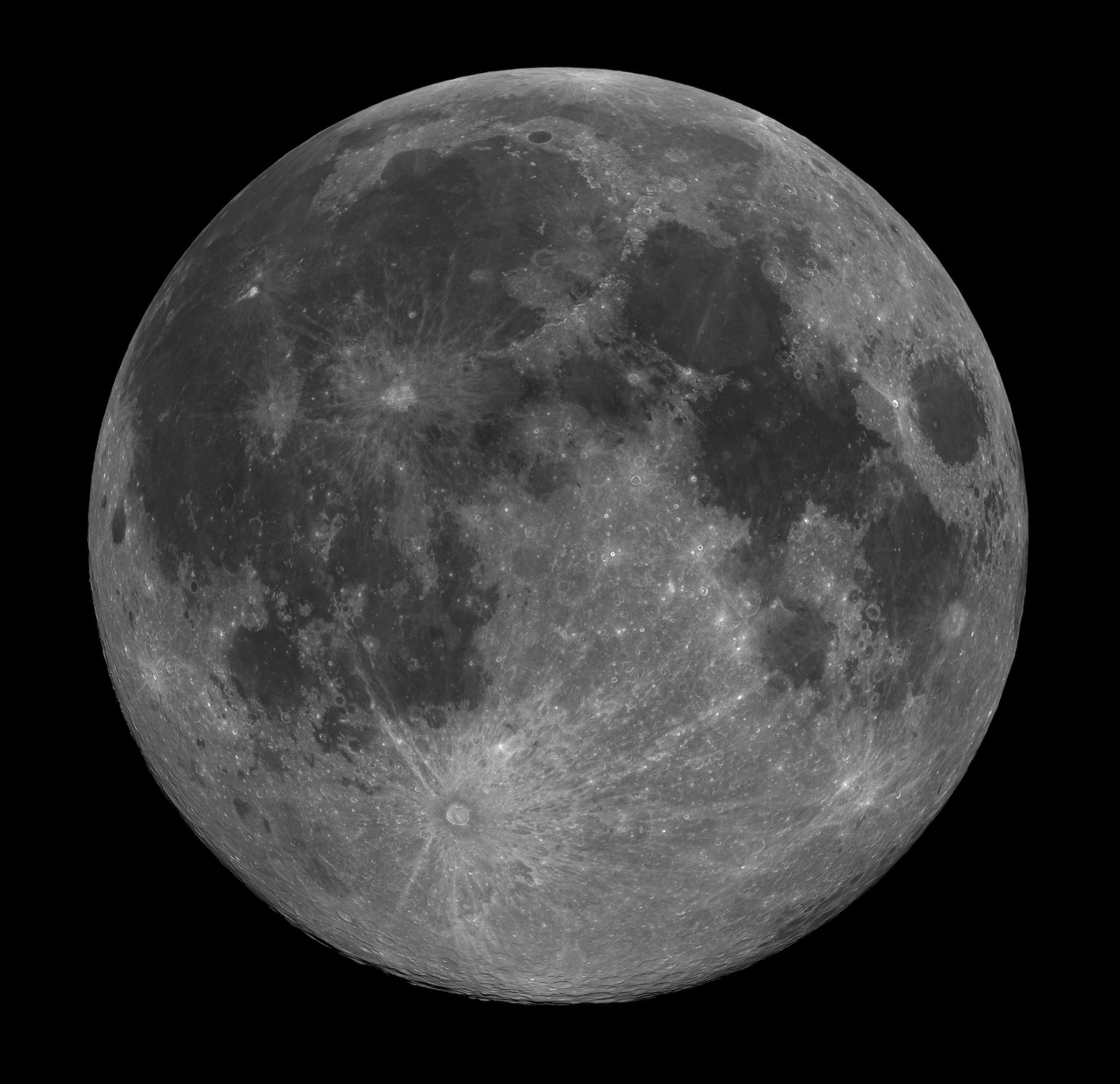
The Moon taken by Neil Webster. The image is made up of 8 frames. Each 90s x 32fps. The image was taken using a AA115 APO, EQ6 R, ZWO ASI290MM, and R/IR Filter. It was processed using Firecapture, AutoStakkert, Photoshop, and Microsoft ICE. Taken from St Marys Platt, Kent, UK.
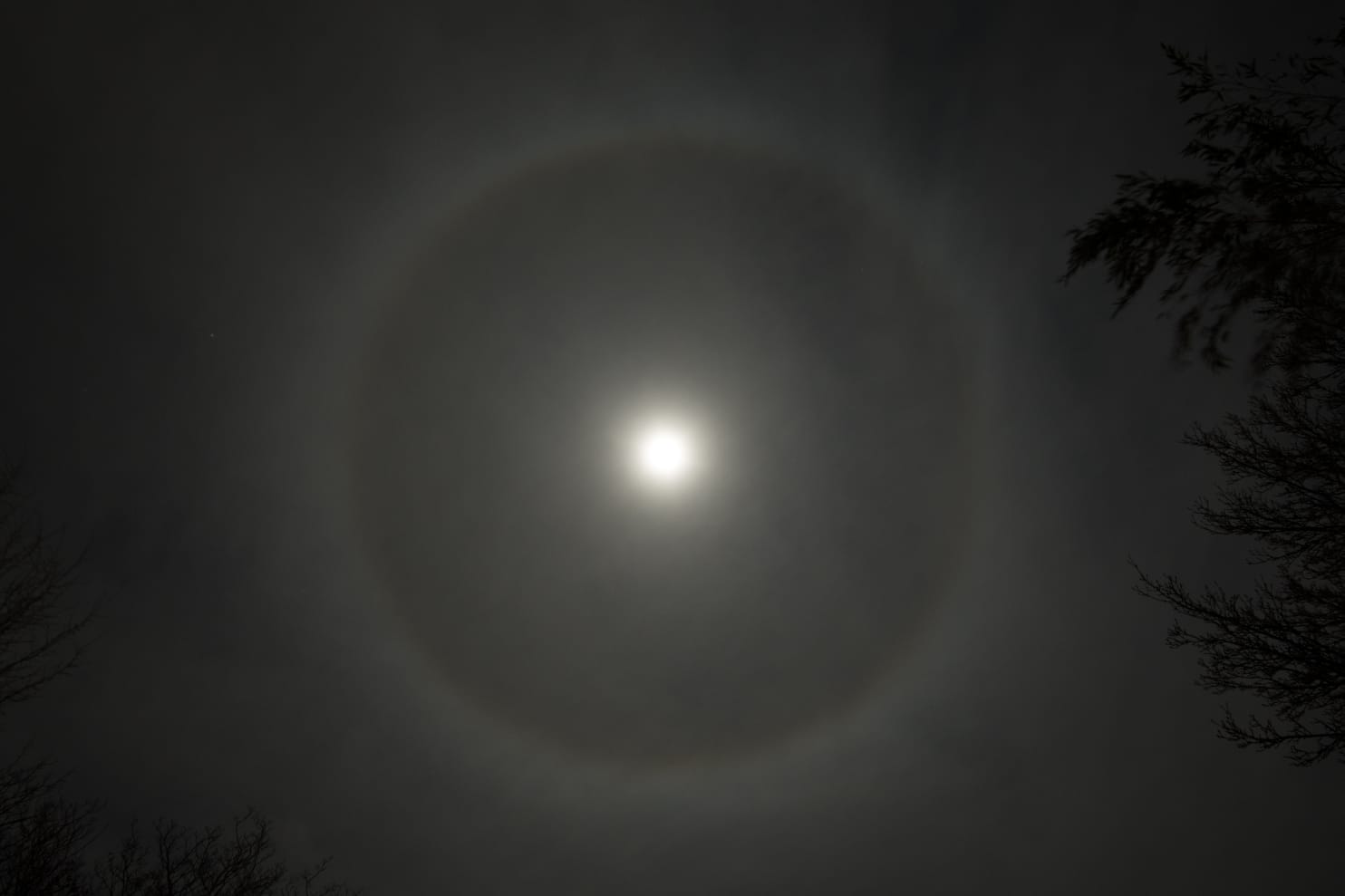
Lunar Halo – 13th Dec 2025
Four fab Lunar Halo images. All taken on the night of the 13th Dec 2025.
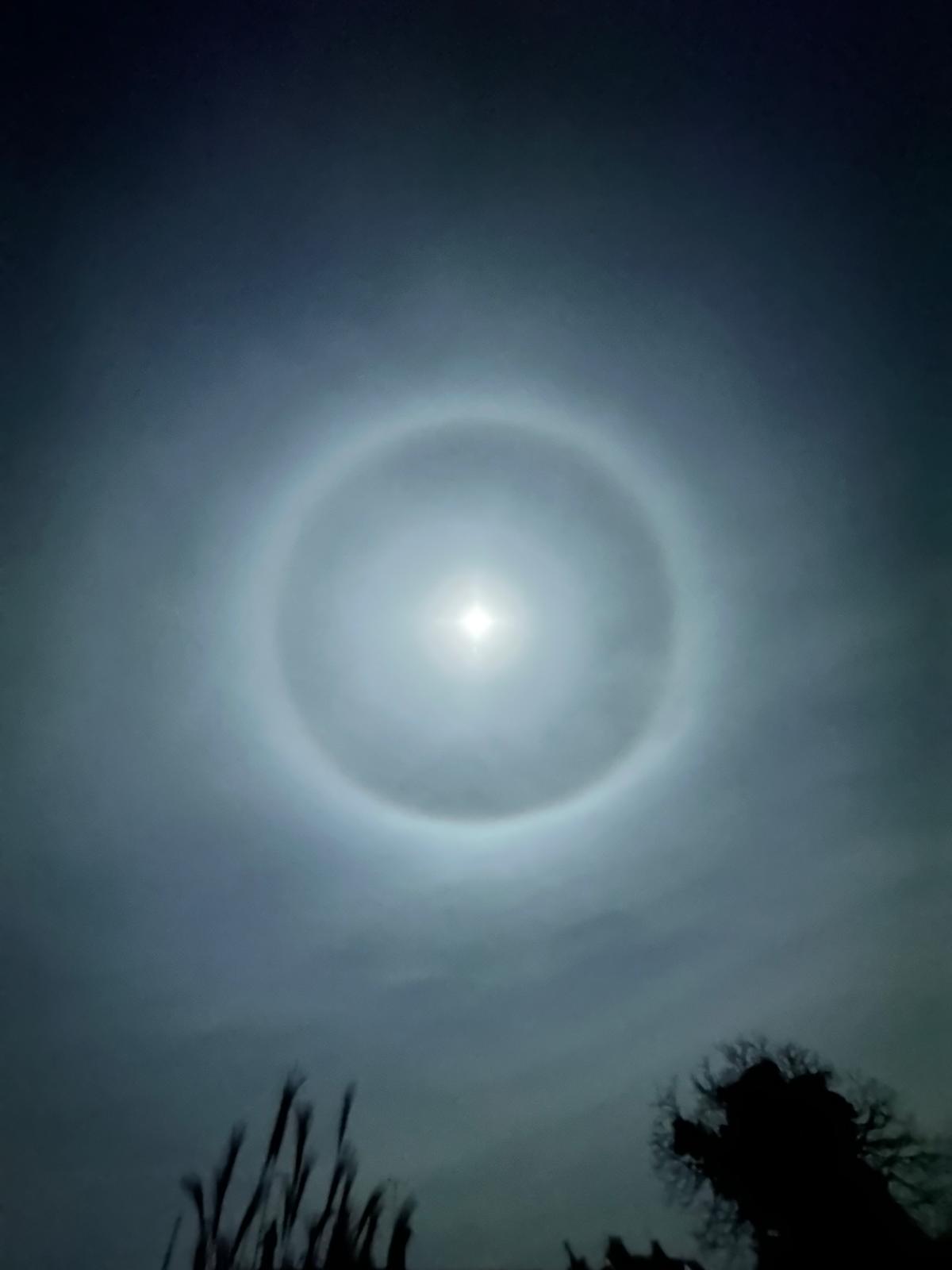
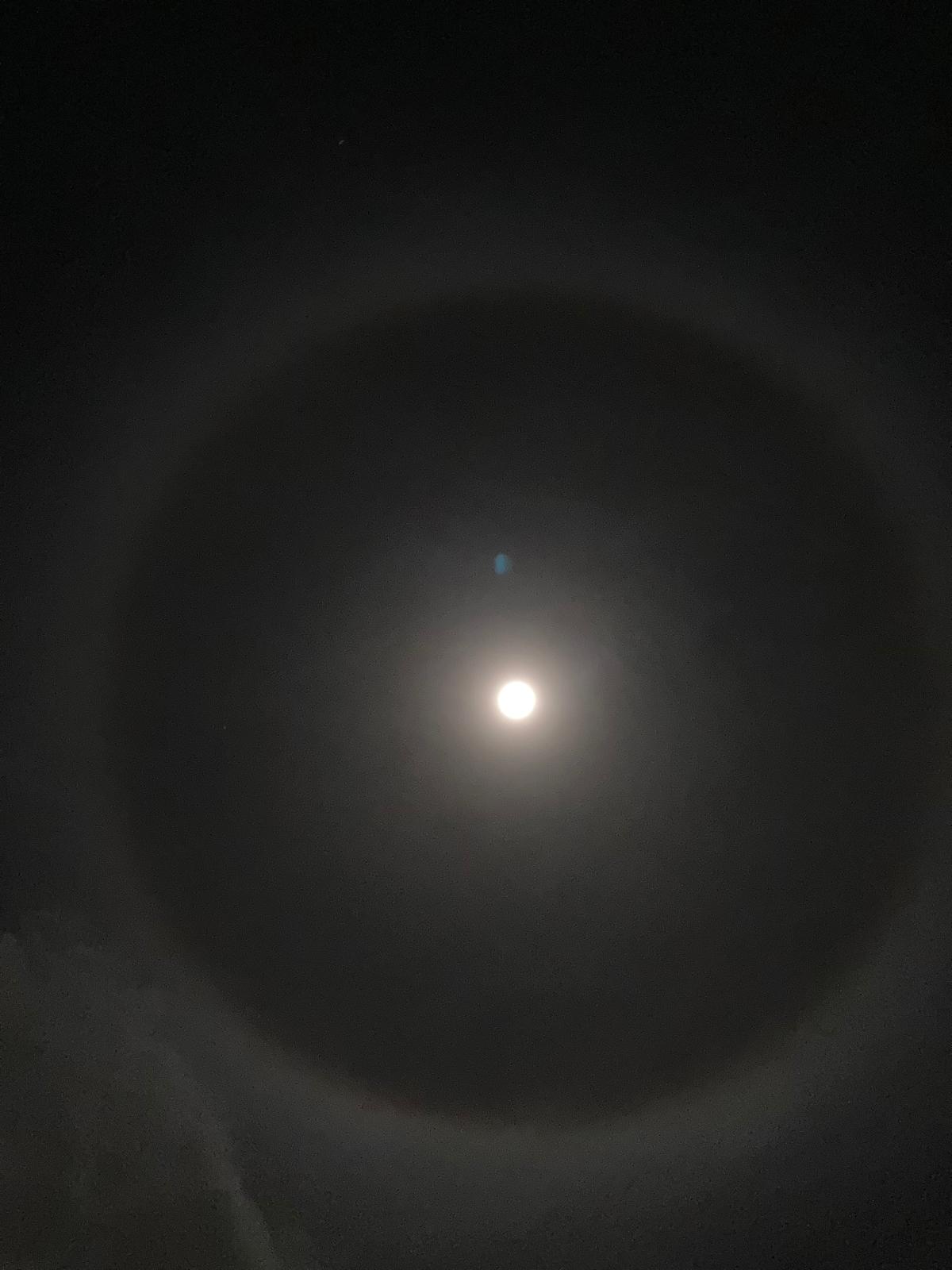
By Martin Crow from Burham-On-Crouch.
By Gary Hunt taken from Isle of Sheppey.
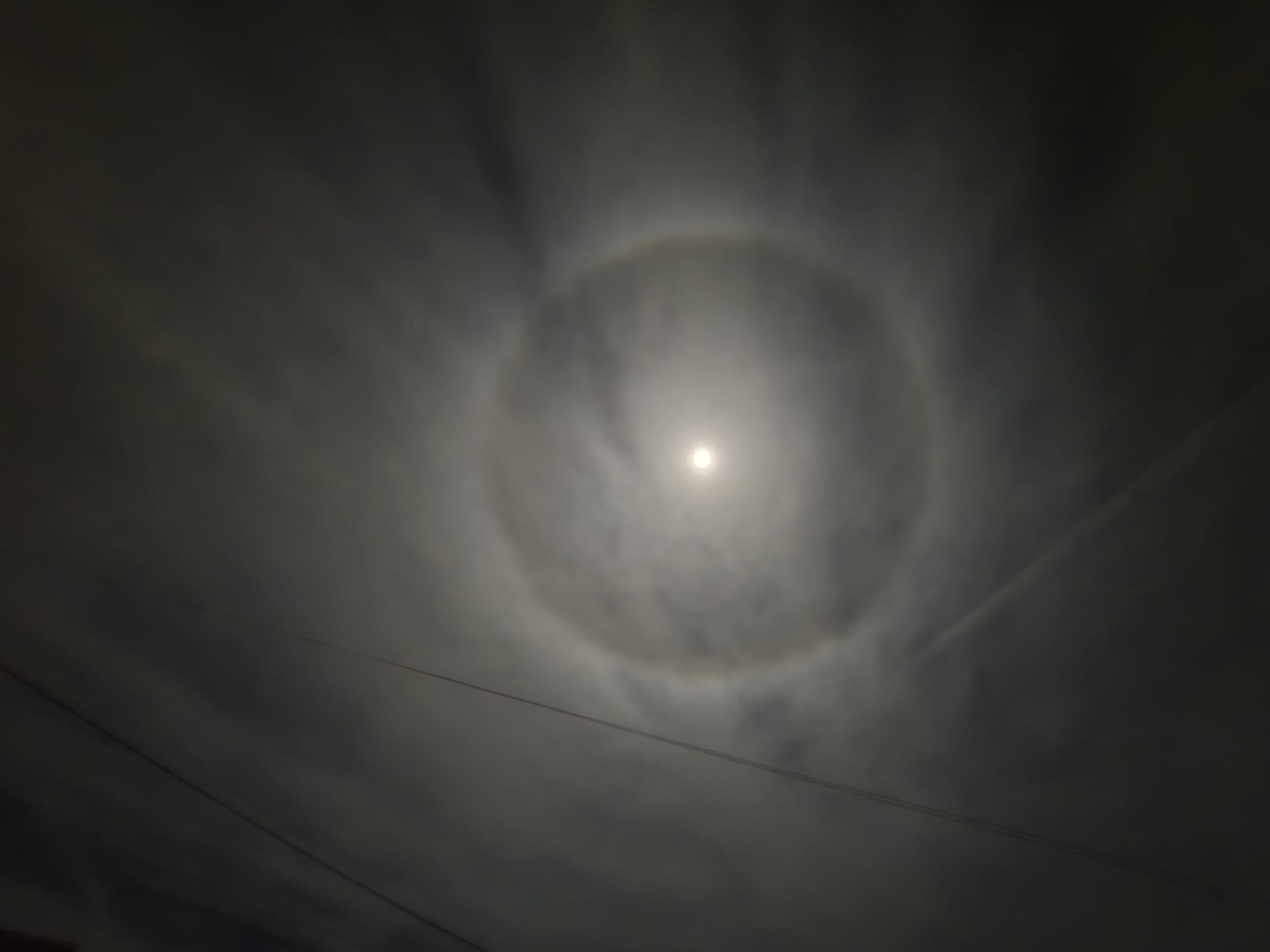
By Honor Wheeler from Dartford.
By George Buckberry from Hextable.
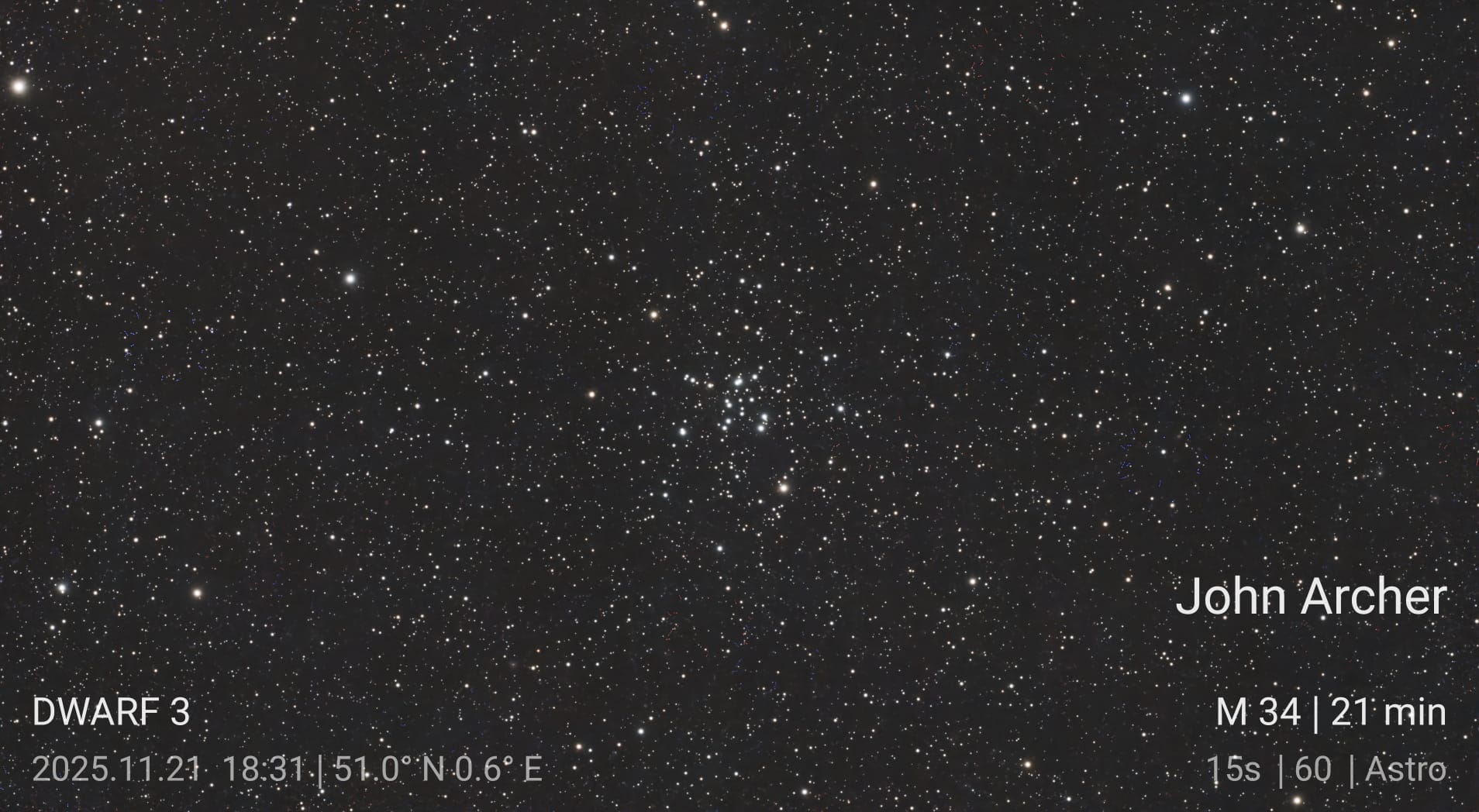
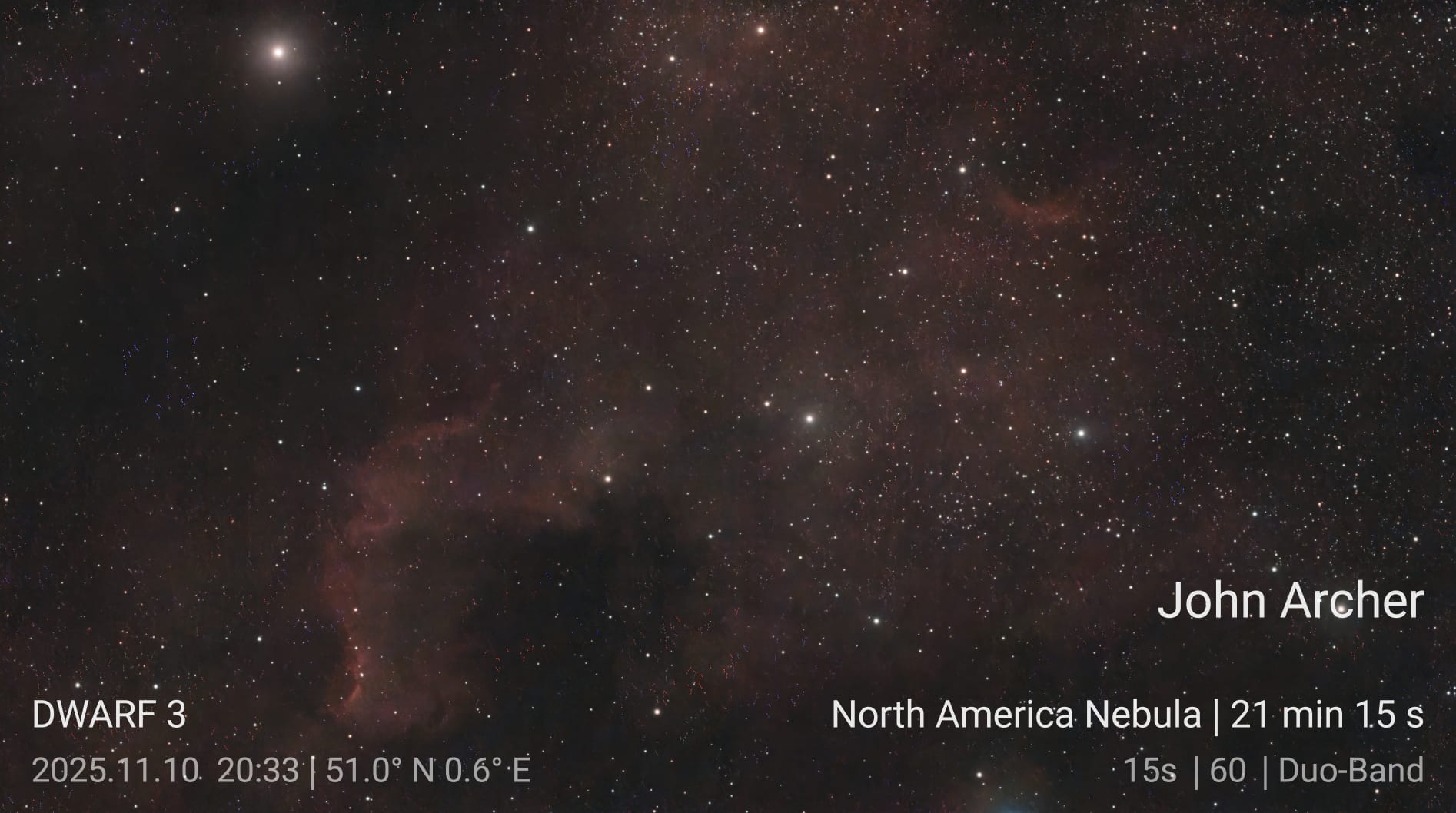
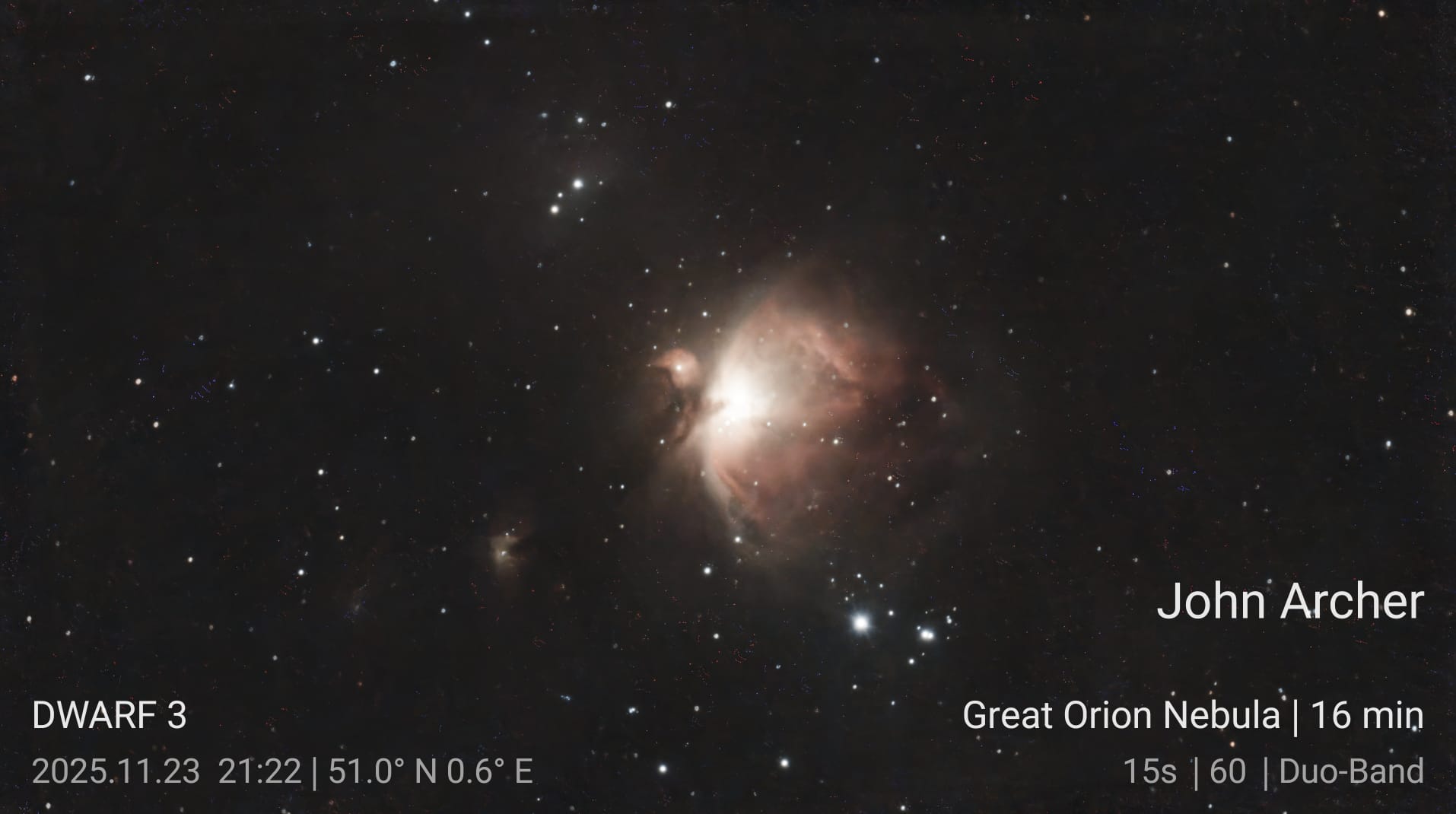
John Archer’s images – 21st Nov to the 28th Nov 2025
A superb collection of images taken by member John Archer from the 21st to the 28th Nov 2025 using a Dwarf3 smartscope.
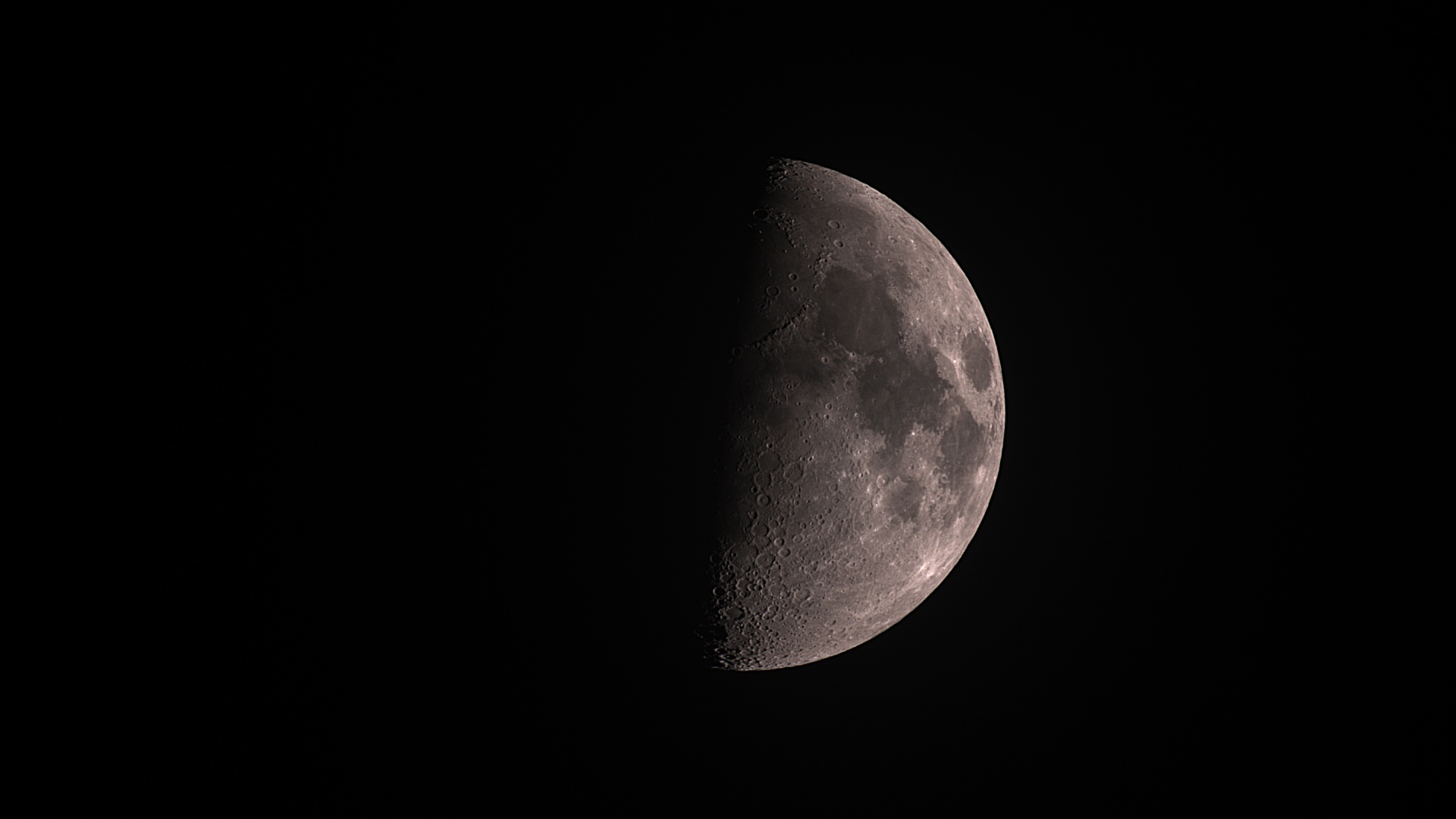
The Moon on the 28th Nov 2025
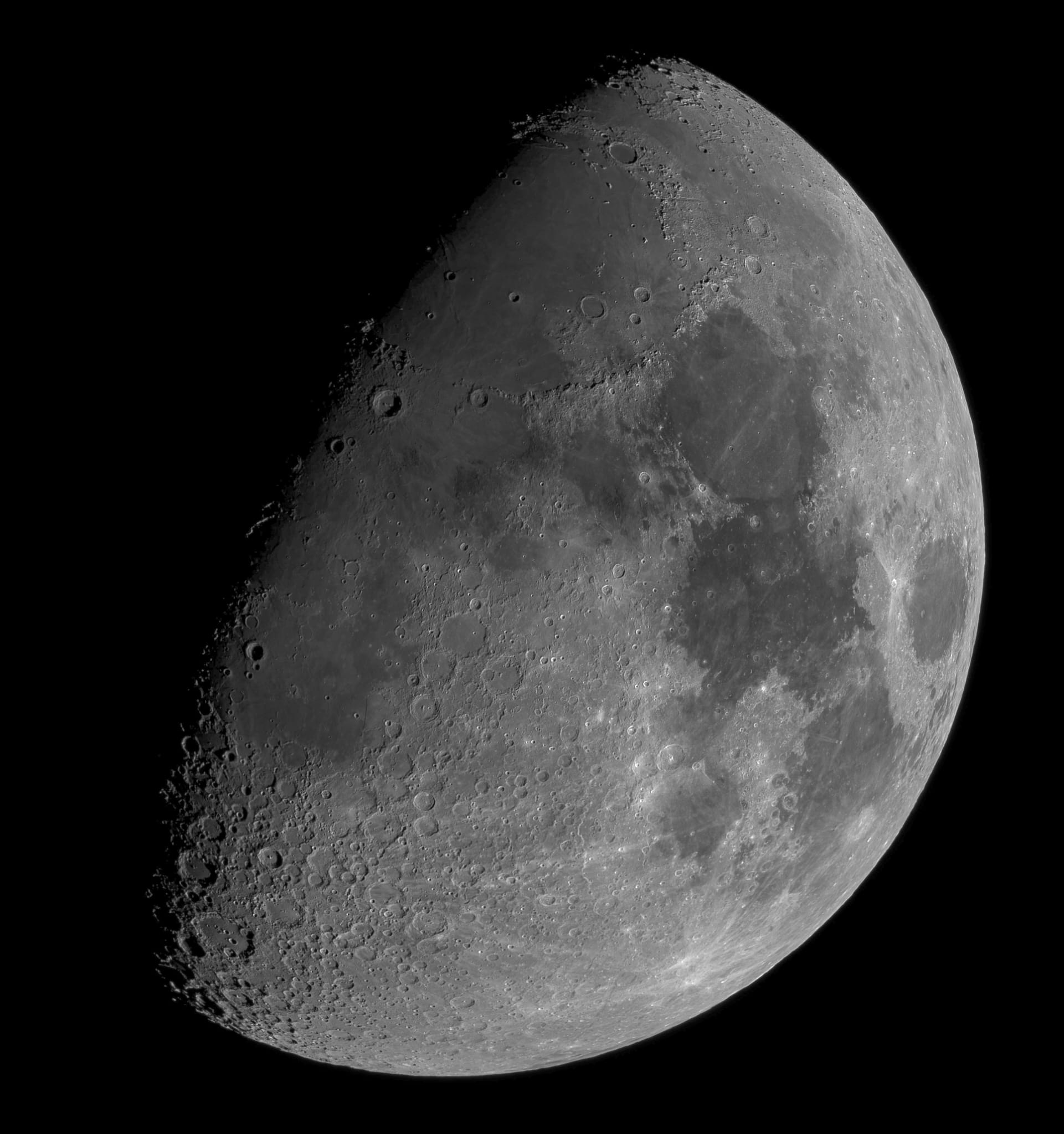
The Moon – 29th November 2025
An absolutely stunning image of the Moon taken by member Neil Webster on the 29th November 2025.
MOON: Waxing Gibbous, 66.8% illuminated and 9.56 days old.
Neil acquired the image using an AA 115 APO, EQ6 R, ZWO ASI 290MM, and R/IR filter.
8 frames: each 90s x 31fps (best 20% selected)
Processed using AutoStakkert and Photo Shop.
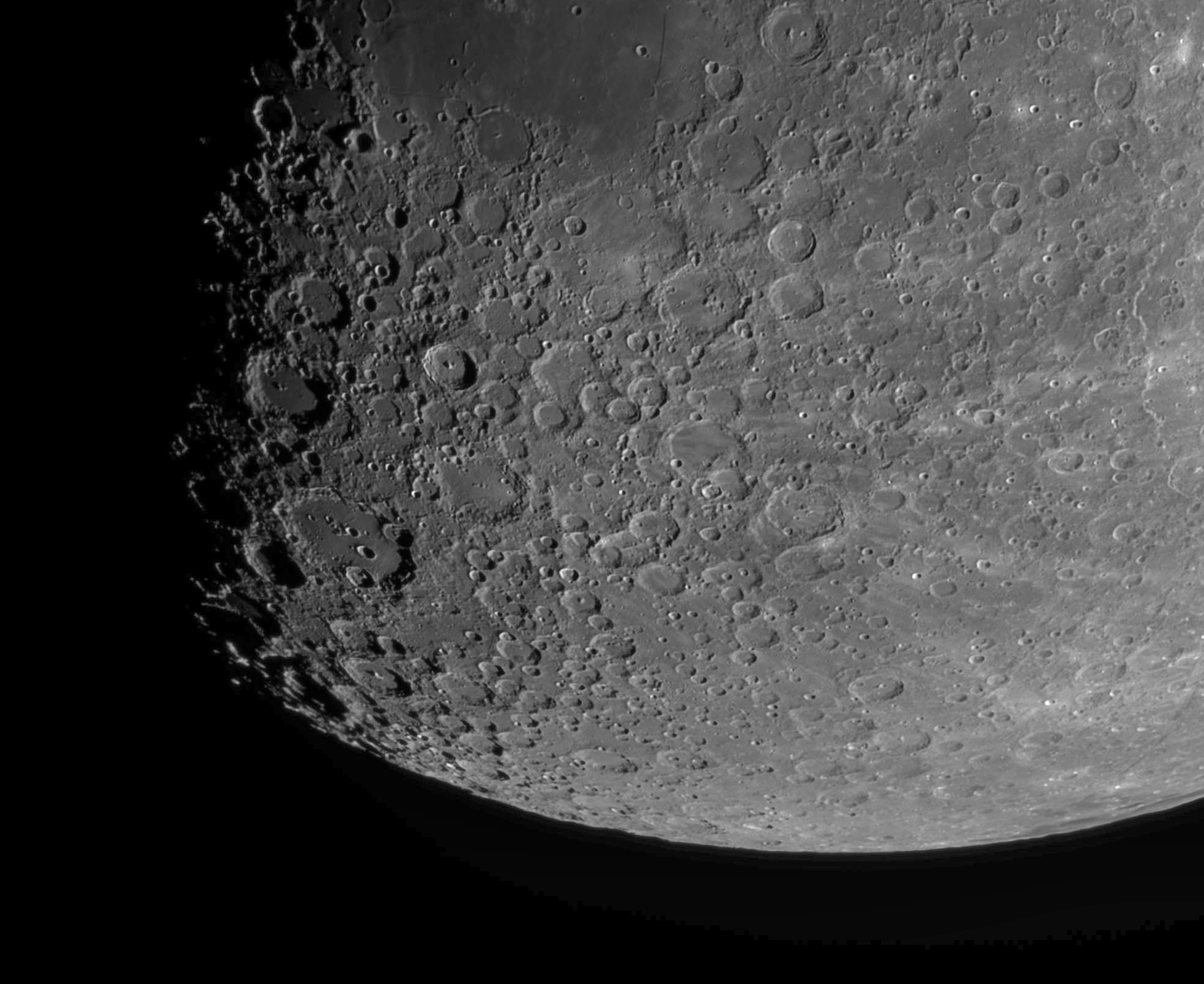
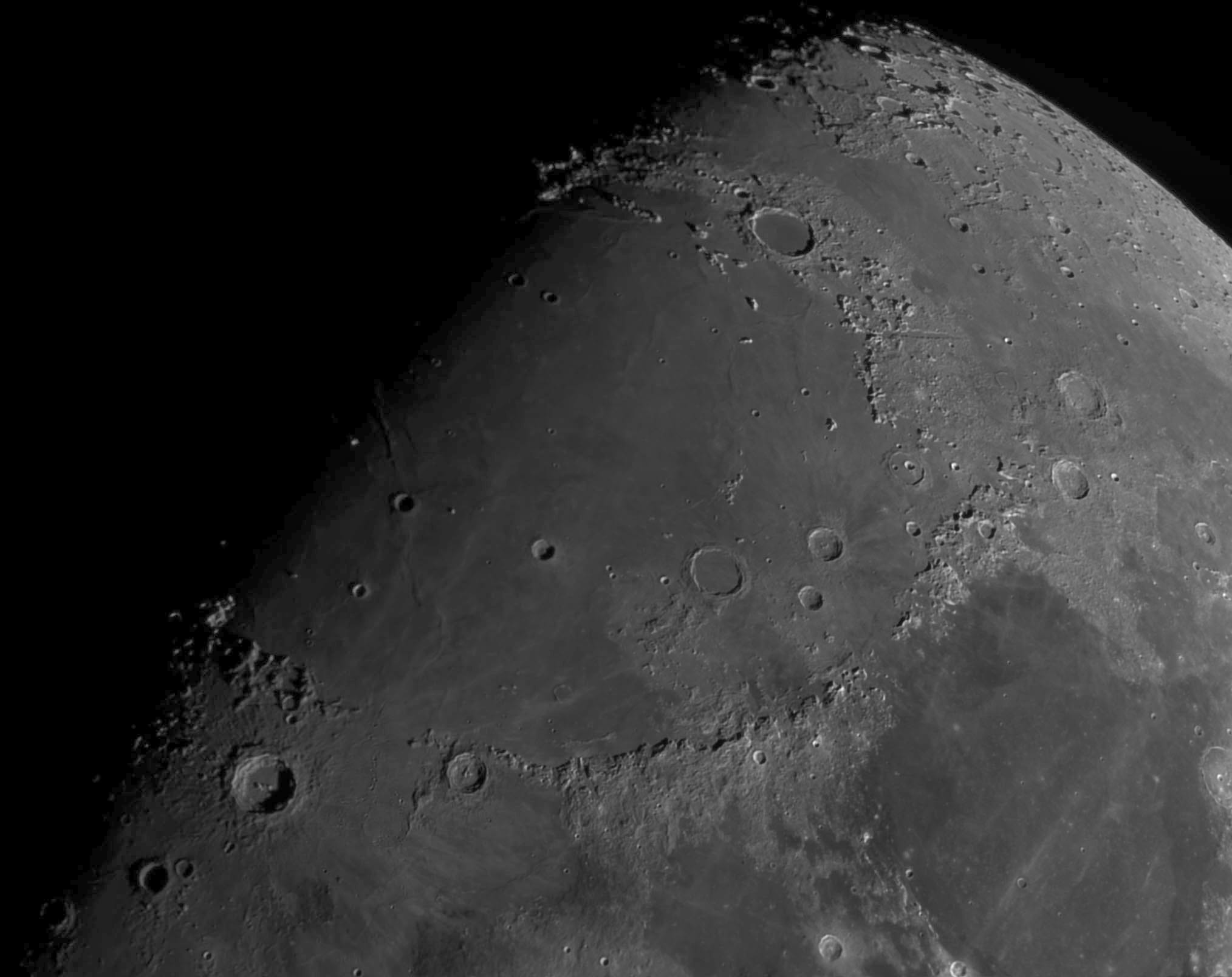
Craters Clavius, Tycho etc.
Check out Neil’s Flickr page at https://www.flickr.com/photos/137388222@N05/
Copernicus, Archimedes, Plato, Montes Apenninus, Montes Caucasus and Alpine Valley.
The Moon – 30th November 2025
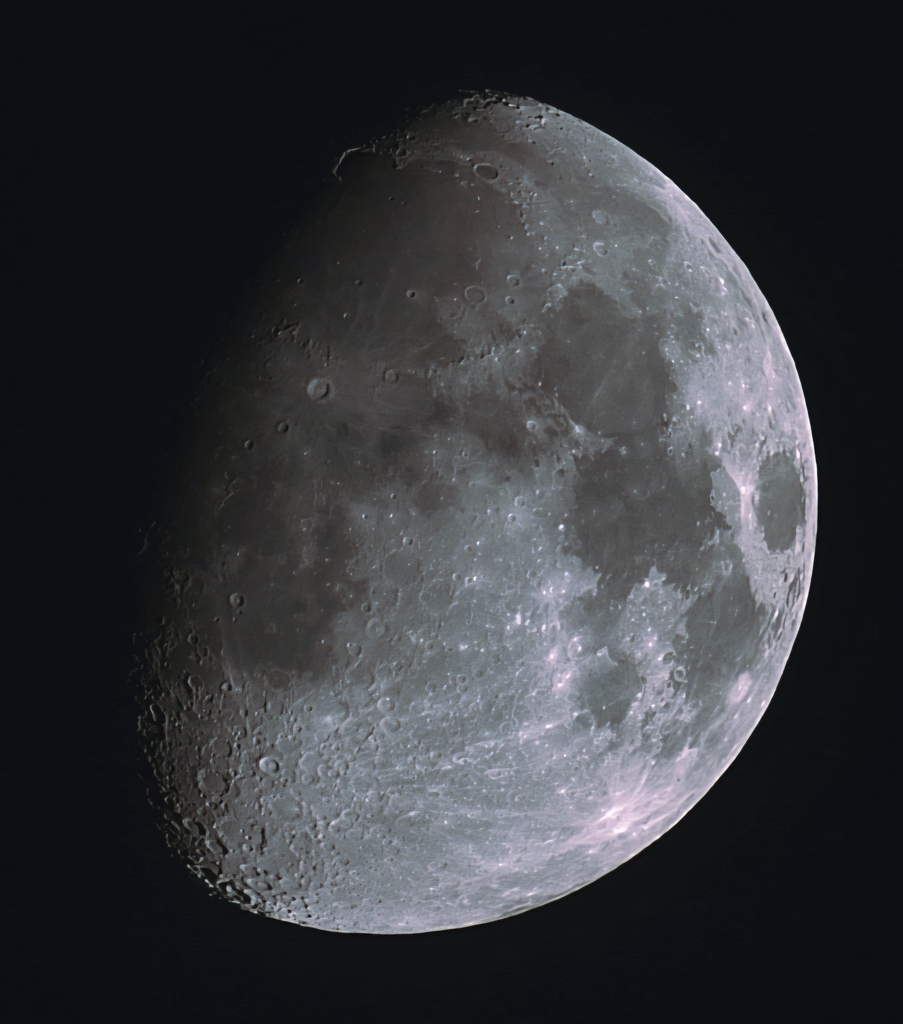
A super image of the Moon taken by member George Buckberry on the 30th November 2025; using his smart scope Dwarf3. The image was taken at 16:35 UTC, Exp 1/320s, Gain 10, and a VIS filter was used.
Moon
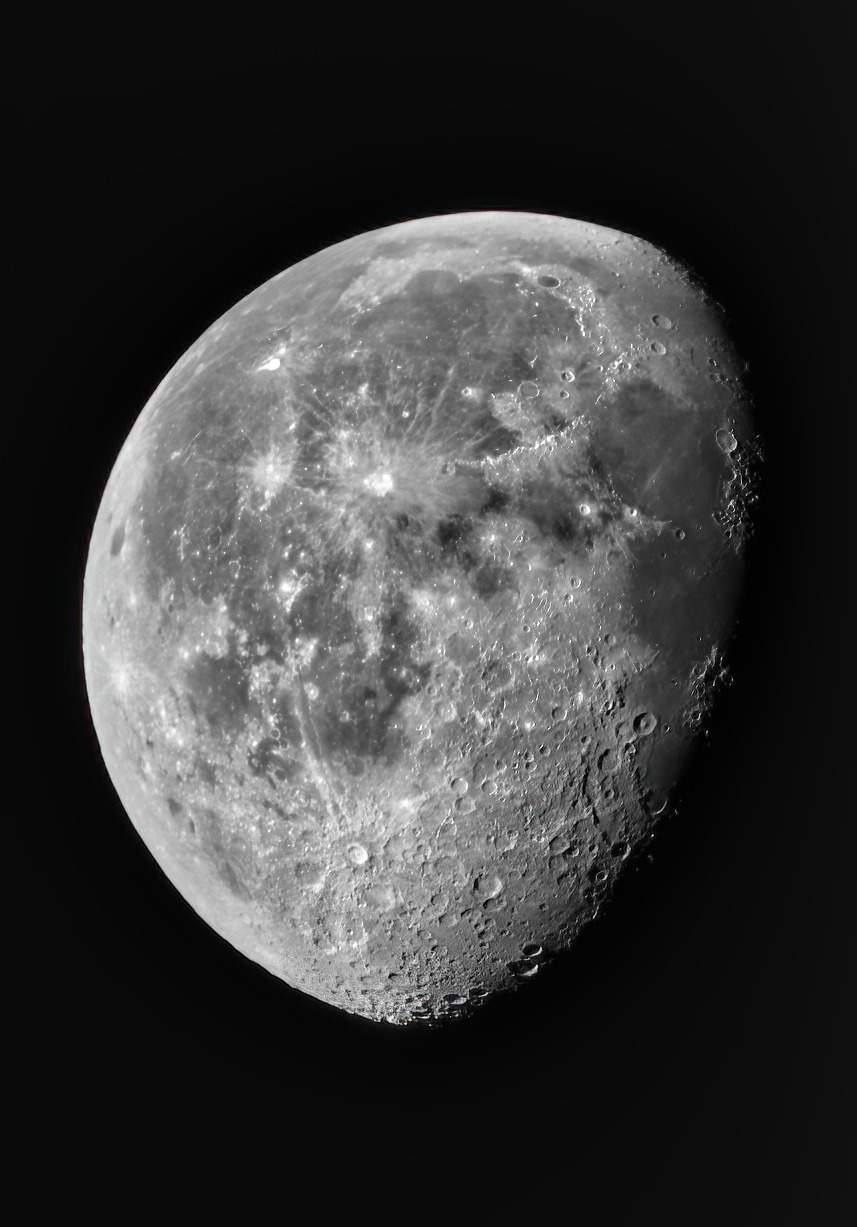
A fantastic image of a waning gibbous Moon taken by member Diane Clarke on the 8th November 2025 using a Seestar s50 smart scope.
Other Images
Sun | Comets | Mercury | Venus | Atmospheric Optics | Meteors | Auroa and NLC | Moon | Minor Planets | Mars | Jupiter | Saturn | Uranus | Neptune | Messier | Caldwell | All Deep Sky | Conjunctions | Transits | Solar Eclipse | Lunar Eclipse | Wide Field |ISS & Space Junk | Exo-Planets
All images are copyright. Permission must be sought to from the image owner to the use of any of these images.