
Messier 92 and 57
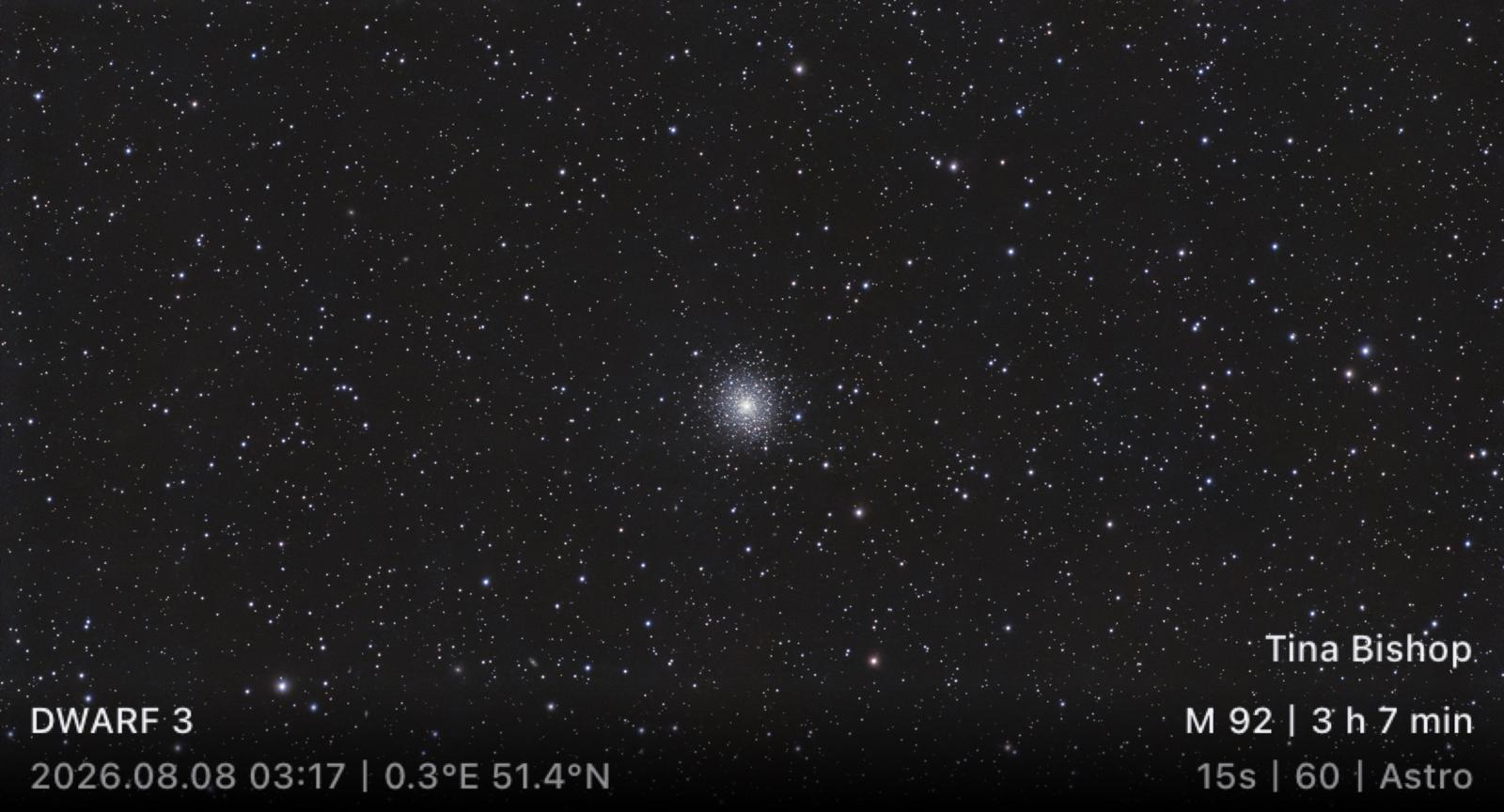
Two splendid images by member Tina Bishop taken using a Dwarf 3 smart scope.
Messier 57 which is also known as the Ring Nebula and found in the constellation Lyra.
Meesier 92 which is a Globular Cluster of stars found in the constellation Hercules.
https://en.wikipedia.org/wiki/Ring_Nebula
https://en.wikipedia.org/wiki/Messier_92

New Nova in Sagitta
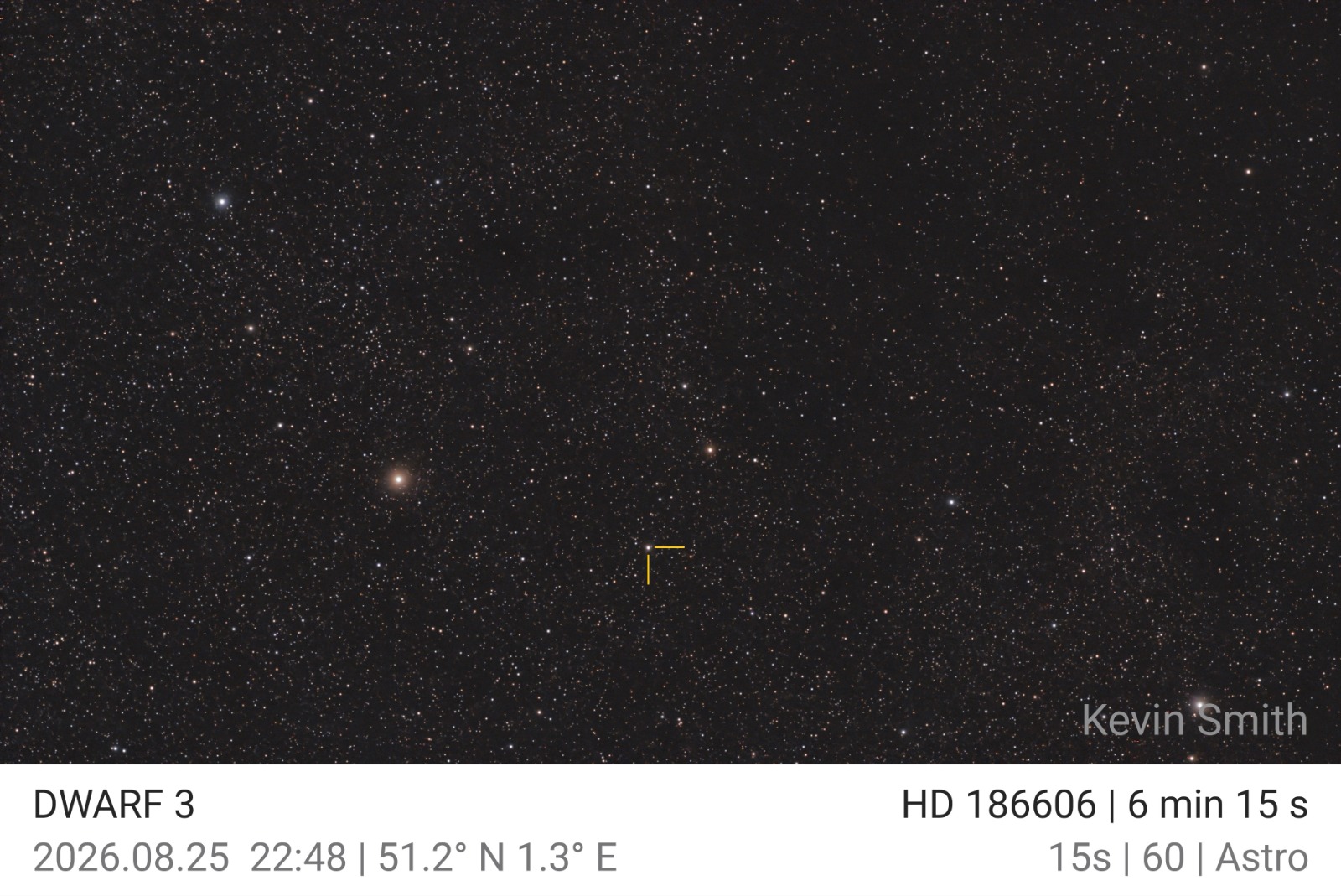
On the 25th August 2026 a new Nova in the constellation Sagitta was discovered.
A few hours after the announcement member Kevin Smith managed to take an image of it using his Dwarf3 smart scope and posted it on the BAA forum https://britastro.org/forums/topic/likely-bright-nova-in-sagitta
The Nova is highlighted on Kevin’s image by the 2 small yellow lines at right angles to each other. The bright star to the left is delta Sagittae.
”The object was picked up on August 25, 2026, by the NMW-TexasTech survey, one of several automated sky-patrol programs that scan wide swaths of sky night after night looking for exactly this kind of change. Within the same day, amateur astronomer K. Yoshimoto in Yamaguchi, Japan, logged a magnitude of 7.42 — a striking brightness for an object that, by all indications, wasn’t visible at all before the eruption. The discovery was formalized through the Central Bureau for Astronomical Telegrams (CBAT), the Harvard-hosted clearinghouse astronomers have relied on for over a century to rapidly circulate news of transient objects. CBAT assigned it the provisional designation PNV J19450648+1822422, pinning its position at RA 19h45m06.48s, Dec +18°22’42.2″
Provisional designations don’t last long once a spectrum comes in. Follow-up spectroscopy revealed the signature astronomers were watching for: clear P Cygni profiles in the hydrogen-alpha and hydrogen-beta lines, with expansion velocities around 1,500 kilometers per second. That combination — a blueshifted absorption trough sitting next to an emission peak, produced by material blasting outward from the star faster than the speed of a jet engine’s exhaust by a factor of thousands — is close to a textbook confirmation of a classical nova. The object has since been given its permanent variable-star name: Nova Sagittae 2026, or V488 Sge.” Ref:https://www.cosmicherald.com/article/nova-sagittae-v488-sge-2026
http://www.cbat.eps.harvard.edu/unconf/followups/J19450648+1822422.html
https://vsx.aavso.org/index.php?view=detail.top&revid=852445
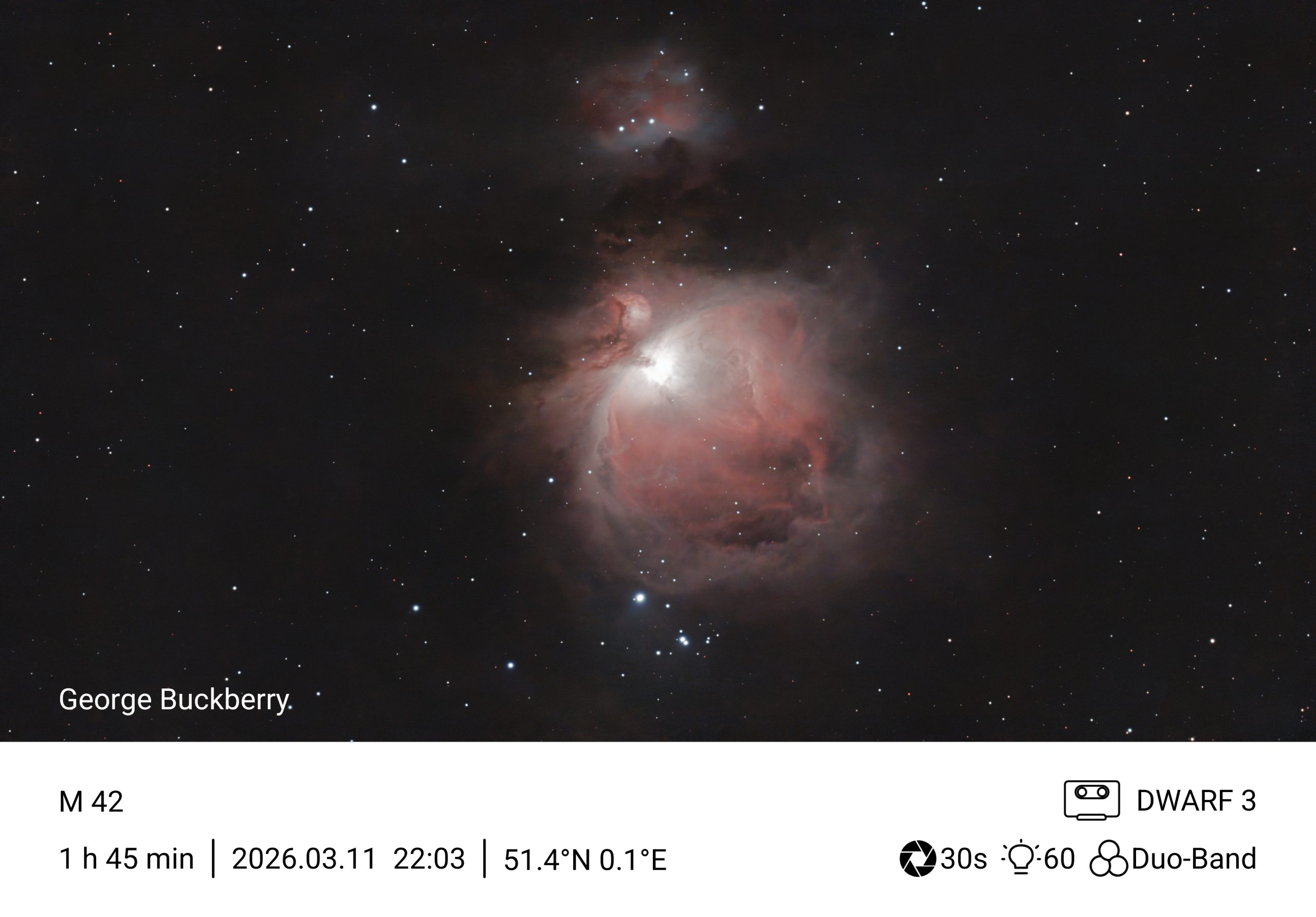
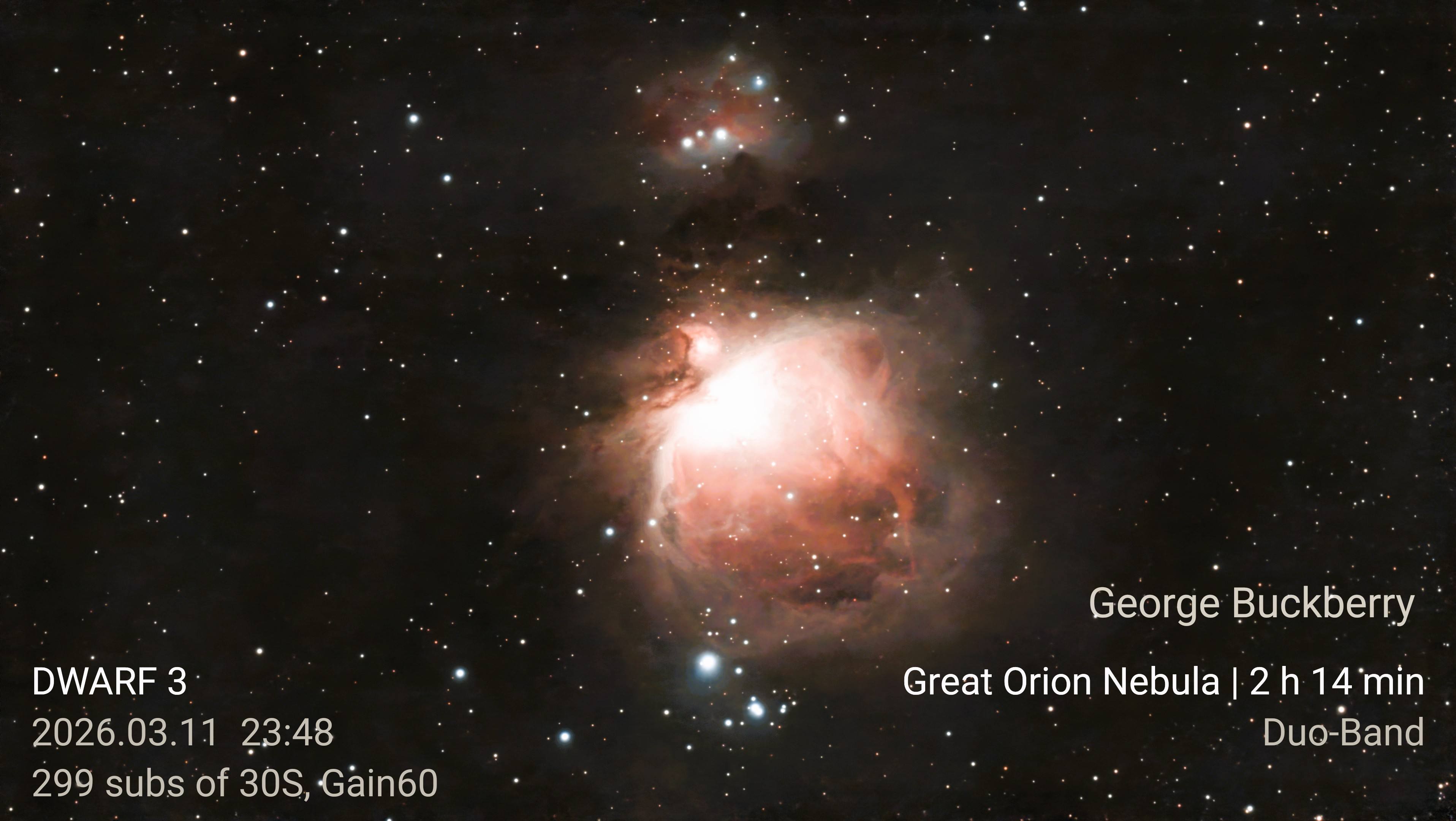
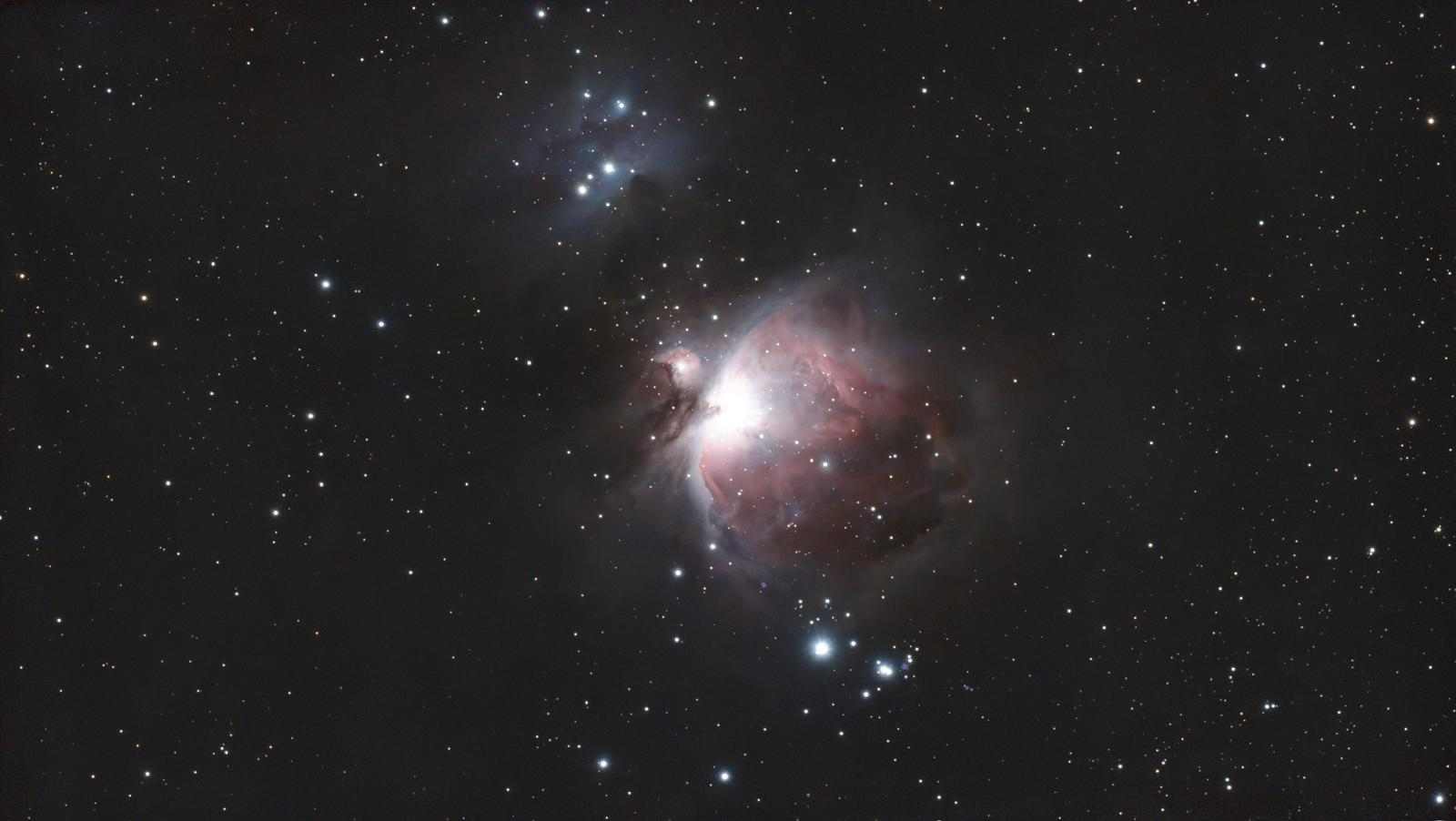
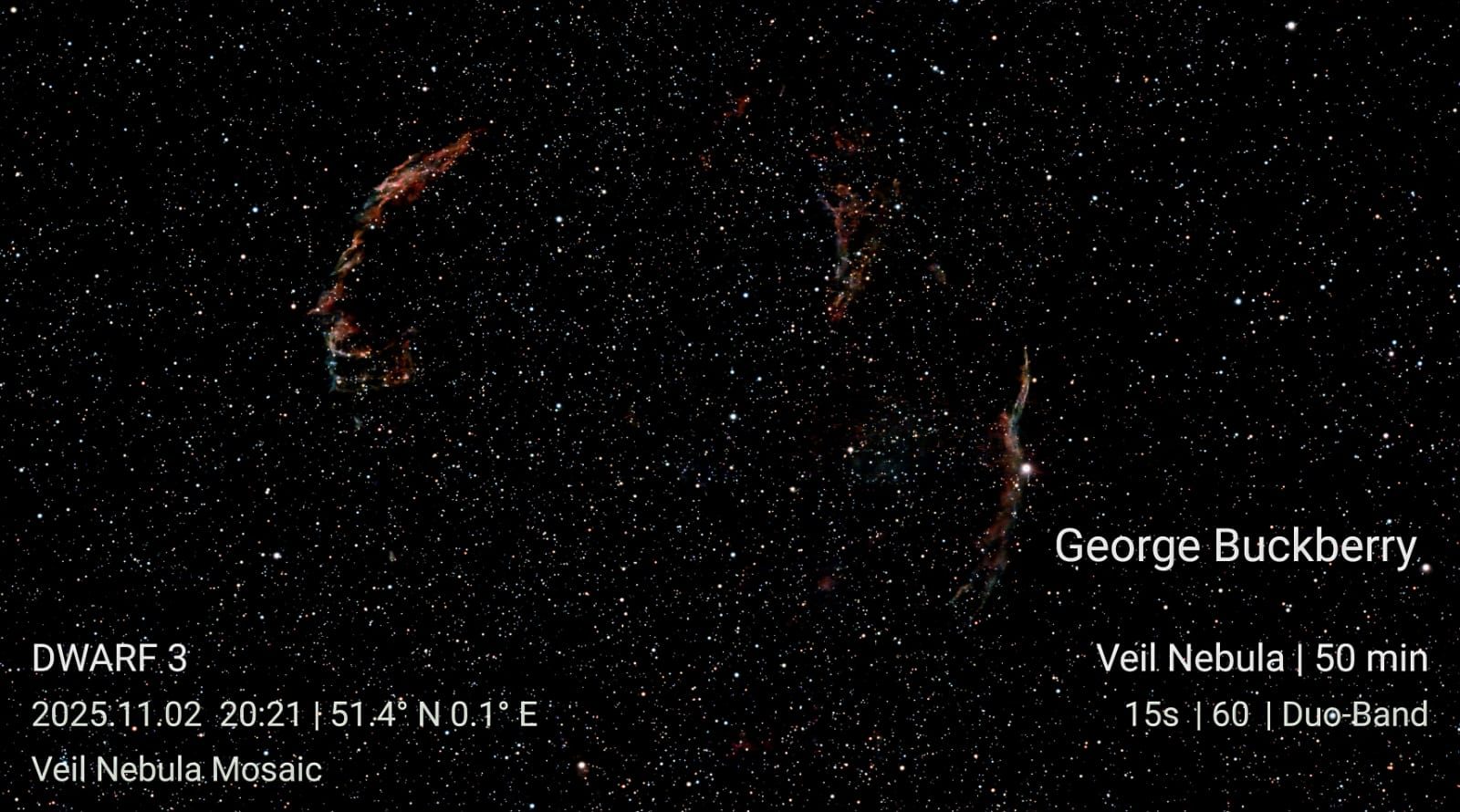
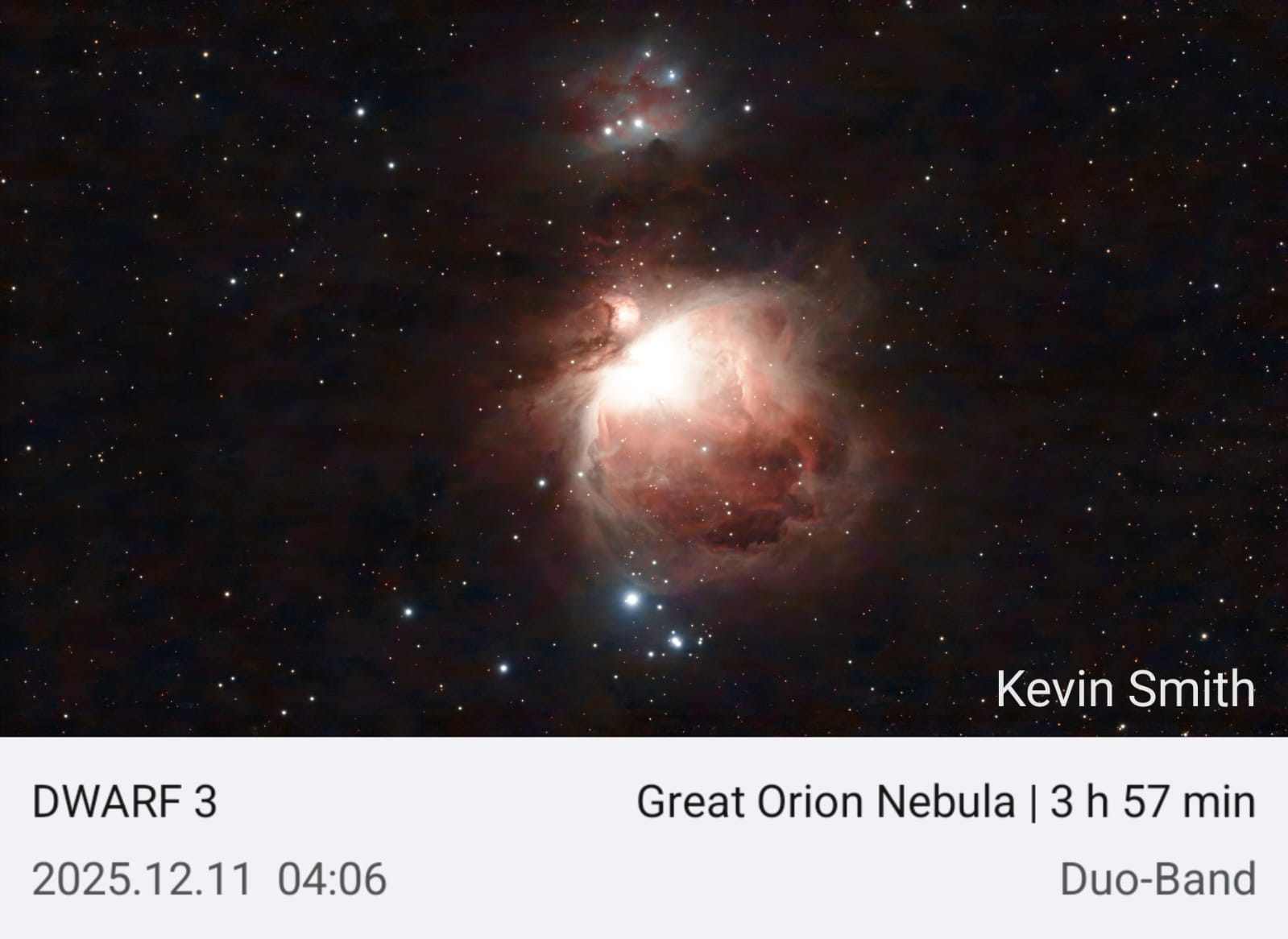
Orion by George Buckberry
Further process of M42 – The Orion nebula on the latest DwarfLab App and Firmware showing improved clarity after star reduction applied by George Buckberry.
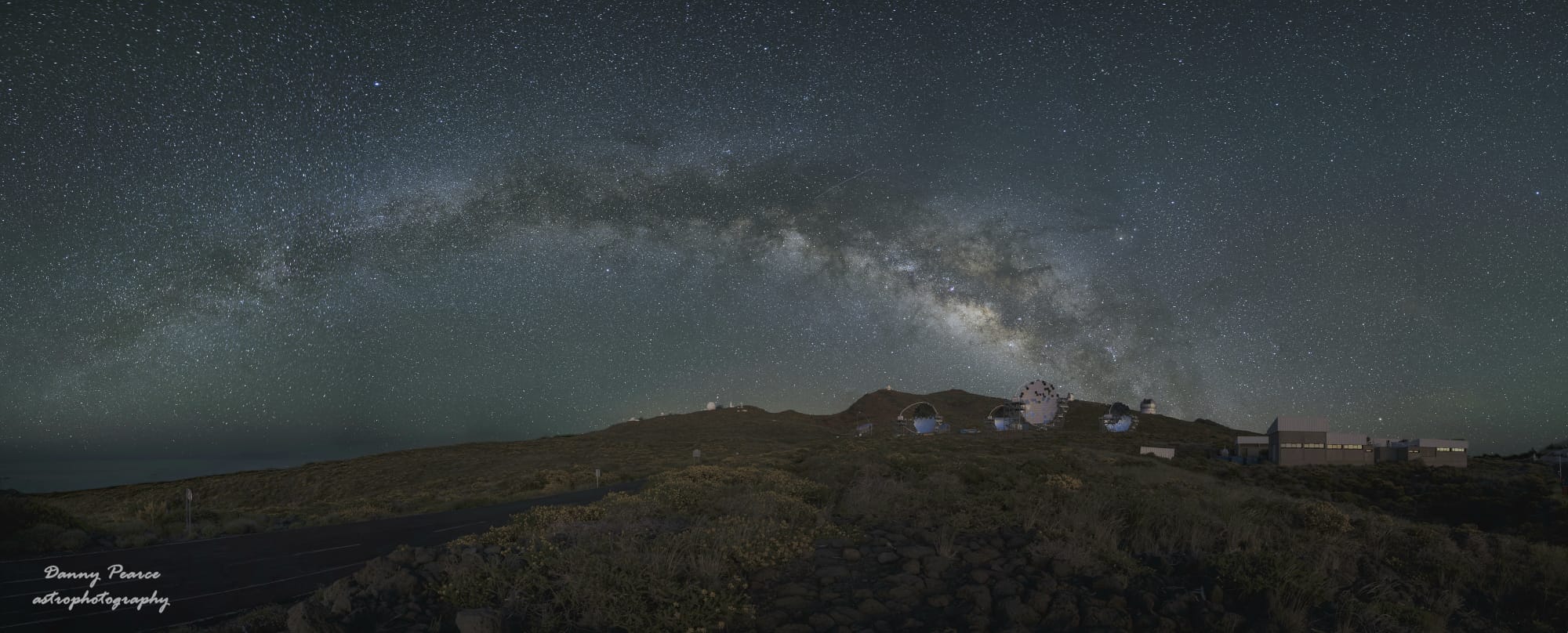
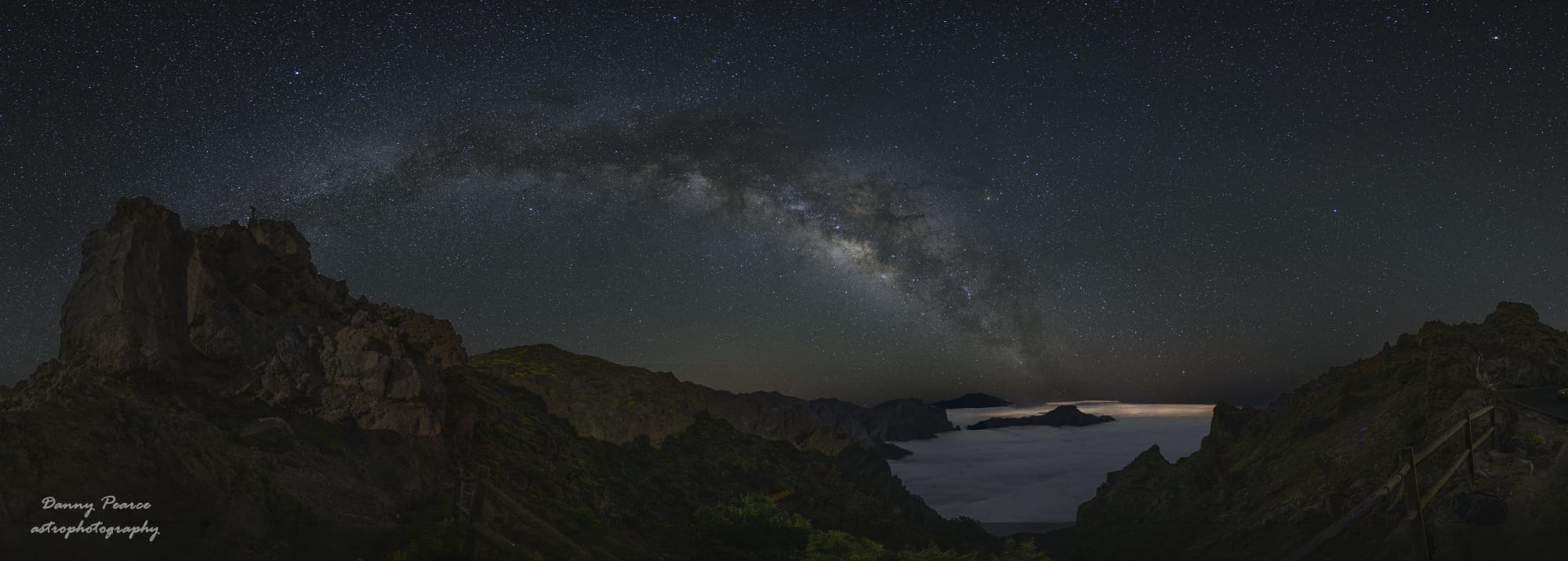
The Milky Way by Danny Pearce
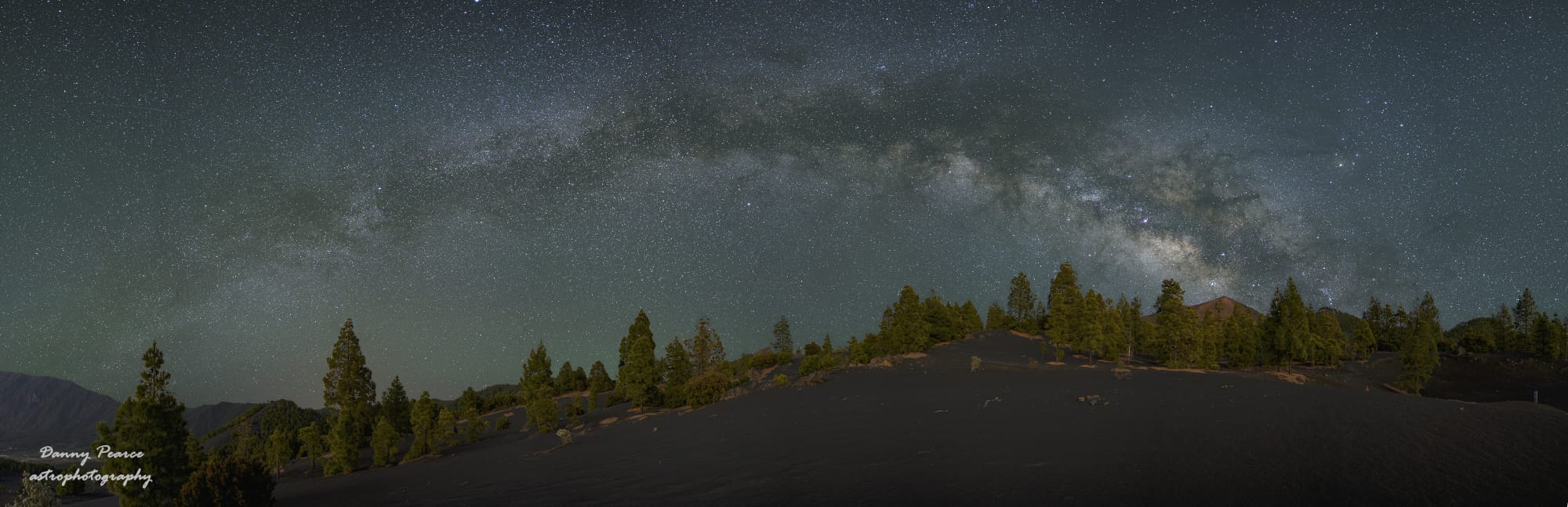
Three fantastic full tracked panorama images of the Milky Way taken by member Danny Pearce whilst on holiday in June on La Palma. All images were taken from locations above the cloud inversion.
All of the images were taken with a Nikon Z6iii on a Skywatcher Star adventurer Mini tracker. Foregrounds were captured at dusk without tracking (9 panels) and sky as 9 x 120sec panorama and stitched in Lightroom.
Latest deep sky images by Tina Bishop
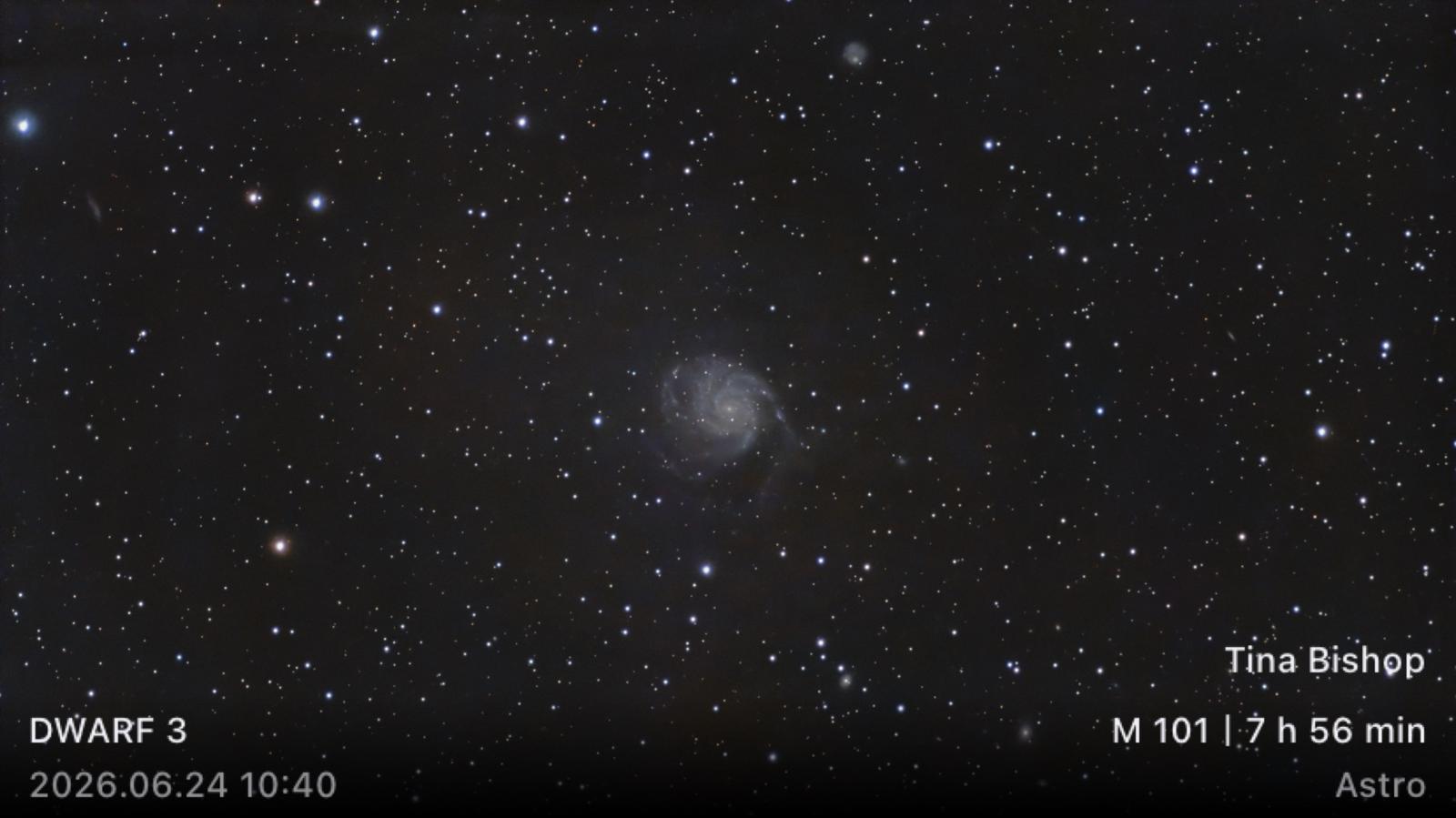
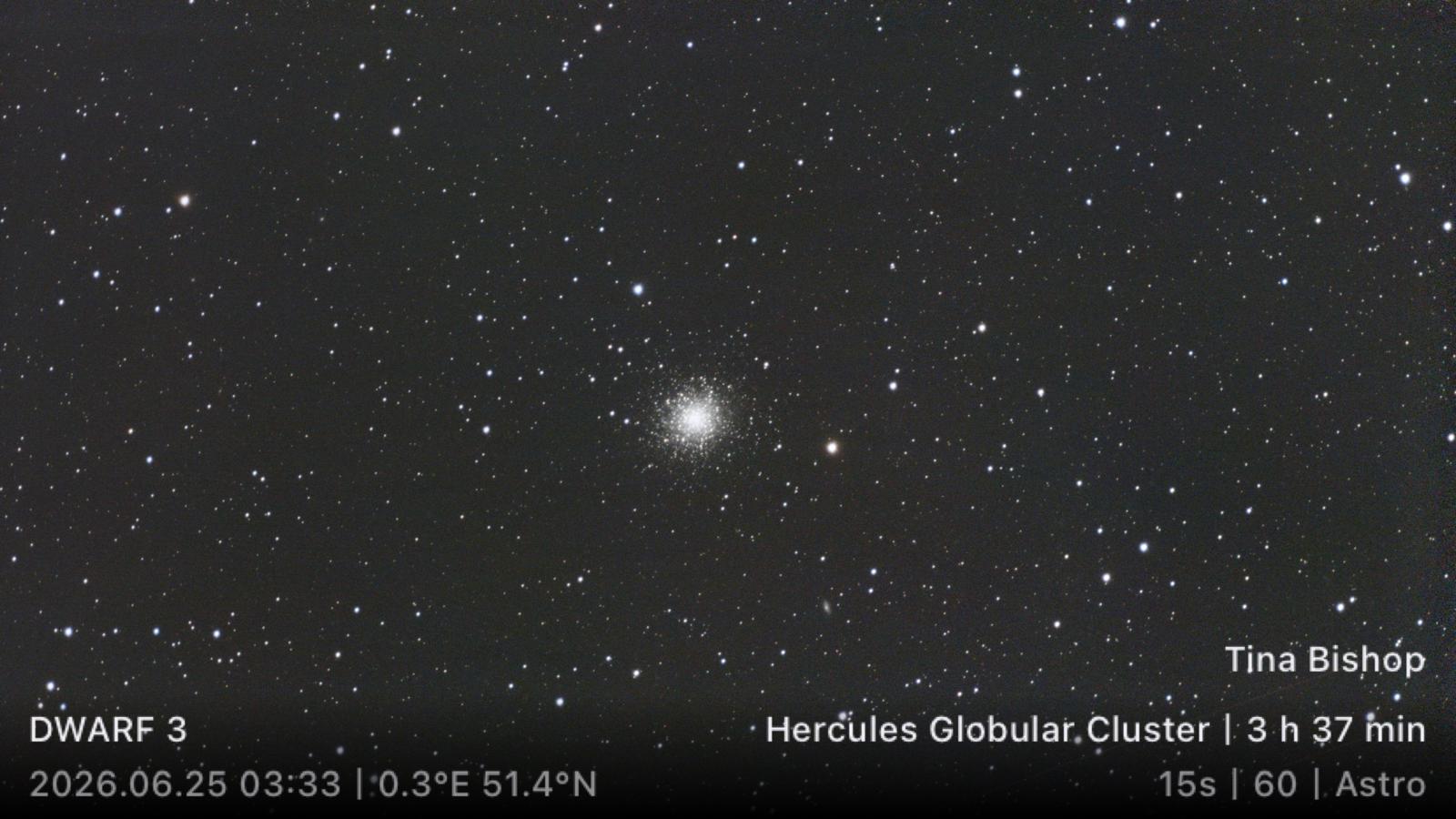
Two super deep sky images by member Tina Bishop. Both images taken using a Dwarf3 smart scope.
M101 (The Pinwheel Galaxy) – 3 sessions totalling 7 hours 56 mins – mega stacked in Dwarfs Stella Studio.
Hercules Globular Cluster (M13). – 1 session of 3 hours 37mins.
Latest images from Danny Pearce
The Owl Nebula (also known as Messier 97, M97 or NGC 3587) is a planetary nebula approximately 2,030 light-years away in the constellation Ursa Major. Estimated to be about 8,000 years old, it is approximately circular in cross-section with a faint internal structure. Ref:https://en.wikipedia.org/wiki/Owl_Nebula
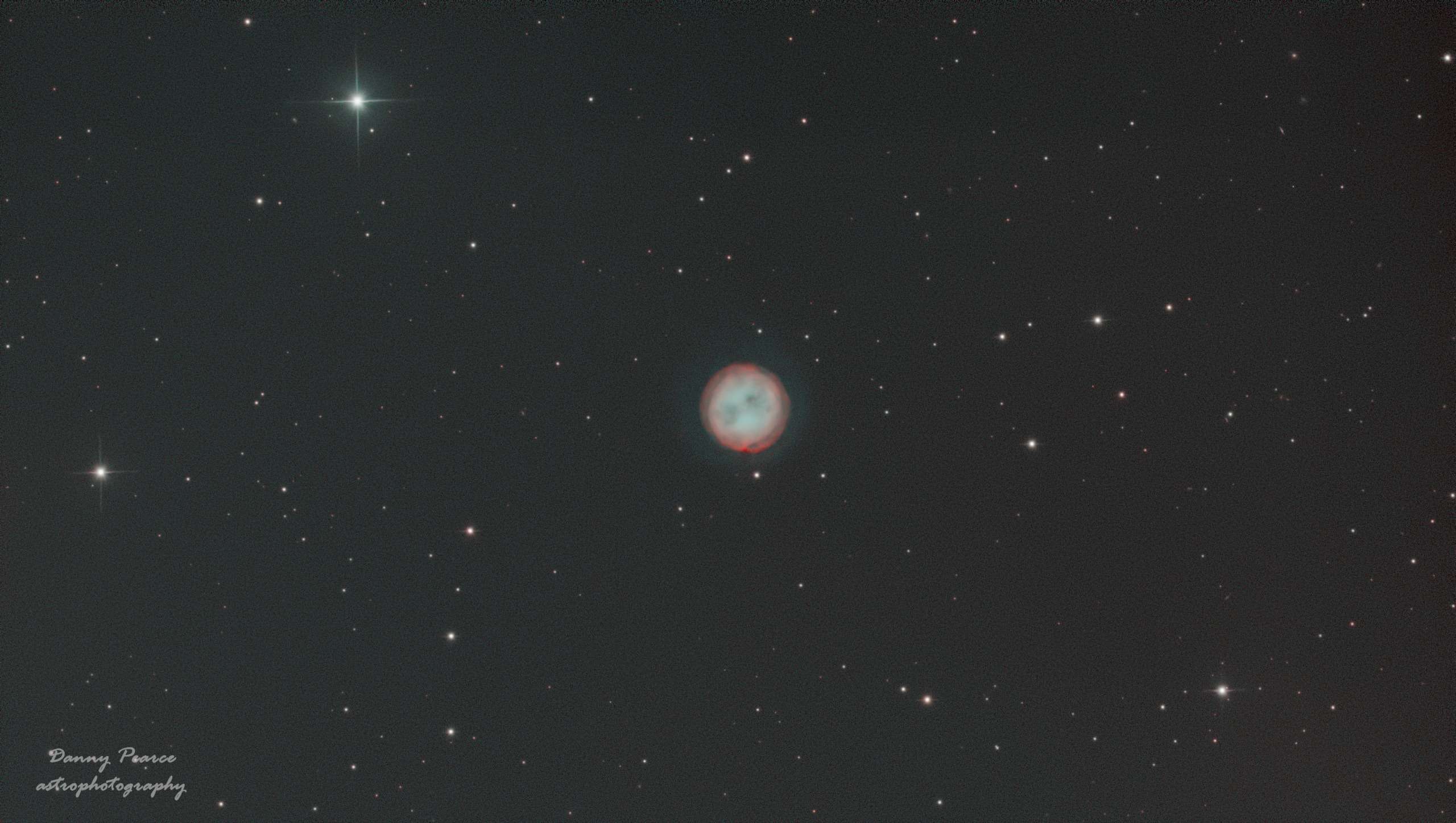
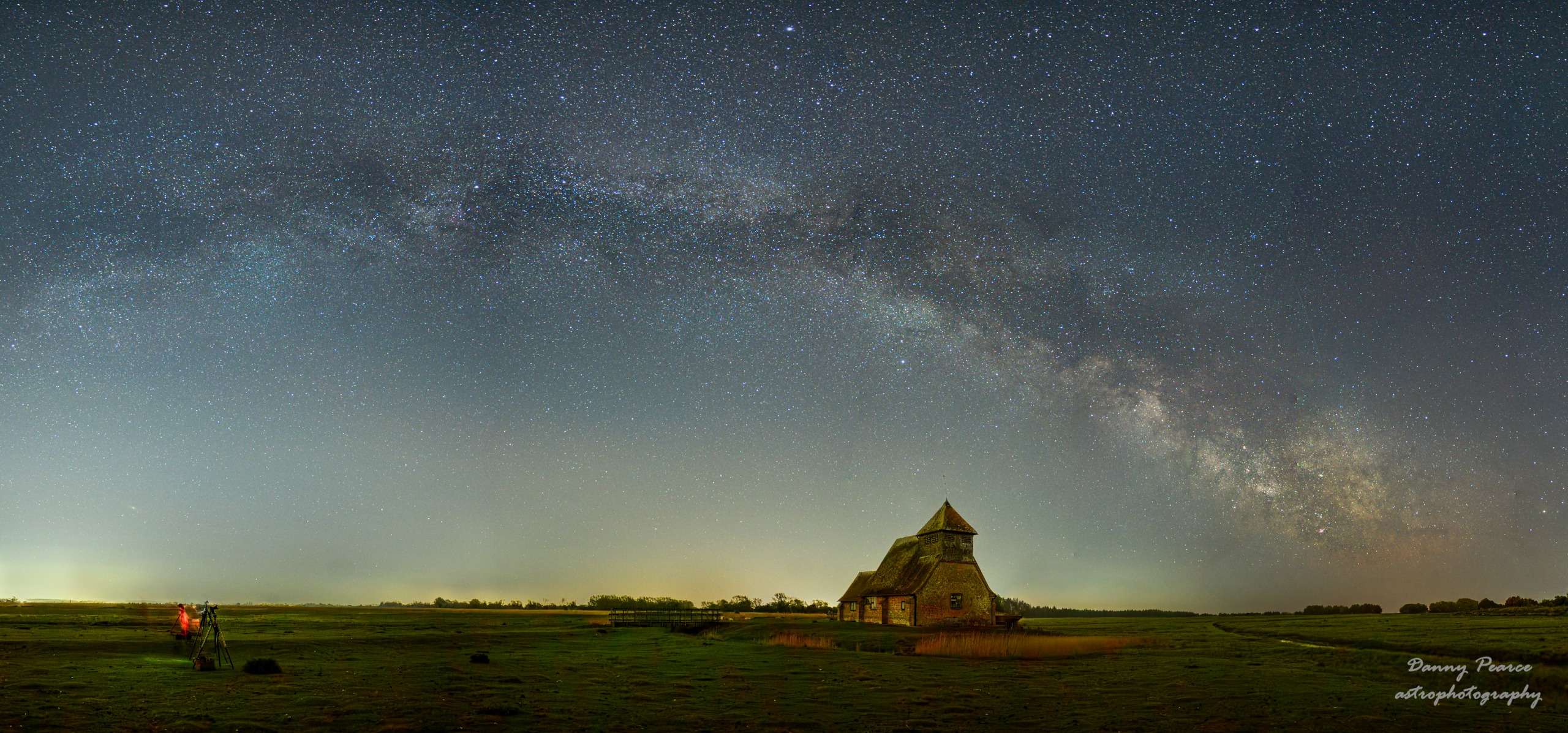
The Milky Way – 22nd April 2026
Taken at St Thomas Becket Church, Romney Marsh last night around 3am. It’s a tracked panorama with 9 panels each of 2 mins and 9 separate (non-tracked) panels for the foreground. Mashed together in Photoshop and Lightroom.
Camera is a Nikon Z6iii full frame with a 17-28mm Nikon f2.8 lens taken at 17mm.
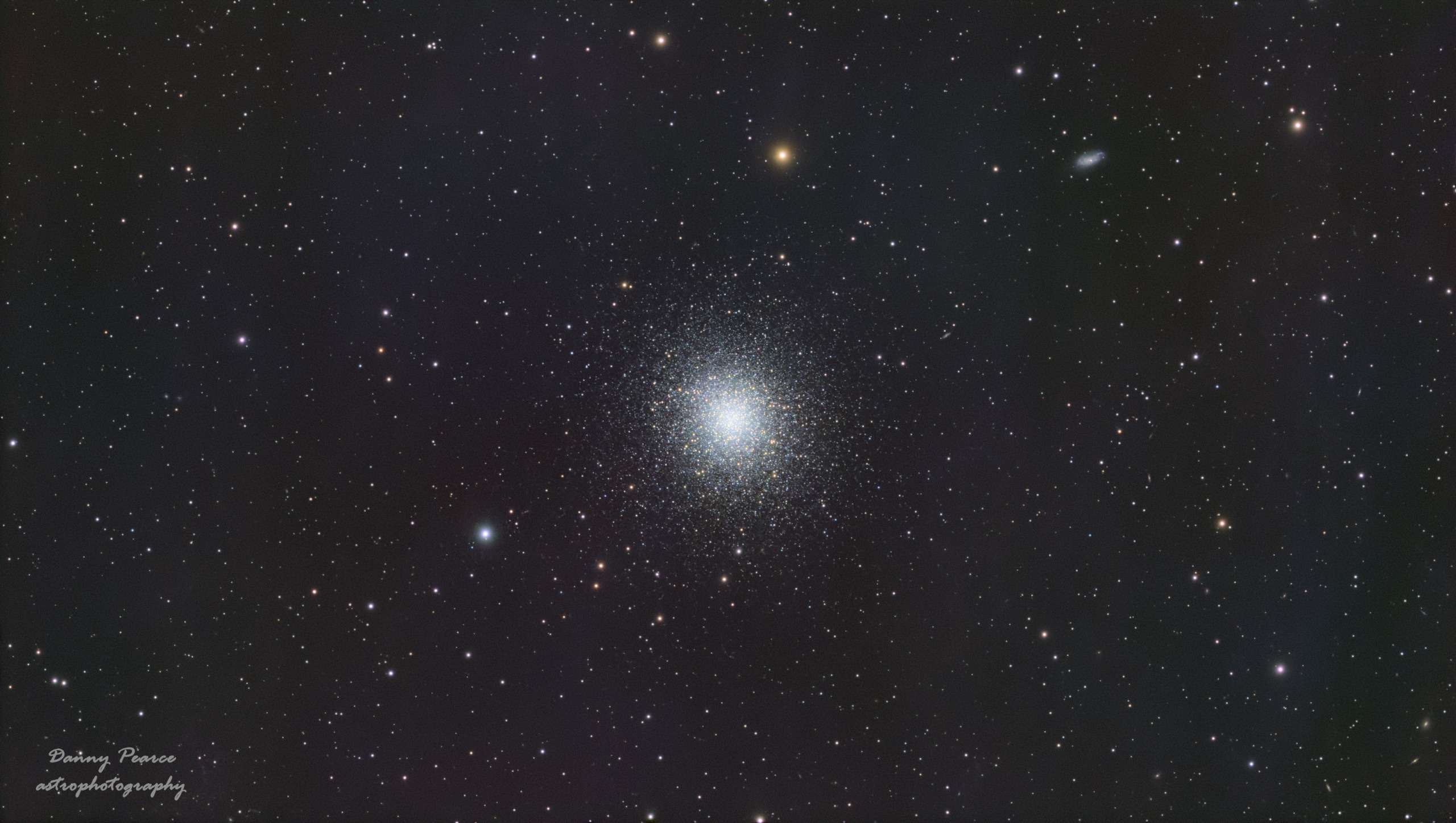
Messier 13, or M13 (also designated NGC 6205 and sometimes called the Great Globular Cluster in Hercules, the Hercules Globular Cluster, or the Great Hercules Cluster), is a globular cluster of several hundred thousand stars in the constellation of Hercules.
5 hours of data using a FRA400 and PlayerOne585MC.
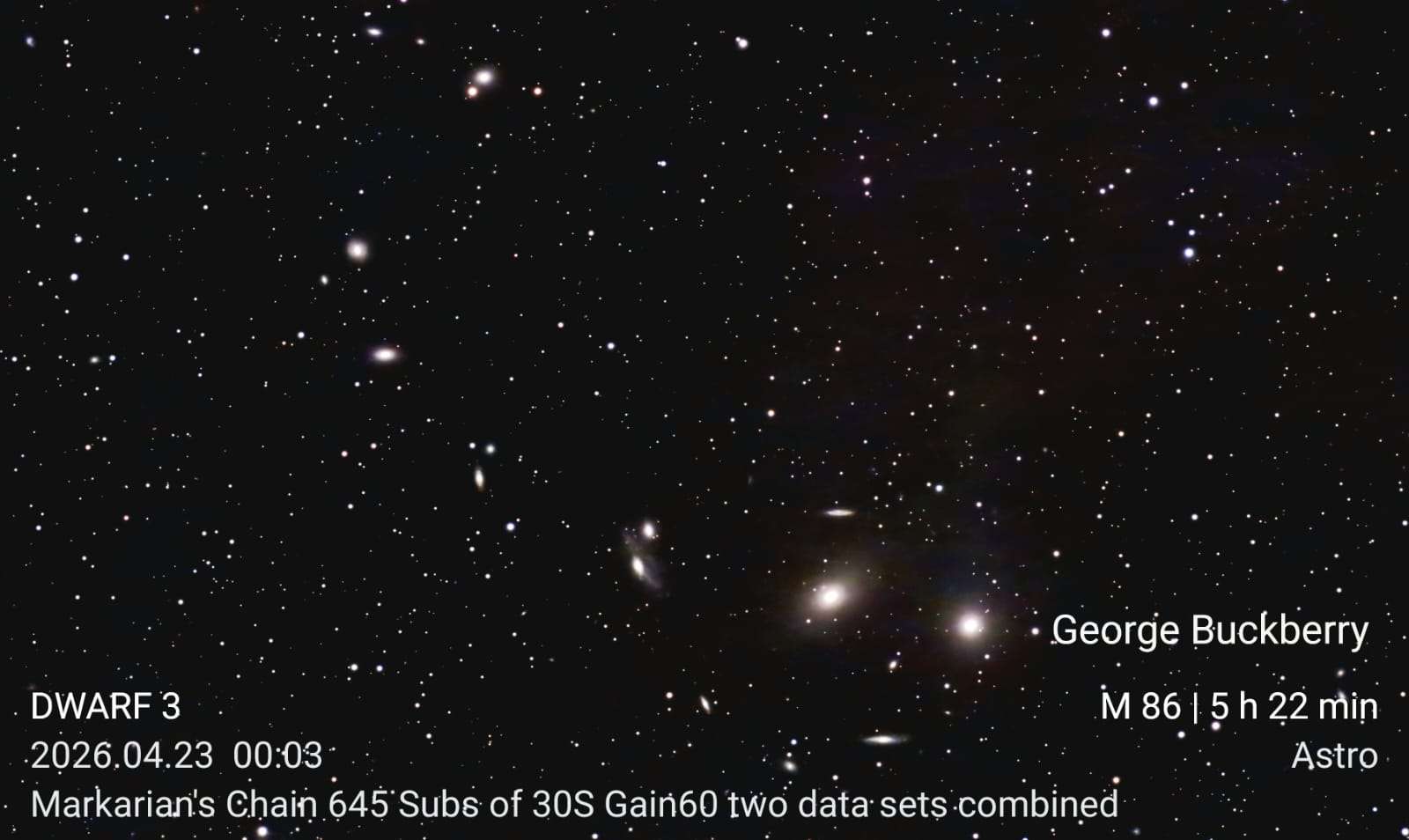
Markarian’s Chain – 23rd April 2026
Settling on the Astro filter; George Buckberry captured more data of the Markarian’s chain on the 23rd April 2026 using his Dwarf3 smartscope. He then stacked the new data with data already acquired on the 18th April 2026 and this is the resulting fabulous image.

Left is a labelled Markarian’s chain by Joe Renzetti from Sky & Telescope to help you identify the galaxies.
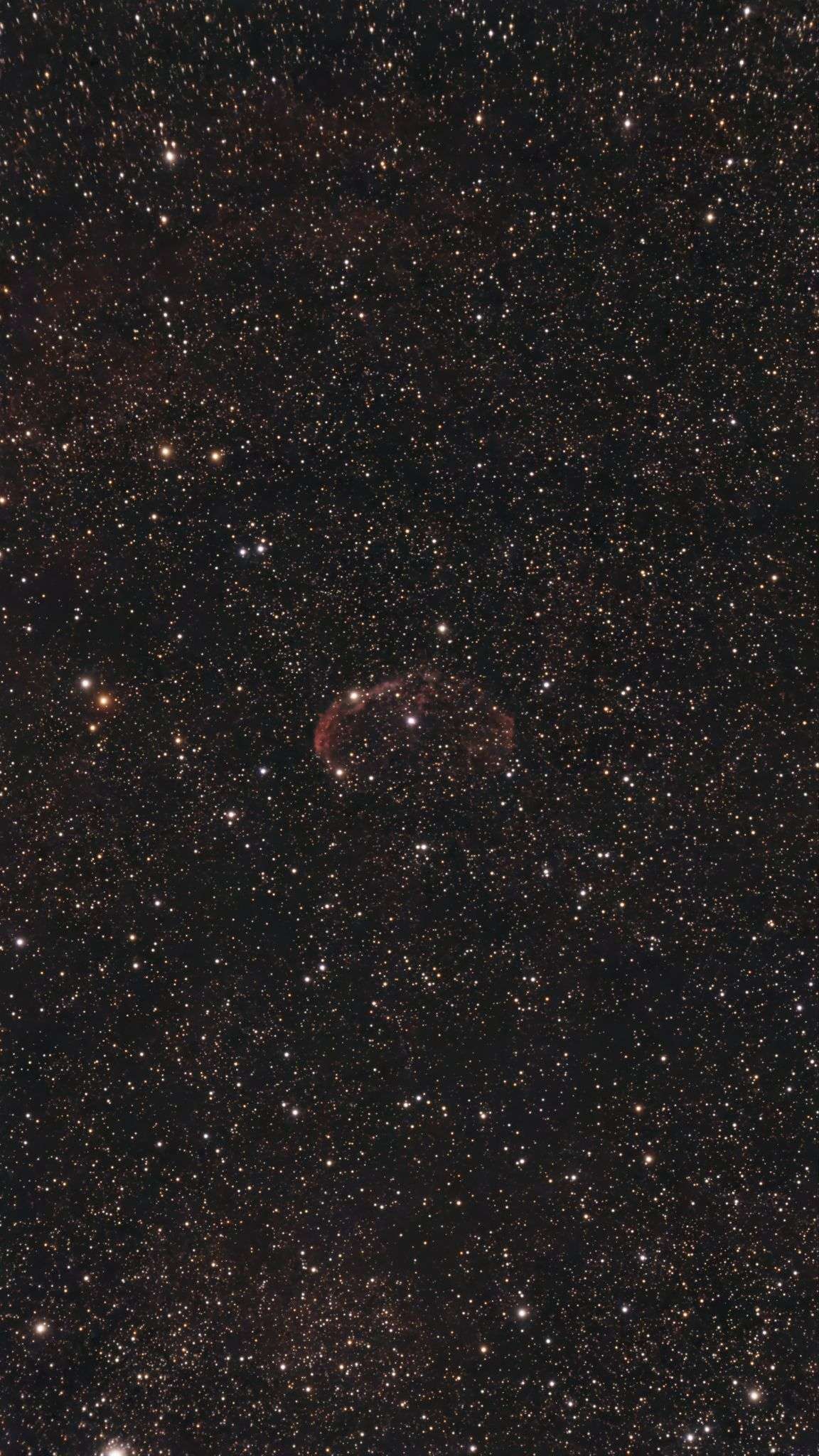
The Crescent Nebula
Only after 25 minutes of capturing data at 10 second exposures – the Crescent Nebula is appearing in Dan Stevens image that he took on the 19th April 2026 using a Seestar S30.
The Crescent Nebula (also known as NGC 6888, Caldwell 27, Sharpless 105) is an emission nebula in the constellation Cygnus about 5000 light-years away.
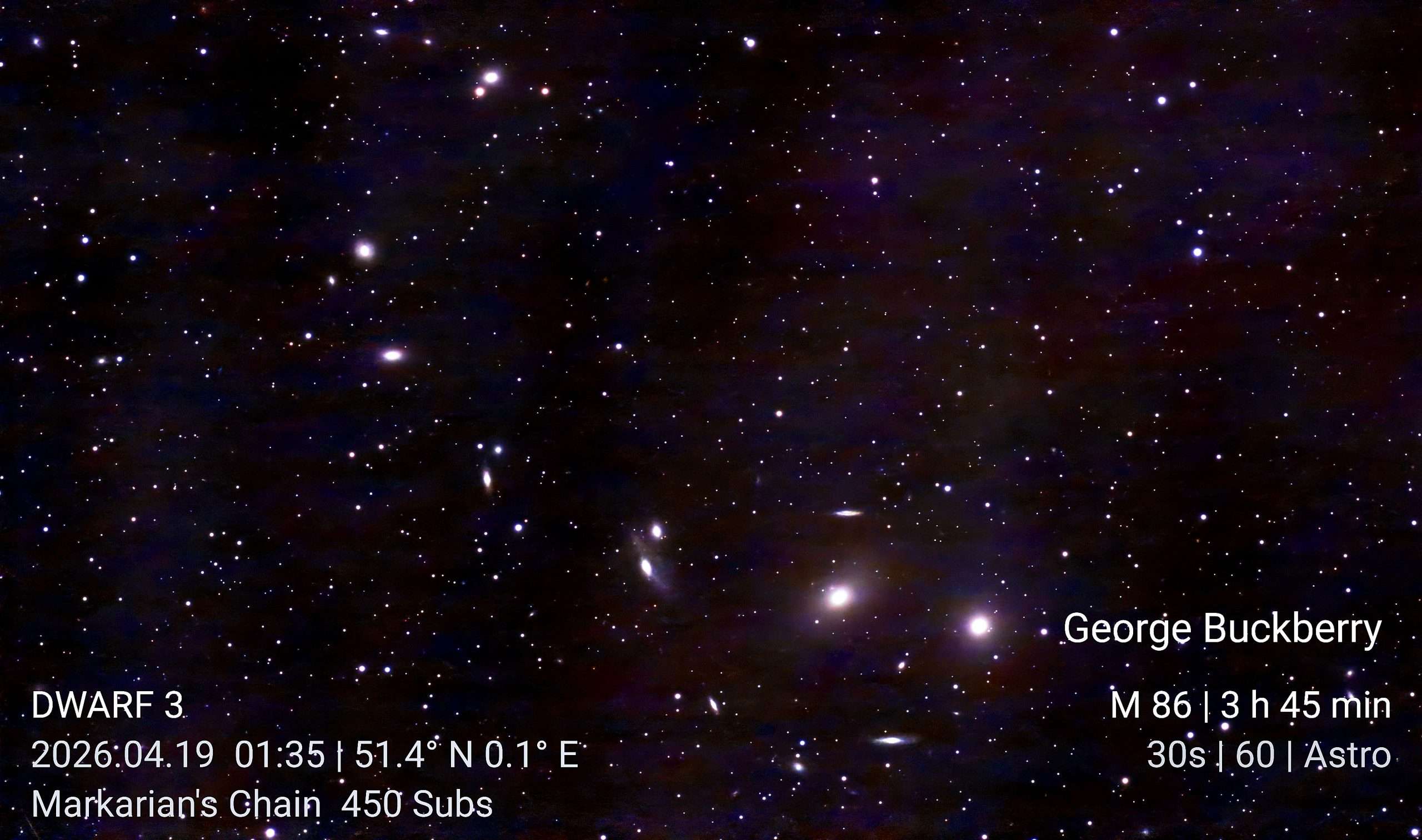
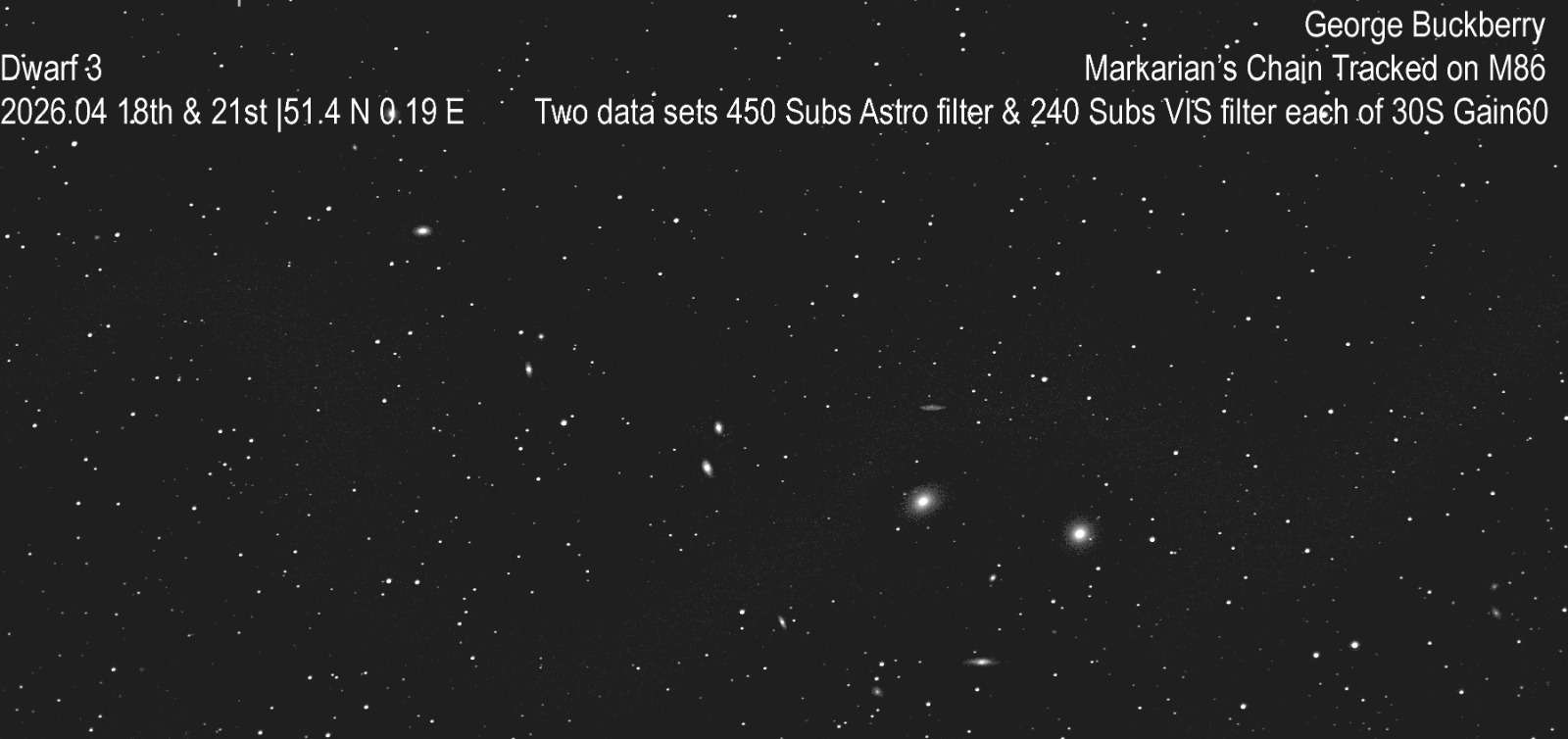
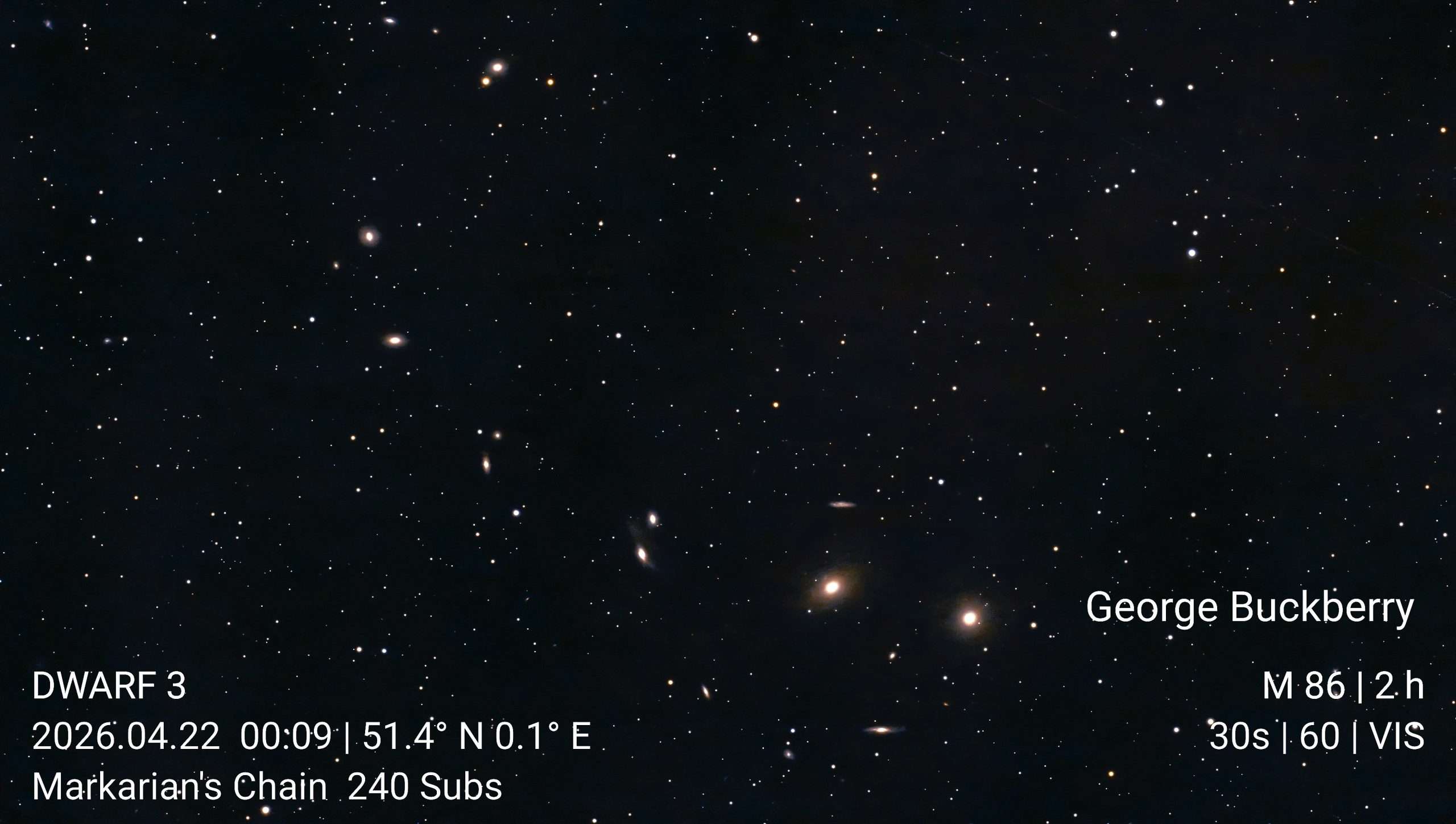
Markarian’s Chain
Experimenting: Three images of Markarian’s Chain taken by George Buckberry using different settings on his Dwarf3 smartscope. Which one do you like the best?
The Leo Triplet
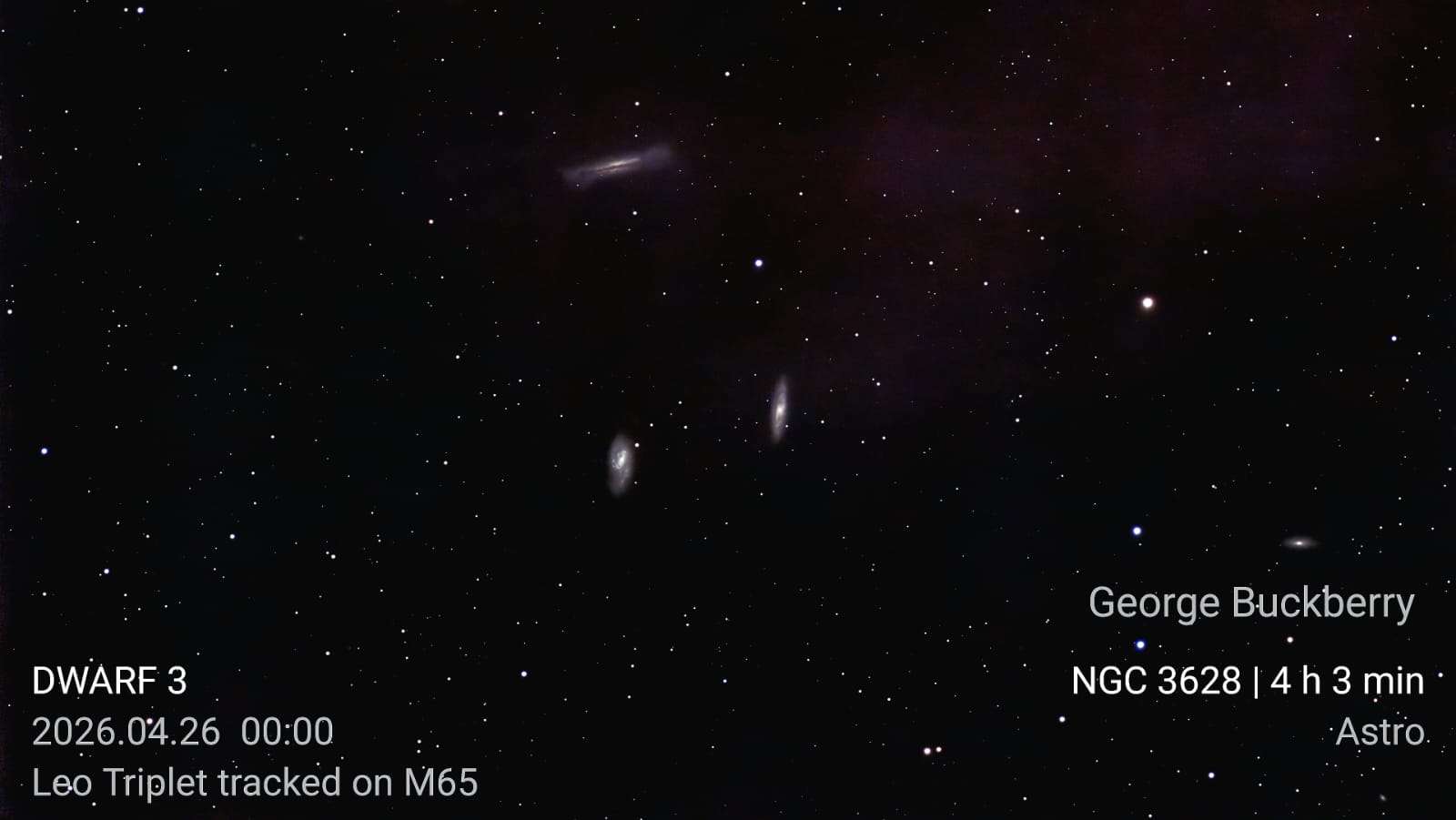
The Leo Triplet by George Buckberry taken on the 26th April 2026 using a Dwarf3 smartscope.
The Leo Triplet (also known as the M66 Group) is a small group of galaxies about 35 million light-years away in the constellation Leo. This galaxy group consists of the spiral galaxies M65 (bottom right), M66 (bottom left) and NGC 3628 (top).


Other Images
Sun | Comets | Mercury | Venus | Atmospheric Optics | Meteors | Auroa and NLC | Moon | Minor Planets | Mars | Jupiter | Saturn | Uranus | Neptune | Messier | Caldwell | All Deep Sky | Conjunctions | Transits | Solar Eclipse | Lunar Eclipse | Wide Field |ISS & Space Junk | Exo-Planets
All images are copyright. Permission must be sought to from the image owner to the use of any of these images.