
The Milky Way by Danny Pearce
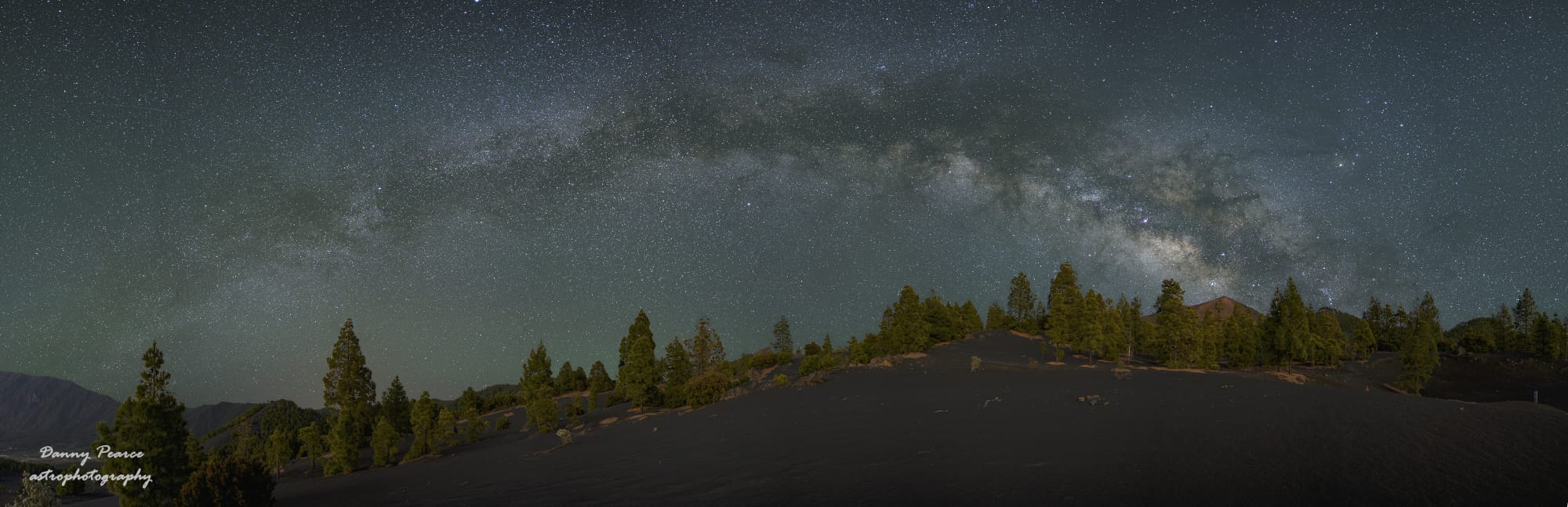
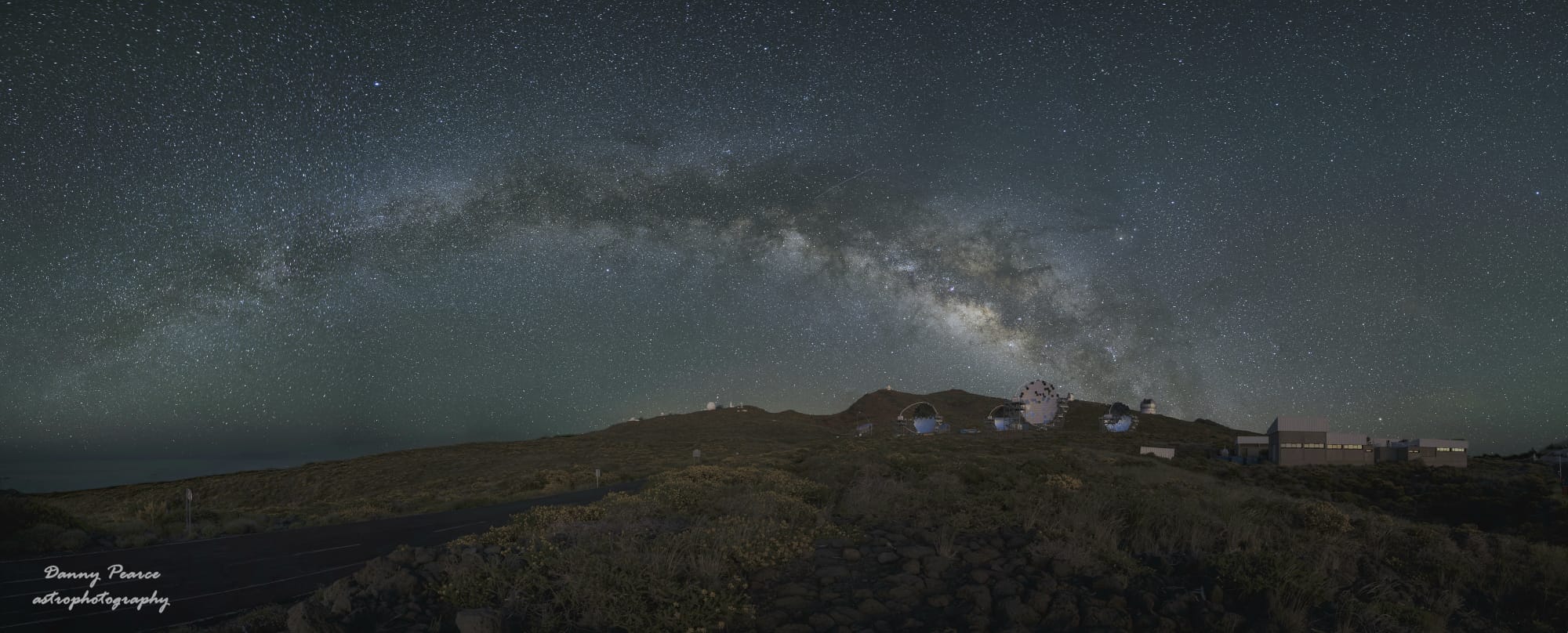
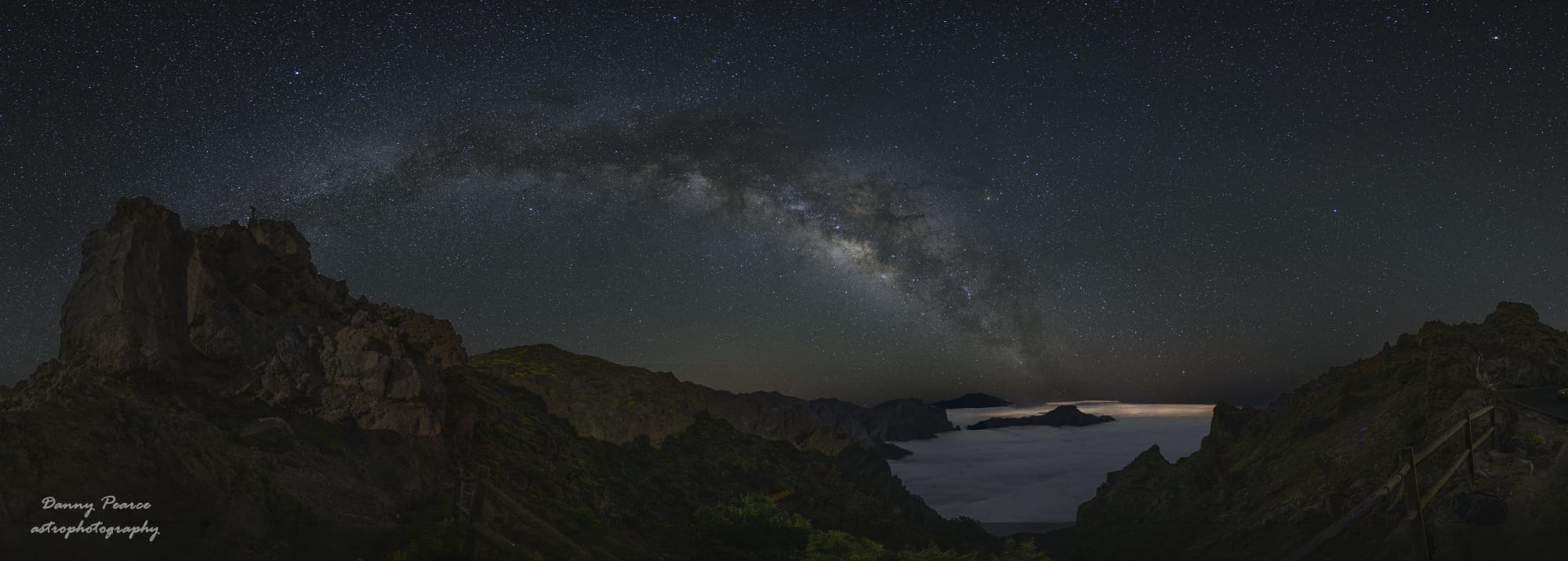
Three fantastic full tracked panorama images of the Milky Way taken by member Danny Pearce whilst on holiday in June on La Palma. All images were taken from locations above the cloud inversion.
All of the images were taken with a Nikon Z6iii on a Skywatcher Star adventurer Mini tracker. Foregrounds were captured at dusk without tracking (9 panels) and sky as 9 x 120sec panorama and stitched in Lightroom.
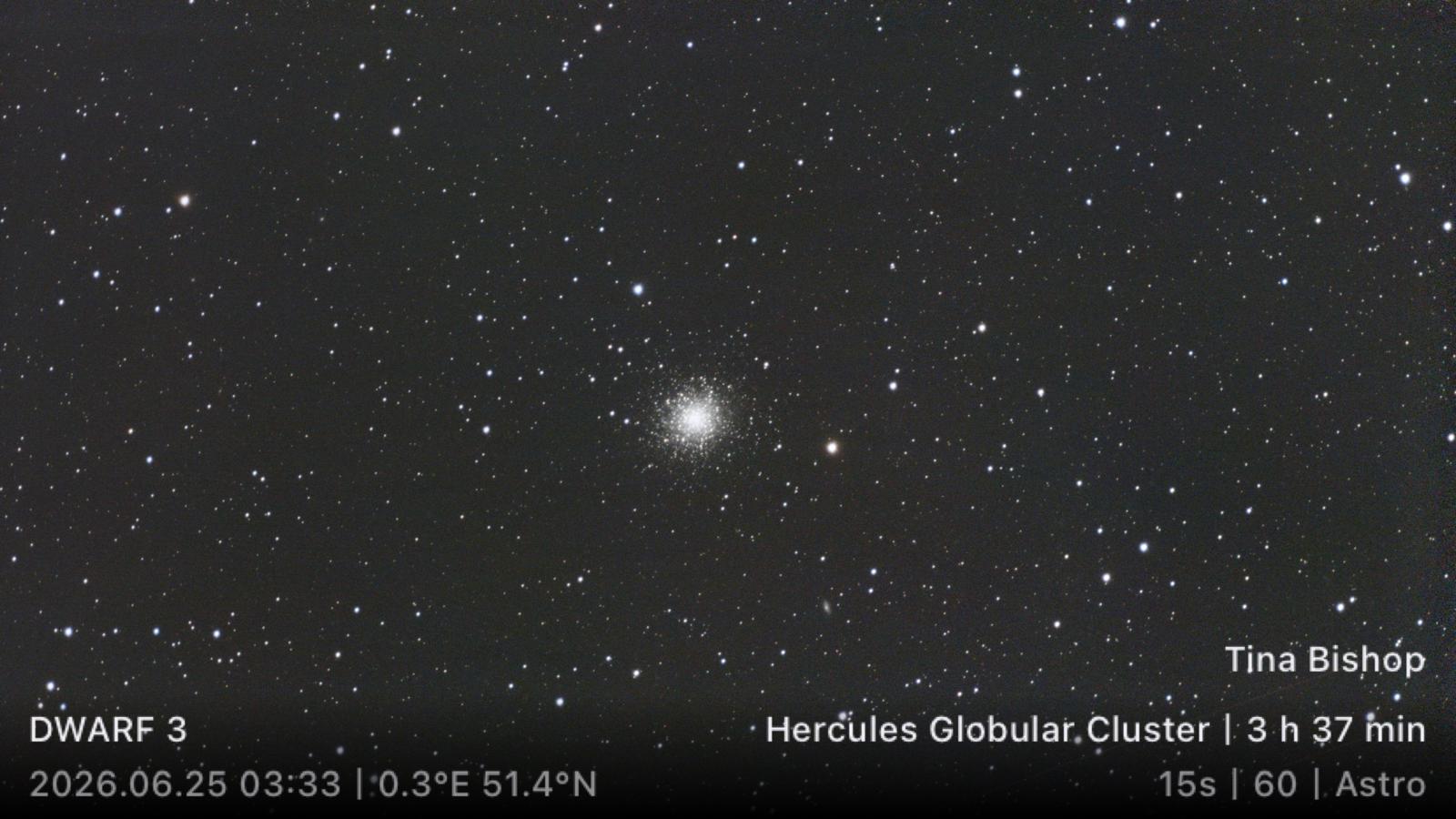
Latest deep sky images by Tina Bishop
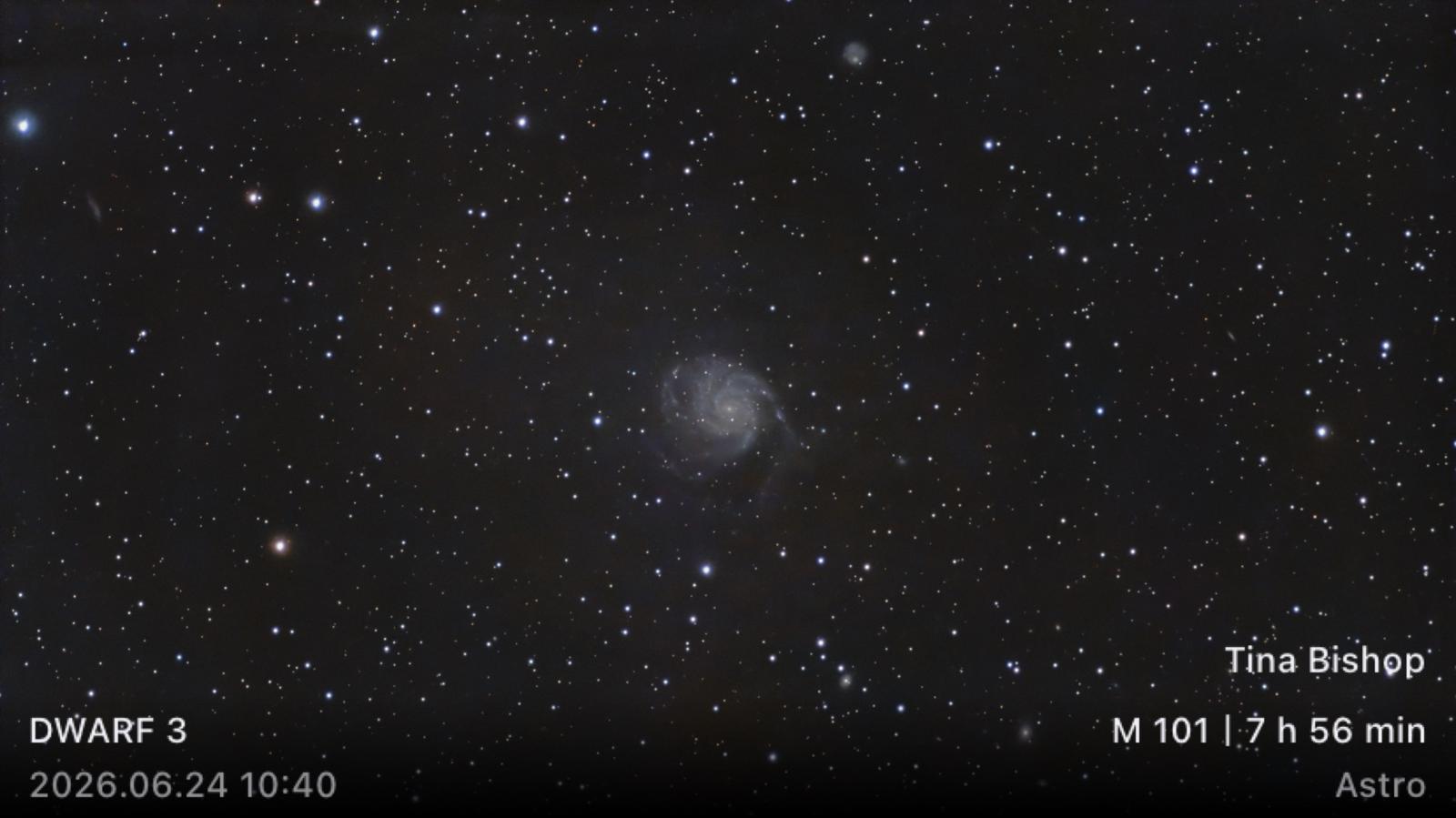
Two super deep sky images by member Tina Bishop. Both images taken using a Dwarf3 smart scope.
M101 (The Pinwheel Galaxy) – 3 sessions totalling 7 hours 56 mins – mega stacked in Dwarfs Stella Studio.
Hercules Globular Cluster (M13). – 1 session of 3 hours 37mins.
Latest images from Danny Pearce
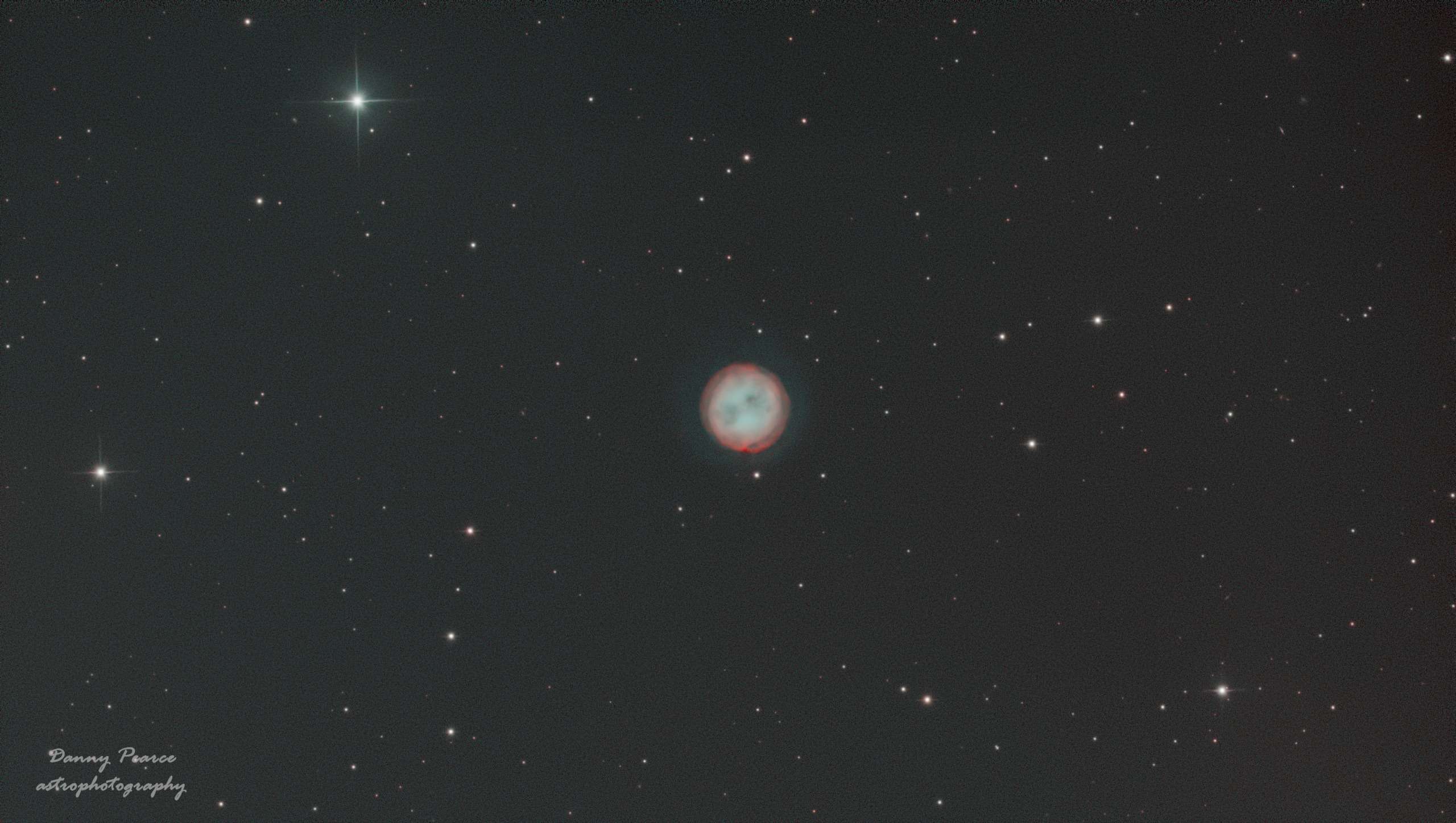
The Owl Nebula (also known as Messier 97, M97 or NGC 3587) is a planetary nebula approximately 2,030 light-years away in the constellation Ursa Major. Estimated to be about 8,000 years old, it is approximately circular in cross-section with a faint internal structure. Ref:https://en.wikipedia.org/wiki/Owl_Nebula
The Milky Way – 22nd April 2026
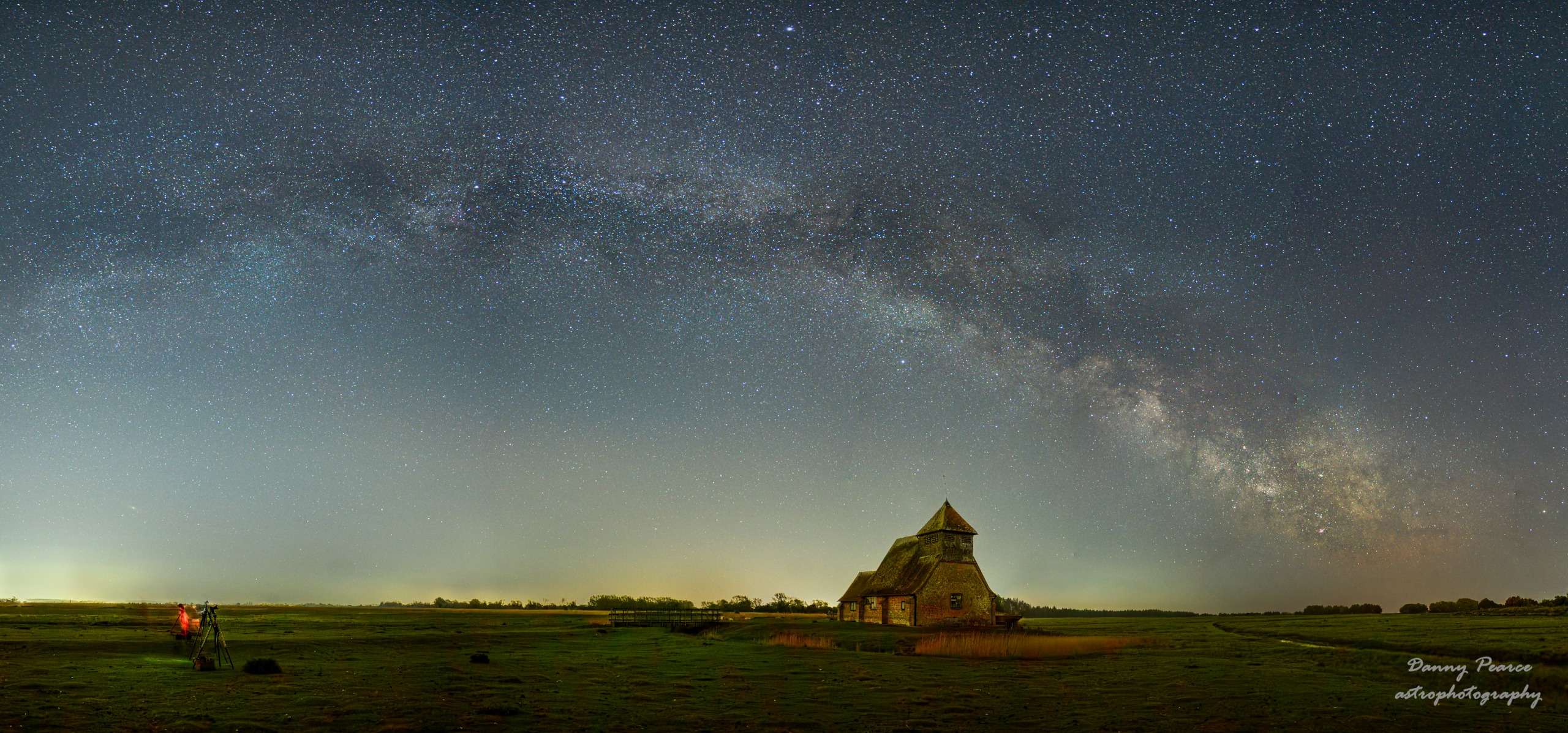
Taken at St Thomas Becket Church, Romney Marsh last night around 3am. It’s a tracked panorama with 9 panels each of 2 mins and 9 separate (non-tracked) panels for the foreground. Mashed together in Photoshop and Lightroom.
Camera is a Nikon Z6iii full frame with a 17-28mm Nikon f2.8 lens taken at 17mm.
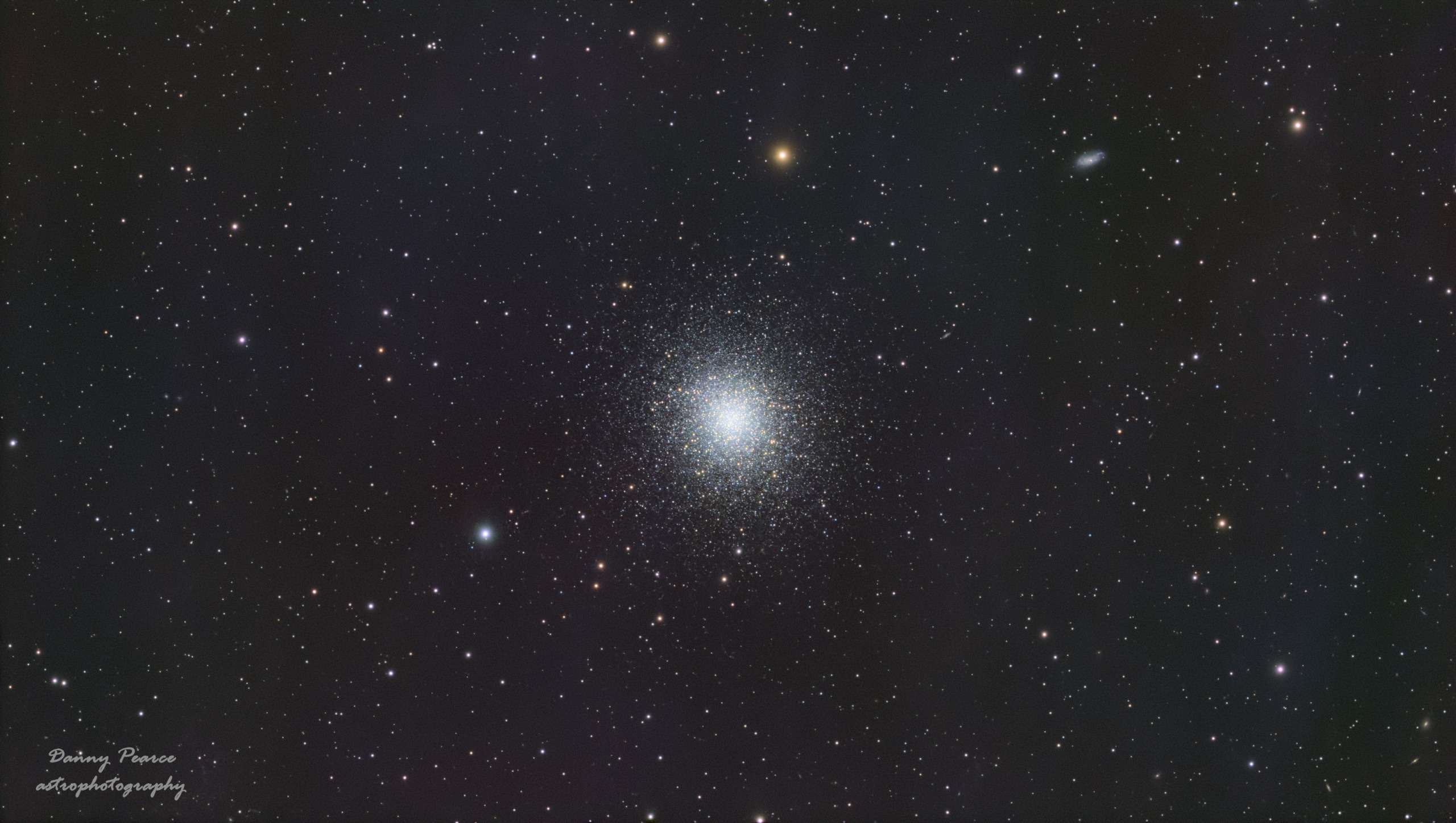
Messier 13, or M13 (also designated NGC 6205 and sometimes called the Great Globular Cluster in Hercules, the Hercules Globular Cluster, or the Great Hercules Cluster), is a globular cluster of several hundred thousand stars in the constellation of Hercules.
5 hours of data using a FRA400 and PlayerOne585MC.
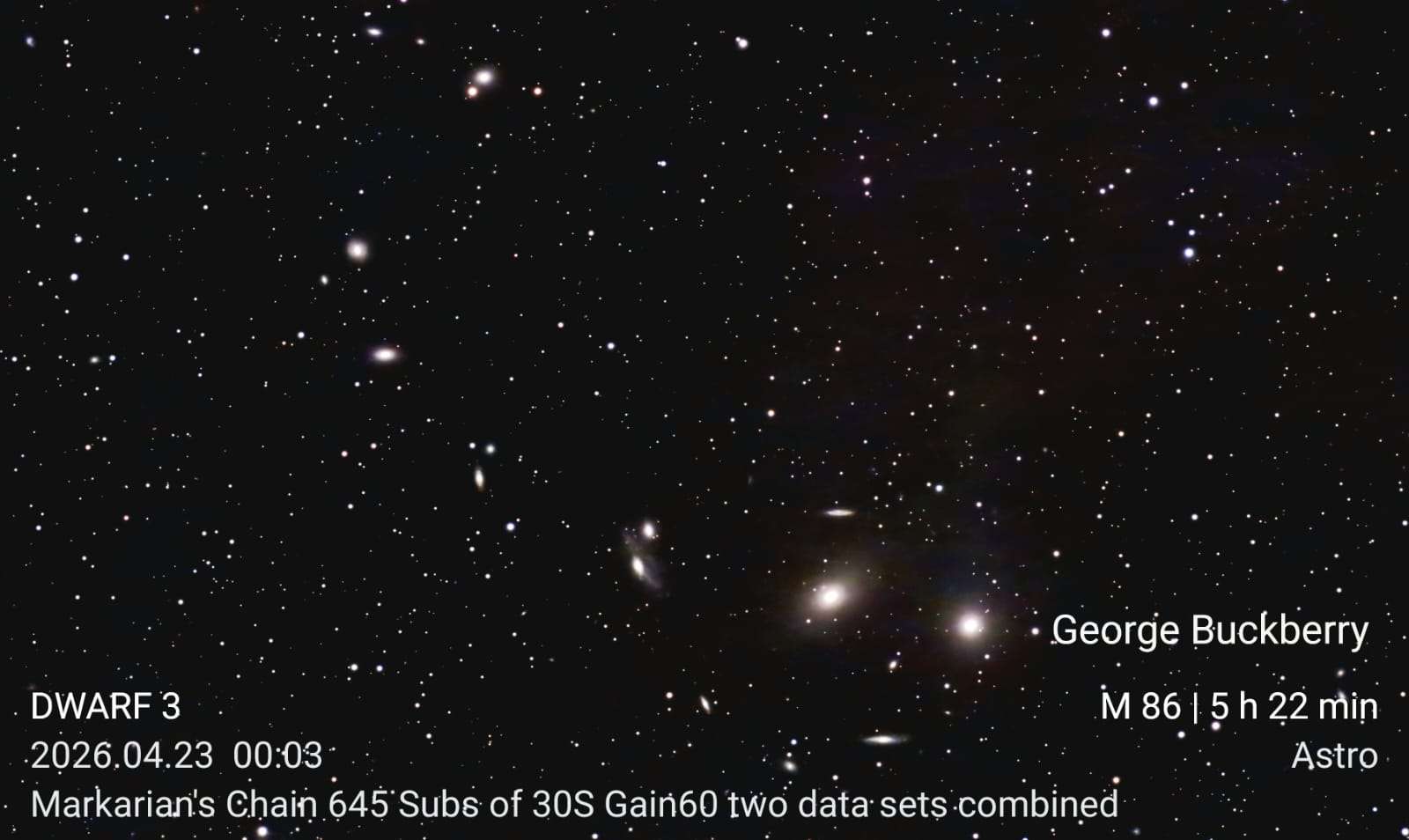
Markarian’s Chain – 23rd April 2026
Settling on the Astro filter; George Buckberry captured more data of the Markarian’s chain on the 23rd April 2026 using his Dwarf3 smartscope. He then stacked the new data with data already acquired on the 18th April 2026 and this is the resulting fabulous image.

Left is a labelled Markarian’s chain by Joe Renzetti from Sky & Telescope to help you identify the galaxies.
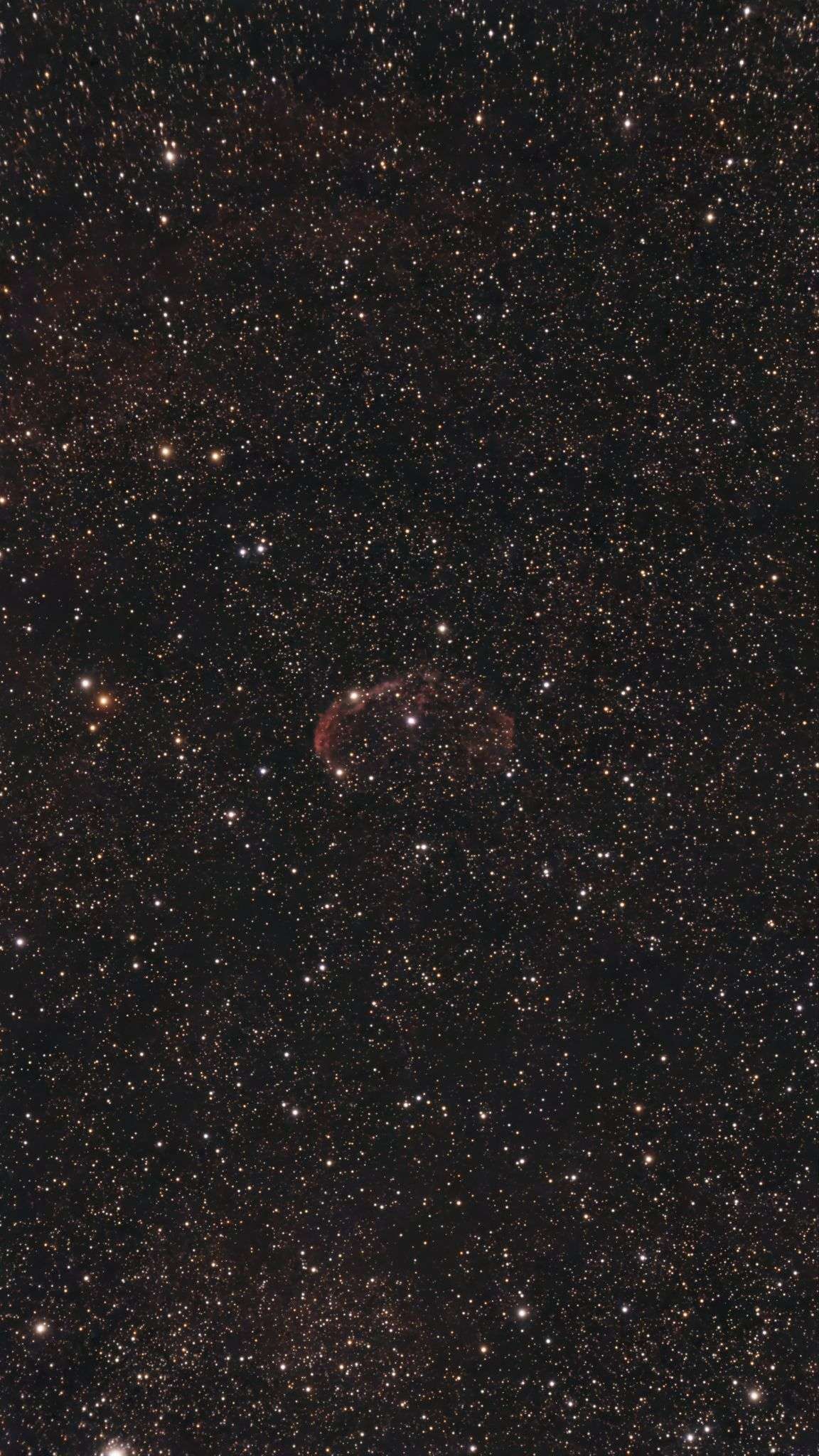
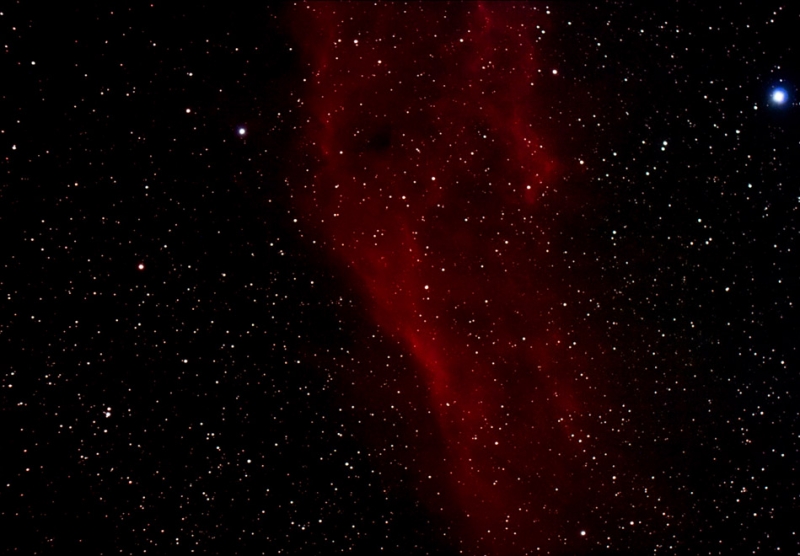
The Crescent Nebula
Only after 25 minutes of capturing data at 10 second exposures – the Crescent Nebula is appearing in Dan Stevens image that he took on the 19th April 2026 using a Seestar S30.
The Crescent Nebula (also known as NGC 6888, Caldwell 27, Sharpless 105) is an emission nebula in the constellation Cygnus about 5000 light-years away.
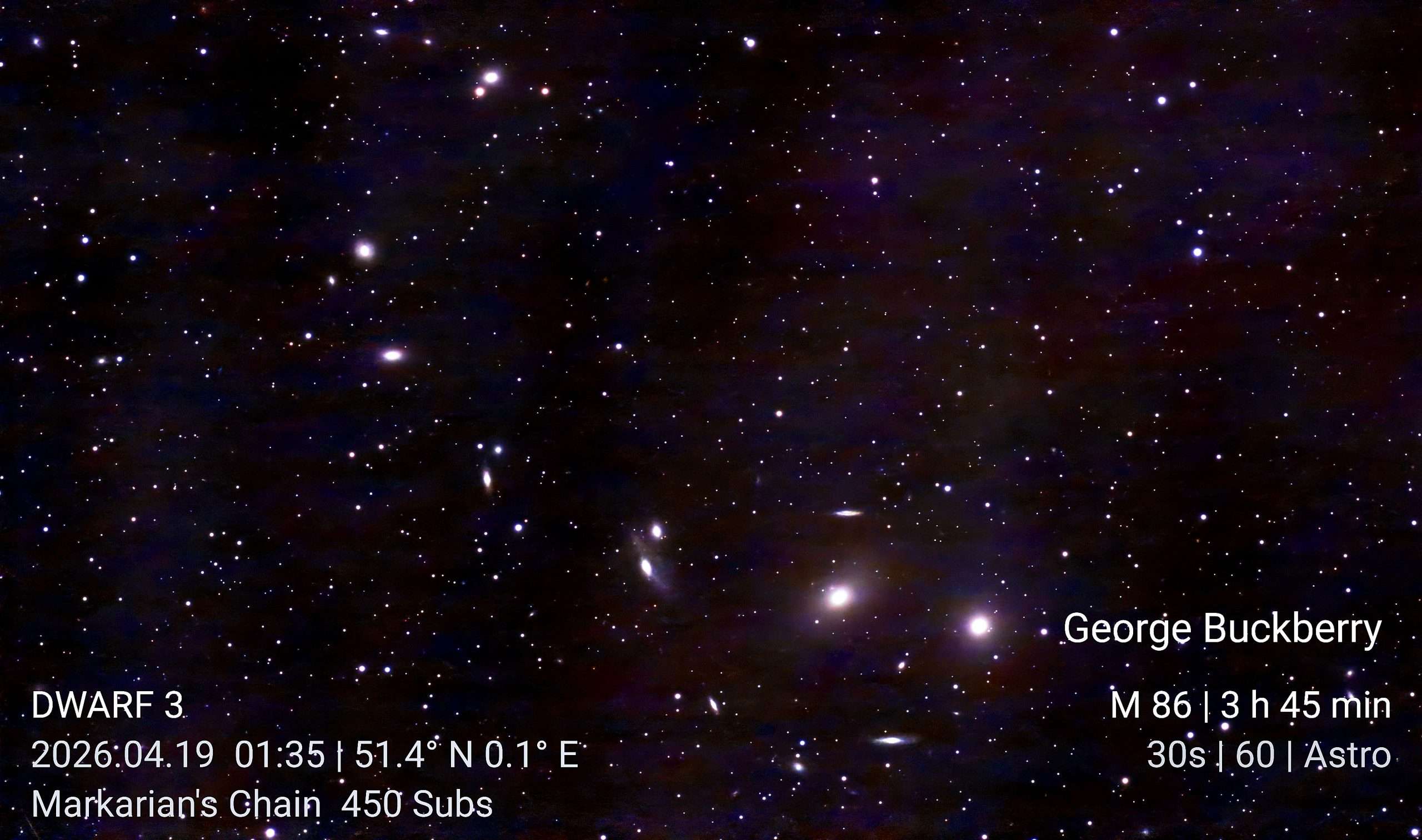
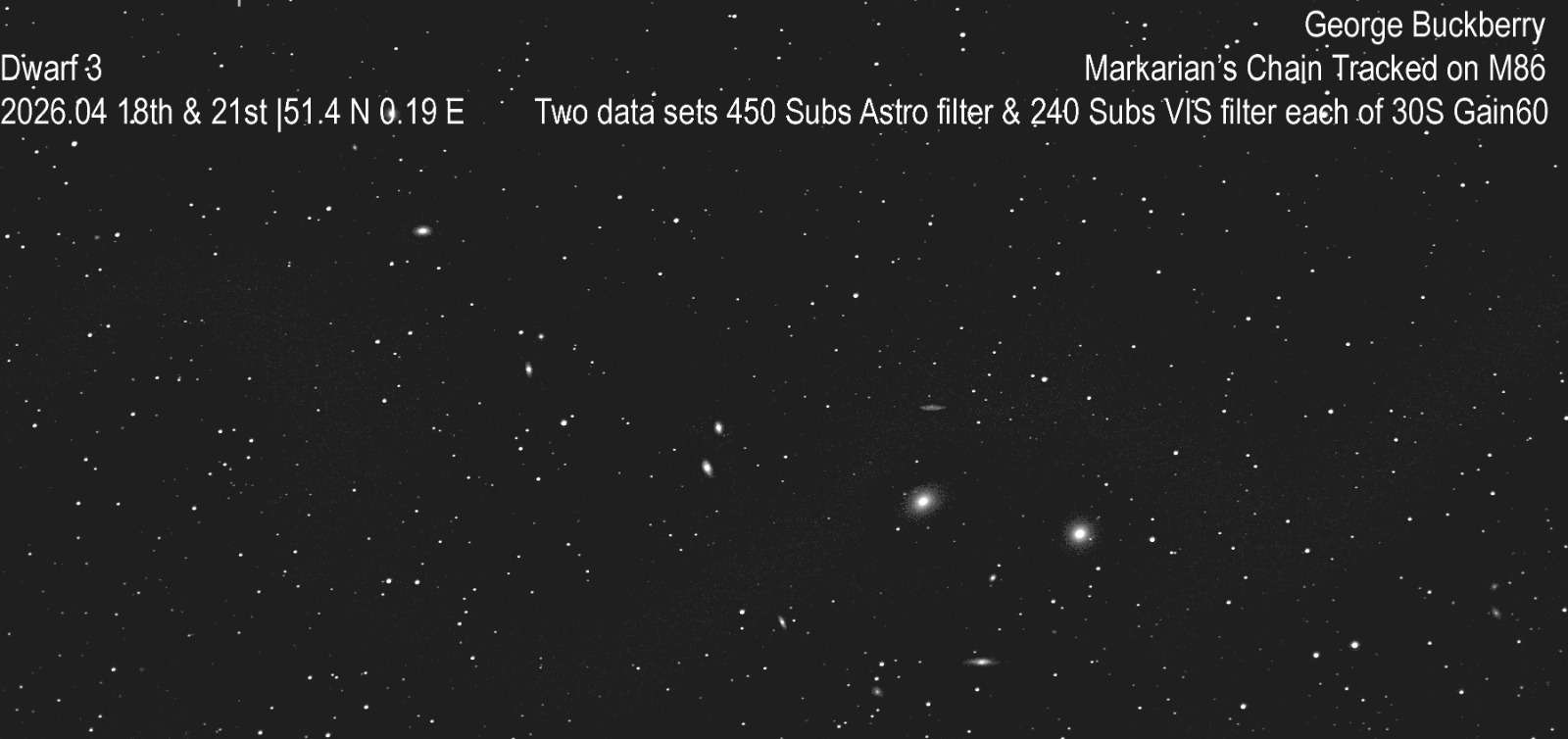
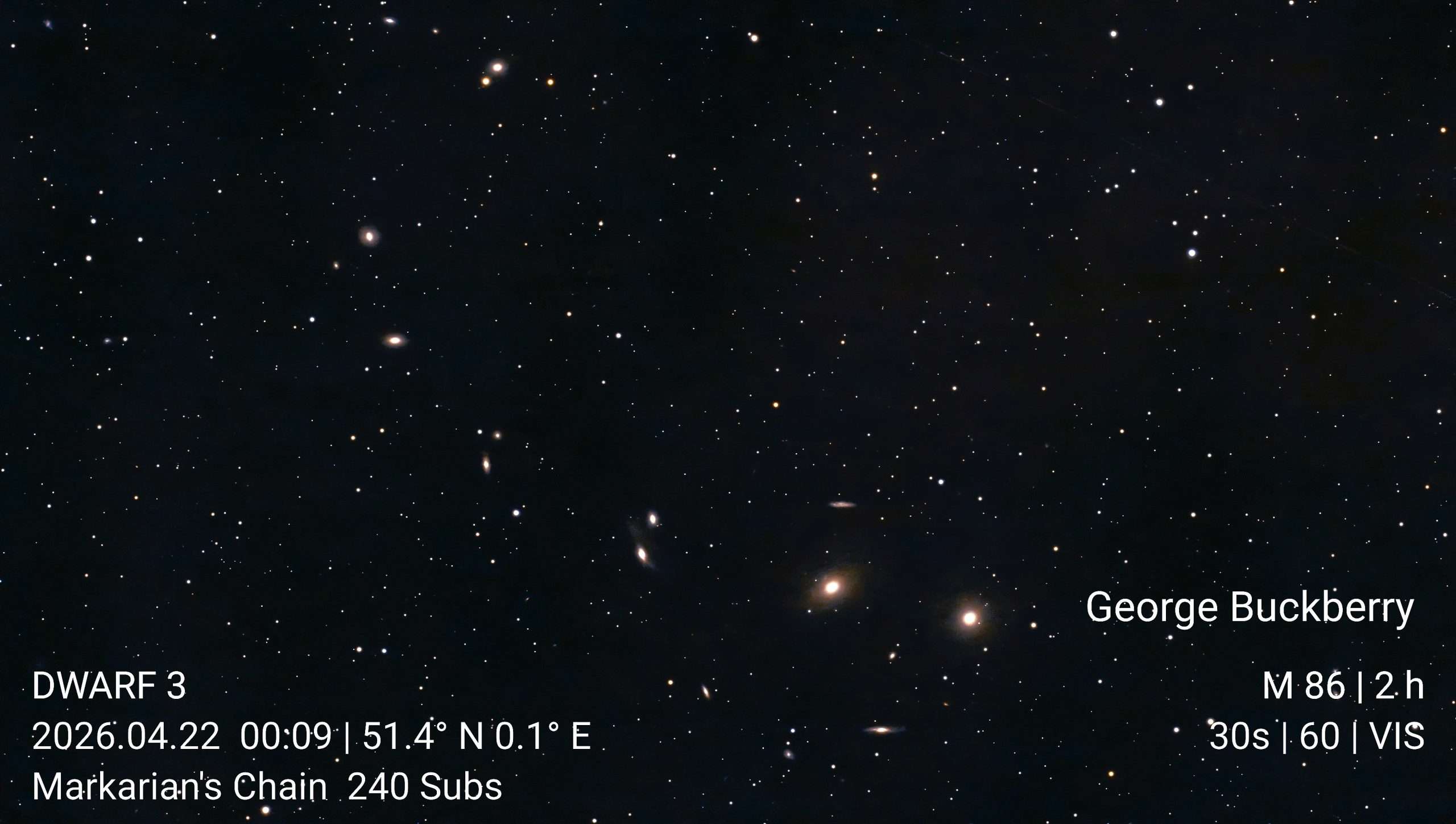
Markarian’s Chain
Experimenting: Three images of Markarian’s Chain taken by George Buckberry using different settings on his Dwarf3 smartscope. Which one do you like the best?
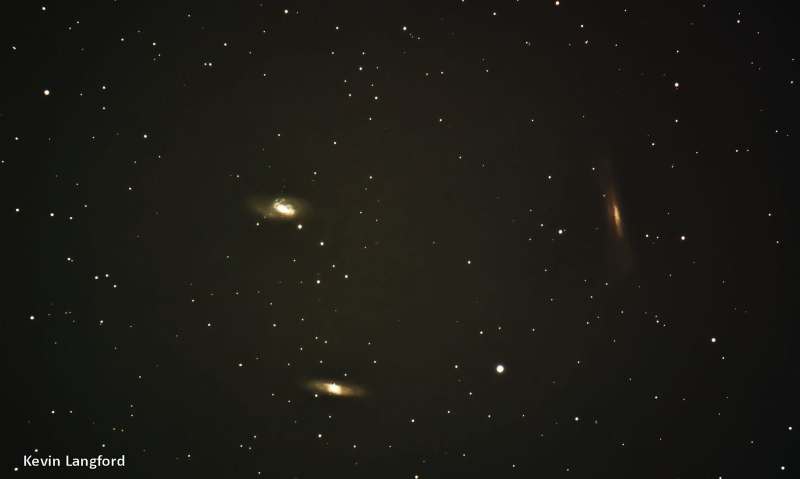
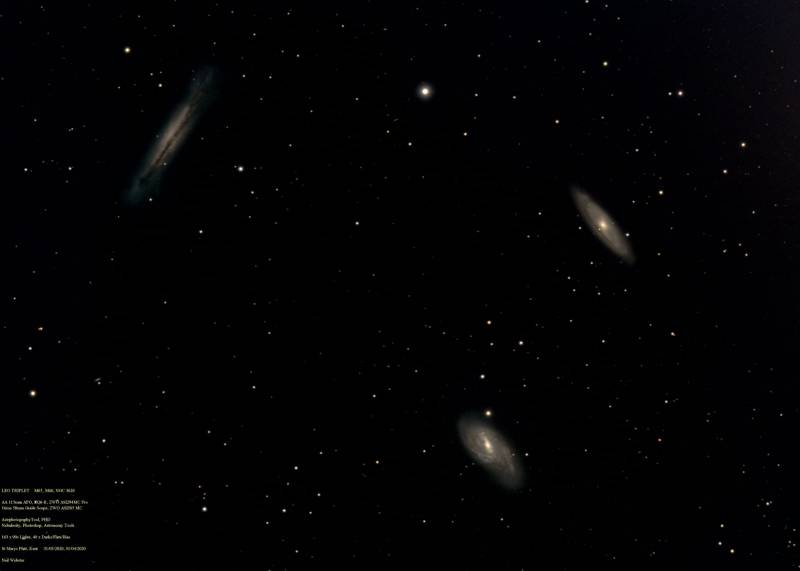
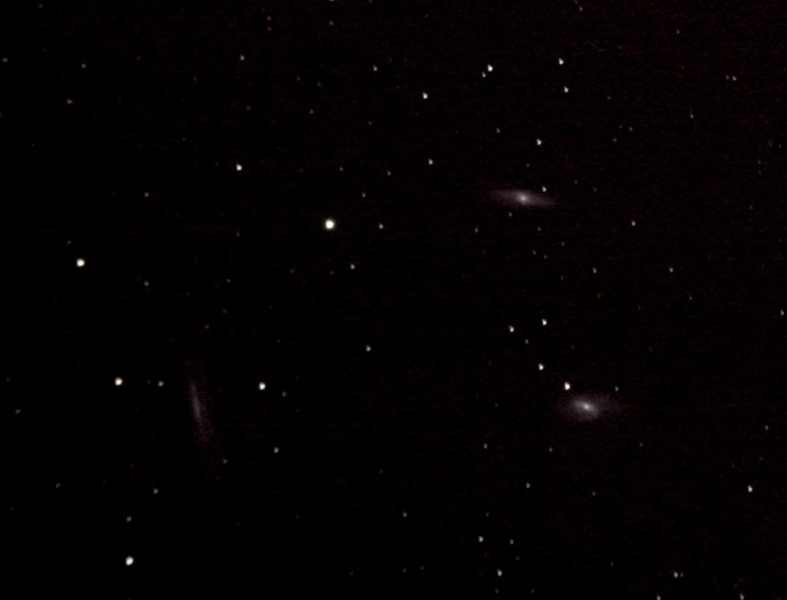
The Leo Triplet
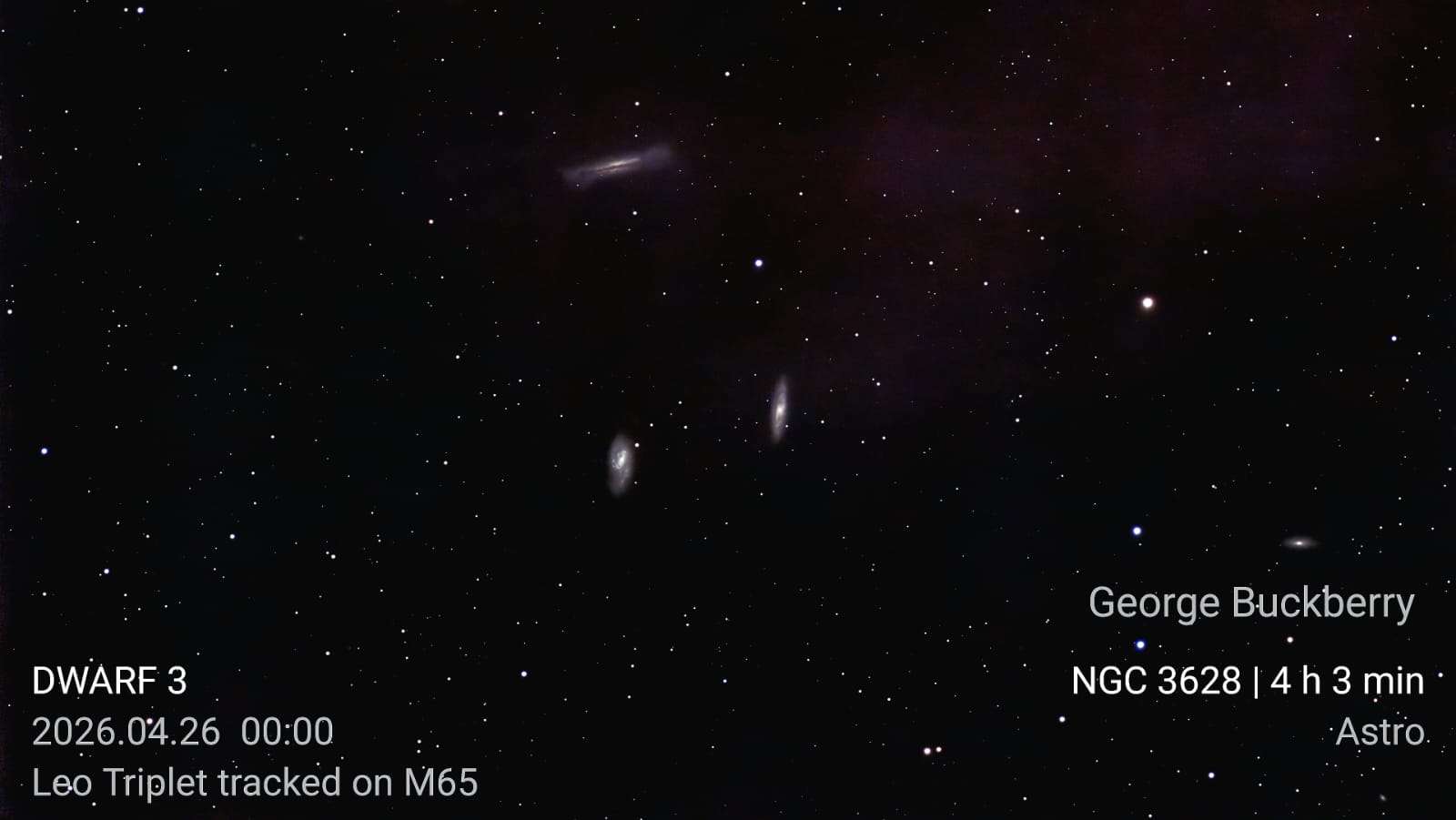
The Leo Triplet by George Buckberry taken on the 26th April 2026 using a Dwarf3 smartscope.
The Leo Triplet (also known as the M66 Group) is a small group of galaxies about 35 million light-years away in the constellation Leo. This galaxy group consists of the spiral galaxies M65 (bottom right), M66 (bottom left) and NGC 3628 (top).
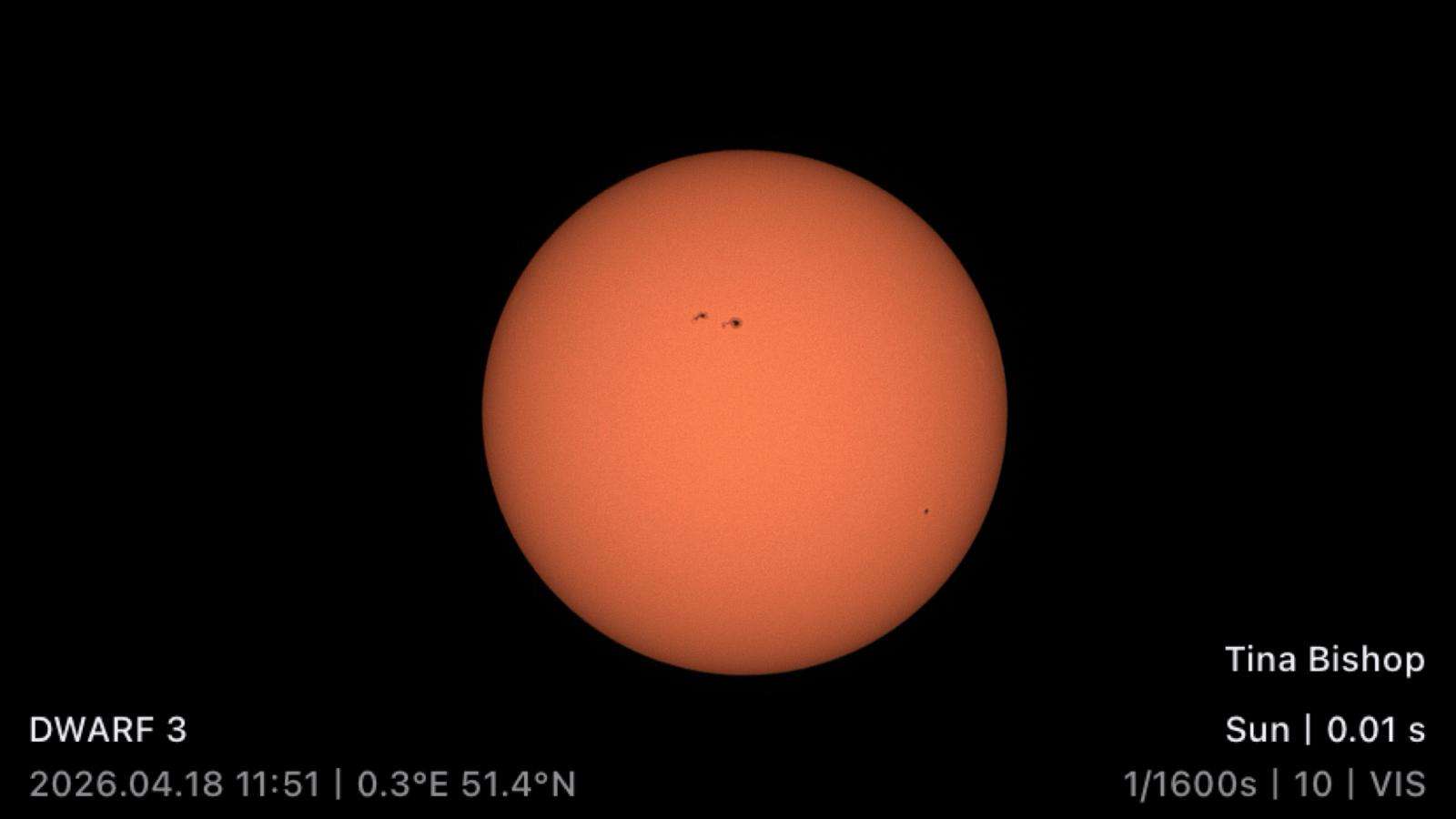
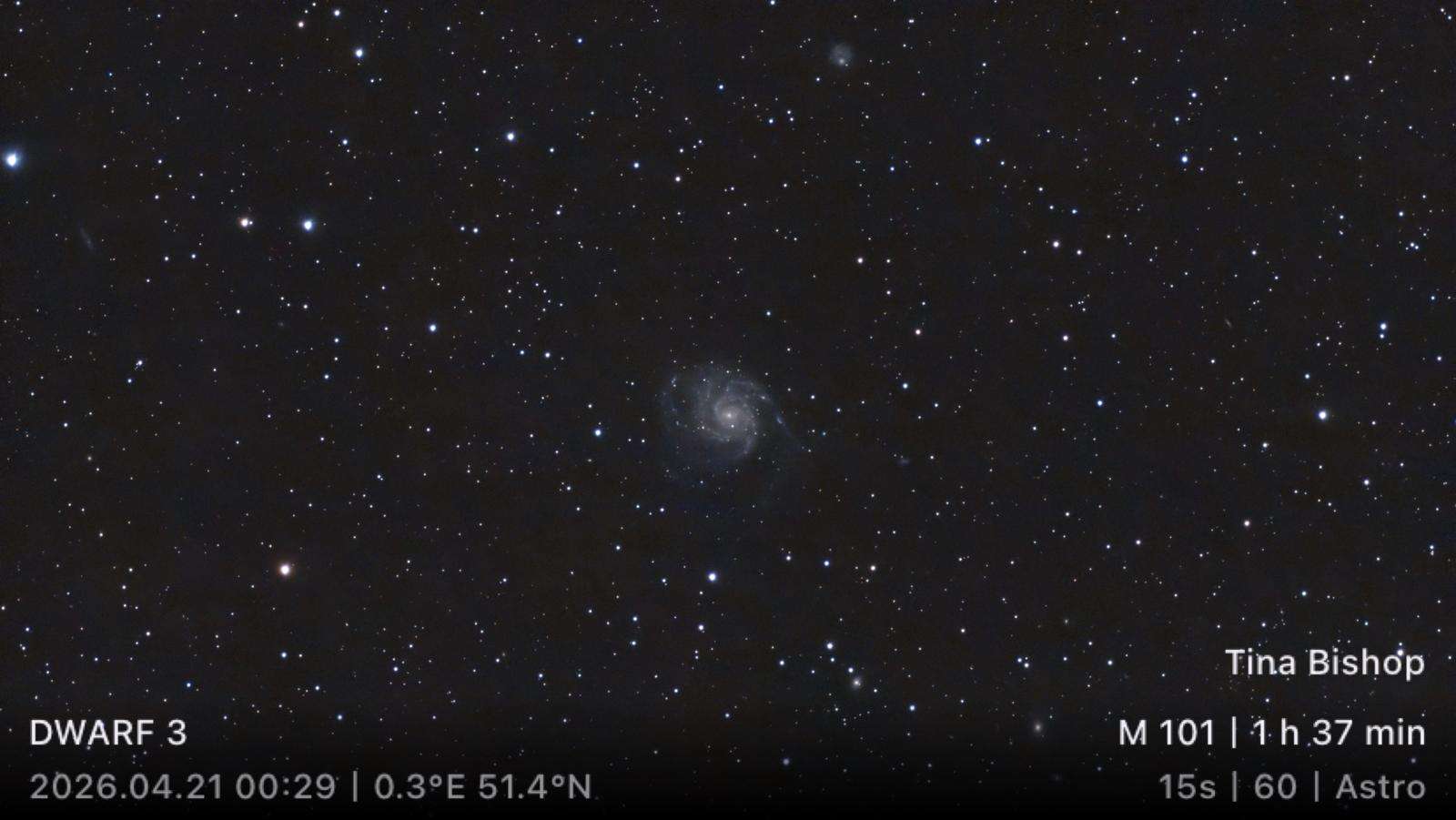
Astroimages by Tina Bishop
Here is a fantastic selection of images taken by new member Tina Bishop and new to astroimaging too.
All images were taken using a Dwarf3 smartscope.
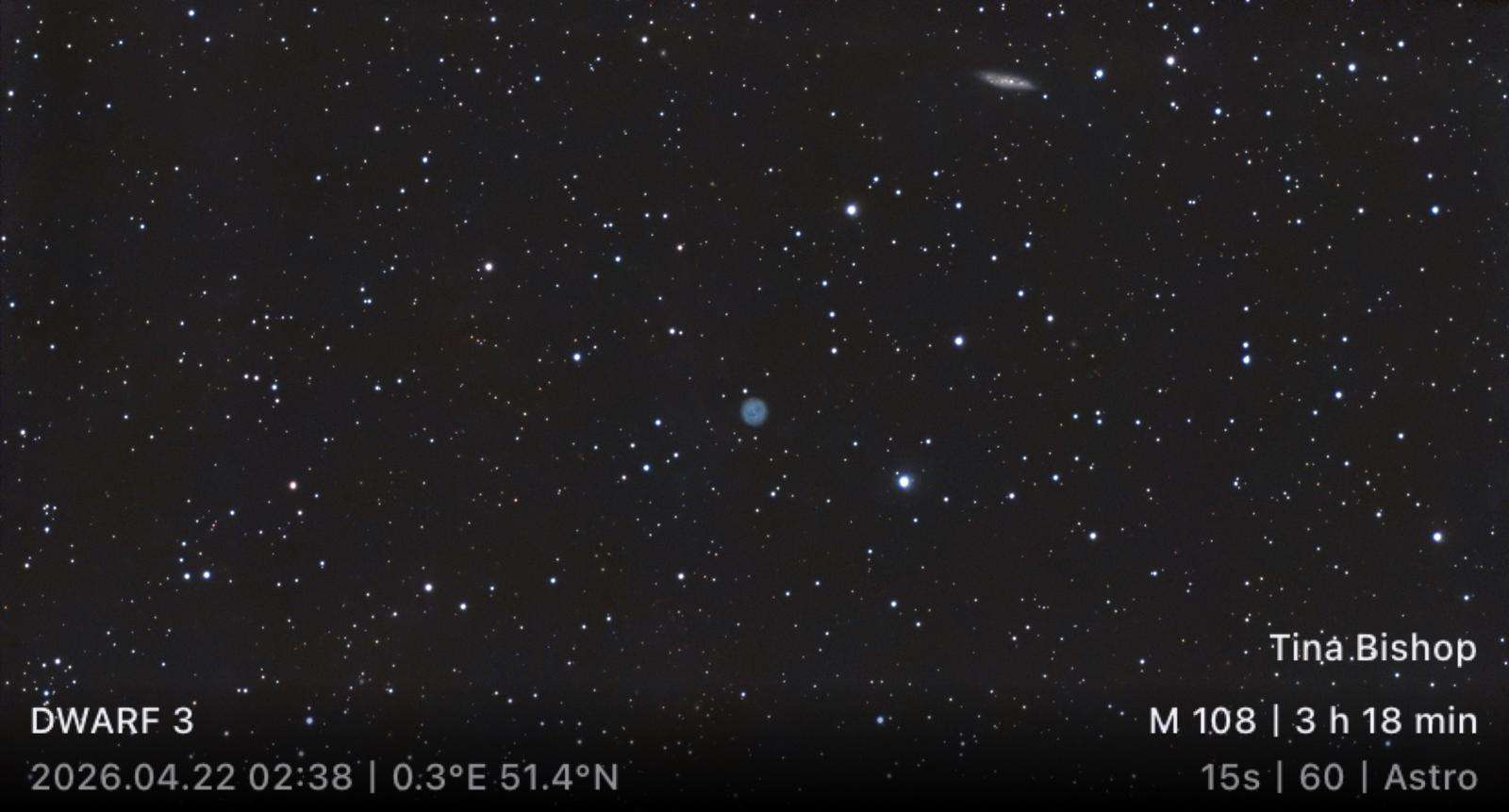
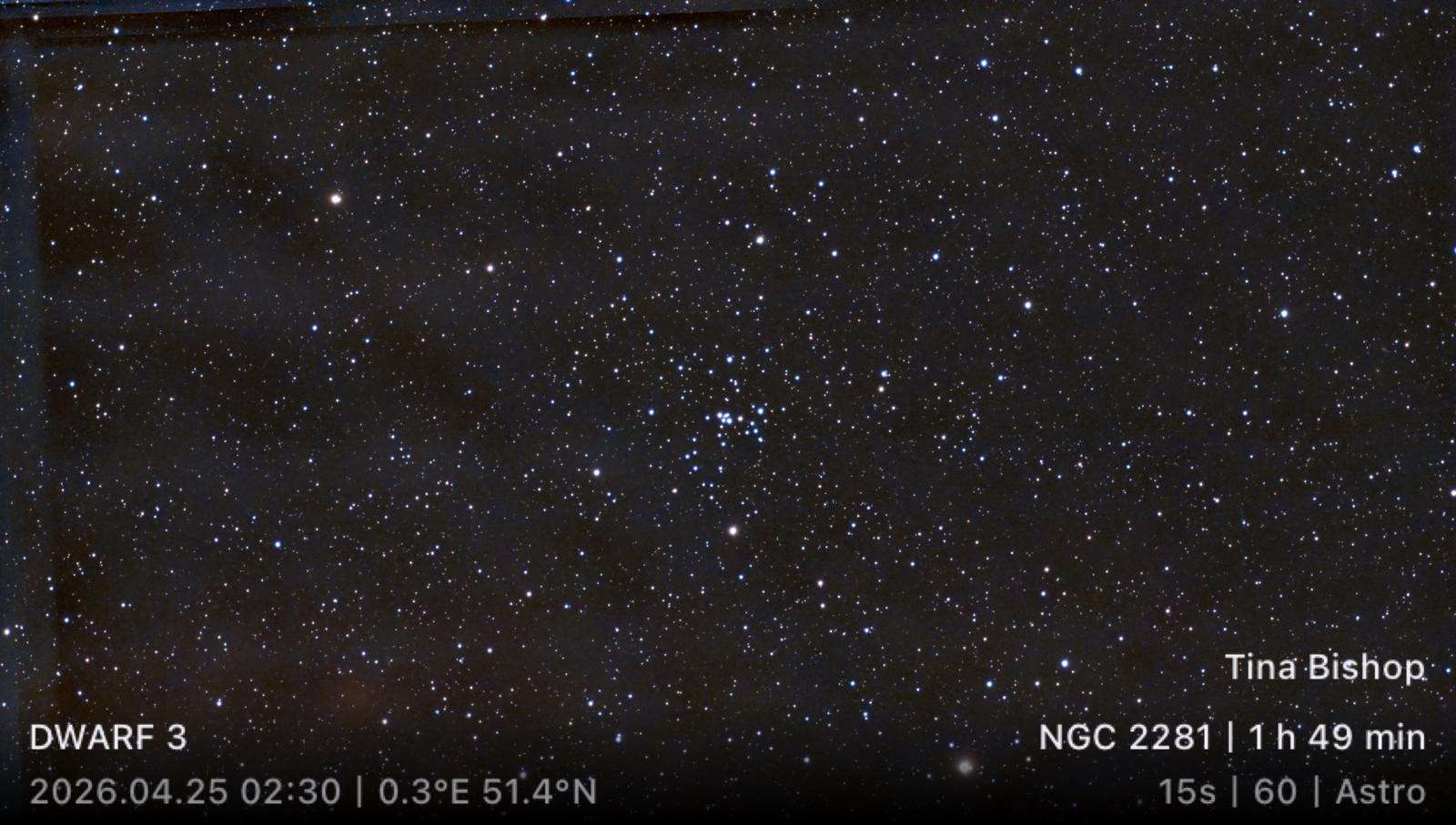
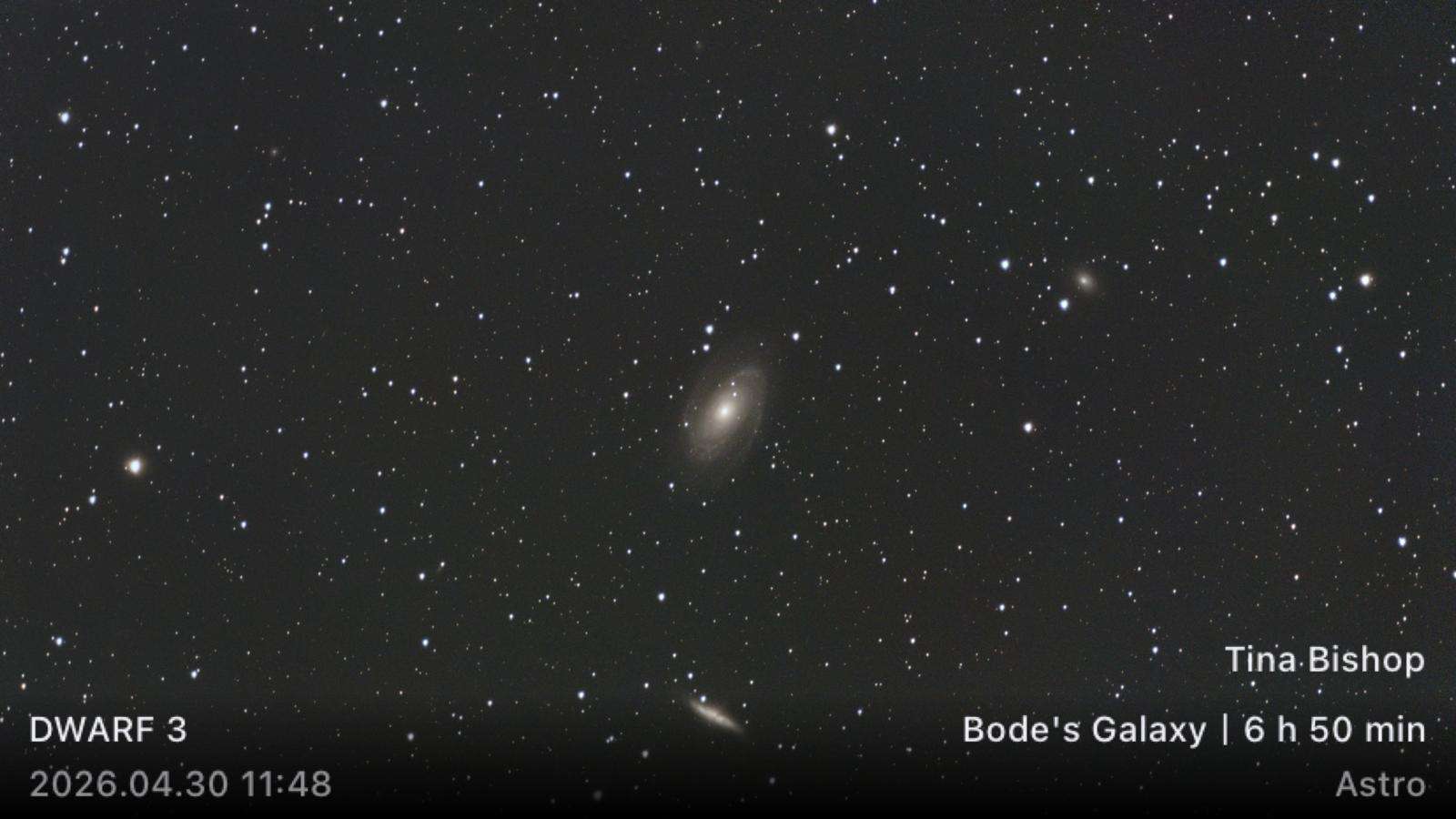
Markarian’s Chain
An absolutely fantastic image of the Markarian’s Chain taken by George Buckberry using a Dwarf 3 smart scope last night. It was George’s 1st attempt at imaging the chain.
Markarian’s Chain is stunning curved string of at least eight galaxies, located near the core of the Virgo Galaxy Cluster. It features prominent galaxies like M84, M86, and the interacting pair “The Eyes” (NGC 4435/4438).
The chain starts with the large elliptical galaxies M84 and M86, and includes NGC 4435, NGC 4438, NGC 4461, NGC 4458, NGC 4473, and NGC 4477.

Left is a labelled Markarian’s chain by Joe Renzetti from Sky & Telescope to help you identify the galaxies.
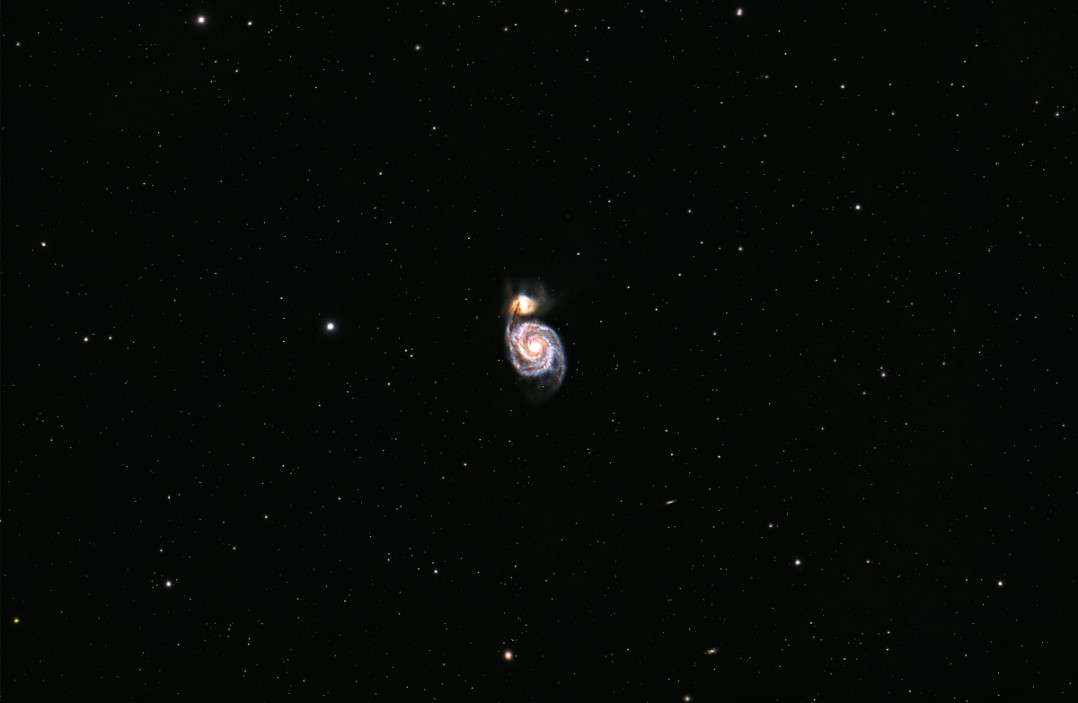
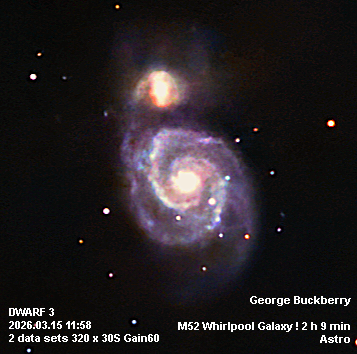
The Whirlpool Galaxy
M51a – The Whirlpool Galaxy and its companion M51b by Kevin Langford from Bexley.
This super image was taken using an ED102 APO, Pegasus NYX-101 mount, ZWO ASI071, and L-Pro filter.
7.5 hours over 3 nights (19/03/26 & 06-07/04/26).
Link to Kevin’s Flickrpage:
https://flic.kr/p/2s7w79z



Other Images
Sun | Comets | Mercury | Venus | Atmospheric Optics | Meteors | Auroa and NLC | Moon | Minor Planets | Mars | Jupiter | Saturn | Uranus | Neptune | Messier | Caldwell | All Deep Sky | Conjunctions | Transits | Solar Eclipse | Lunar Eclipse | Wide Field |ISS & Space Junk | Exo-Planets
All images are copyright. Permission must be sought to from the image owner to the use of any of these images.