Exoplanets WASP-148b & HAT-P-44b observations

Simon Dawes has been busy again with his exoplanet observations for the ExoClock project. Below are his observations.

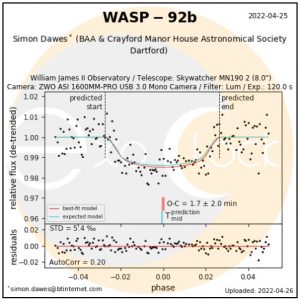
Exoplanet HAT-P-44b was discovered in 2013 by the HATNet transit survey. Its mass is 0.39 mass of Jupiter and has an orbital period of 4.3 days.

Of Exoplanet WASP -148b Simon said ''This is a 11.8 magnitude star and the dip is 8 thousandths of a magnitude - I think it must be one of the most challenging to observe with my 8" telescope, but the conditions were obviously good and I got this fit very quickly (this is the one I said at last night's meeting that I hadn't submitted because I wanted to see if I could improve - this is the improved reduction) .  WASP 148b is a hot Jupiter, there is another planet in this system (WASP 148c with a 35 day orbit) and the gravitational tug of the outer planet (WASP-148c) perturbs the orbit of the hot Jupiter WASP-148b''


ISS pass – 23rd March 2022

A superb composite image showing part of tonight's bright 19.46 International Space Station (ISS) pass taken by Diane Clarke.
 
Diane said 'This is a composite image consisting of 3 x 10 sec images.  I missed the start of the pass due to local roof lines obscuring my view but did manage to capture the 3 images that I put together to create this composite image.  The gaps are due to the self timer to reduce/remove camera shake.'
 
Diane used a Canon M50m2 Tripod Mounted Sigma 18-250mm lens @ 18mm  f4.5 10 sec @ ISO 100 to acquire the images.


Exoplanet TOI-1298b observations by Martin Crow

These are the latest exoplanet observations by Martin Crow.

TOI-1298 b is a gas giant exoplanet that orbits a G-type star TOI -1298 in the constellation of Ursa Minor.  Its mass is 0.356 Jupiters.  It takes 4.5 days to complete one orbit of its star and is 0.059 AU from its star. TOI-1298 b was discovered by the Transiting Exoplanet Survey Satellite (TESS) observatory, in 2021-09.

Martin wrote ''The observations were done as part of the ExoClock synchronous observations group. This particular transit has a depth of <5 thousandths of a magnitude!! To get useful data for this target would require a telescope diameter of at least 400mm or greater. My telescope at 235mm is too small although the dip is clearly detectable buried in the noise. The aim of the project is to combine three or more data sets from similar sized small instruments taken on the same night to increase the accuracy to that achievable with a bigger telescope. This method will help to make otherwise impossible targets viable for the majority of instruments registered on the ExoClock project.''

Dobsonian Telescope Mount – flat pack

[et_pb_section fb_built="1" _builder_version="4.16" global_colors_info="{}"][et_pb_row _builder_version="4.16" background_size="initial" background_position="top_left" background_repeat="repeat" global_colors_info="{}"][et_pb_column type="4_4" _builder_version="4.16" custom_padding="|||" global_colors_info="{}" custom_padding__hover="|||"][et_pb_text _builder_version="4.17.4" background_size="initial" background_position="top_left" background_repeat="repeat" hover_enabled="0" global_colors_info="{}" sticky_enabled="0"]

In this video Simon Dawes builds a Dobsonian telescope mount for Keith that folds flat for transport.

[/et_pb_text][et_pb_code _builder_version="4.17.4" _module_preset="default" admin_label="youtube video" hover_enabled="0" sticky_enabled="0"][/et_pb_code][/et_pb_column][/et_pb_row][/et_pb_section]

Diane Clarke’s The Moon & M45 The Pleiades on the 8th March 2022

A lovely image of the Moon 4.1° south of M45 taken on the 8th March 2022 by Diane Clarke.
 
Diane said ''I had my doubts about capturing this event due to the cloud forecast, but there were breaks starting to appear as 19.00 hrs approached, so I went to set up but there was a strong breeze forcing me to find a sheltered spot to stop my equipment suffering wind blast, the breeze was also making the clouds scud across the sky very quickly.  So much so that any breaks in the cloud could disappear as quickly as they appeared the image was taken in one of these short lived break's in the cloud cover.''
 
Image Details: Camera EOS M50m2 using a 100mm Canon EF Lens.
2.5 sec's @ f5.6, ISO 2000, on a static tripod, with a 2 sec delay to remove camera shake.
 

TOP