Thursday 21st April 2022 was an informal night at the pavilion and some members took the opportunity to do some observing with some members viewing a very rare sight indeed.
Chairman John Archer summed the evening up in his ebulletin to members dated 27th April 2022. He wrote 'Last week we had another opportunity to get together for an observing evening and a variety of instruments were rolled out – everything from EV Scope and iPhone to Mark 1 eyeball was scanning the night sky.
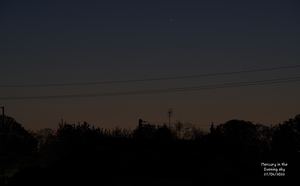
Members sought out the elusive planet Mercury, and once skies darkened, other more distant objects could be seen.
A flurry of excitement and speculation surrounded the appearance of a mysterious, moving object in the night sky which turned out to be a SpaceX Falcon upper stage conducting a de-orbit burn prior to re-configuring itself into a marine reef / insurance claim – depending on where it finally landed.''
Some objects were also observed using the societies 16" Peter Hindle telescope they were M81, M82, M44 and the Eskimo Nebula.
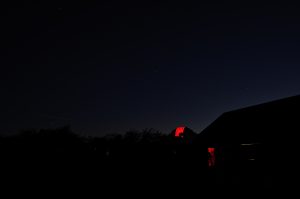
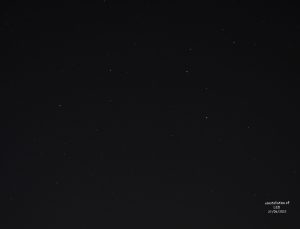
Below are some images from the evening taken by member Jim Burchell.
Mercury in the constellation Aries just before sunset taken using a Pentax KP 135mm F11.0, Exp 1/2sec & ISO 800.
The Observatory taken using a Pentax KP 18mm F3.5, Exp 10sec & ISO 800.
Constellation Leo taken using Pentax KP 48mm F7.1, Exp 2.50sec & ISO 800.
The next 2 images below are snapshots taken from a video that member Steve Goldson managed to capture of the UFO that four other CMHASD members witnessed too at 8.46pm. The 1st photo shows what looks like a small cloud moving very quickly through the sky. The 2nd photo shows the same unidentified object a few seconds later now as a bright dot with a cloud in front of it moving through the sky.
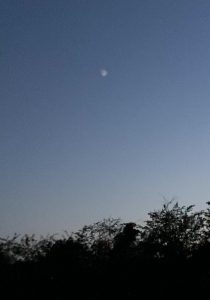
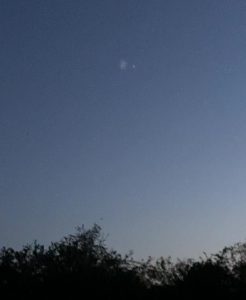
The members were perplexed but excited by what they had seen with most sighting it as their 1st UFO. Later after some detective work by Honor & Sonia it was concluded that they along with Jim Burchell, David Freed and Steve Goldson had witnessed the second stage deorbit of SpaceX Falcon 9 after launching another batch of Starlink internet satellites (Starlink 4-14).