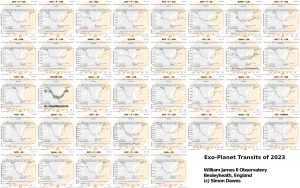
Latest ExoClock Observations by Simon Dawes

[et_pb_section fb_built="1" _builder_version="4.27.5" _module_preset="default" global_colors_info="{}"][et_pb_row _builder_version="4.27.5" _module_preset="default" global_colors_info="{}"][et_pb_column type="4_4" _builder_version="4.27.5" _module_preset="default" global_colors_info="{}"][et_pb_text _builder_version="4.27.5" _module_preset="default" global_colors_info="{}"]

These are the latest Exoplanet transits that member Simon Dawes has done for the ExoClock project.

To find out more about the ExoClock project click here.

[/et_pb_text][/et_pb_column][/et_pb_row][et_pb_row column_structure="1_2,1_2" _builder_version="4.27.5" _module_preset="default" global_colors_info="{}"][et_pb_column type="1_2" _builder_version="4.27.5" _module_preset="default" global_colors_info="{}"][et_pb_image src="https://crayfordmanorastro.com/wp-content/uploads/2026/01/WhatsApp-Image-2026-01-12-at-19.05.32.jpeg" title_text="WhatsApp Image 2026-01-12 at 19.05.32" _builder_version="4.27.5" _module_preset="default" global_colors_info="{}"][/et_pb_image][/et_pb_column][et_pb_column type="1_2" _builder_version="4.27.5" _module_preset="default" global_colors_info="{}"][et_pb_text _builder_version="4.27.5" _module_preset="default" global_colors_info="{}"]

XO-6b is a transiting exoplanet, orbiting the star XO-6 around 760 light years (230 parsecs) away from Earth. It was discovered in 2016 by the XO planet search team.

XO-6b orbits XO-6, a faint 10th magnitude star in the constellation Camelopardalis.

XO-6b is classified as a hot Jupiter. The planet has an orbital period of just 3.8 days and an average orbital separation of 0.082 astronomical units. Ref: https://en.wikipedia.org/wiki/XO-6b

[/et_pb_text][/et_pb_column][/et_pb_row][et_pb_row column_structure="1_2,1_2" _builder_version="4.27.5" _module_preset="default" global_colors_info="{}"][et_pb_column type="1_2" _builder_version="4.27.5" _module_preset="default" global_colors_info="{}"][et_pb_image src="https://crayfordmanorastro.com/wp-content/uploads/2026/01/WhatsApp-Image-2026-01-11-at-12.40.25.jpeg" title_text="WhatsApp Image 2026-01-11 at 12.40.25" _builder_version="4.27.5" _module_preset="default" global_colors_info="{}"][/et_pb_image][/et_pb_column][et_pb_column type="1_2" _builder_version="4.27.5" _module_preset="default" global_colors_info="{}"][et_pb_text _builder_version="4.27.5" _module_preset="default" hover_enabled="0" global_colors_info="{}" custom_padding="1px|||||" sticky_enabled="0"]

EPIC 246851721 b is a gas giant exoplanet, 3x the mass of Jupiter, it takes 6.2 days to orbit its (F-Type) star and is 0.07229 AU from its star. It was discovered in 2018.

The F-type star EPIC 246851721 is a star in the constellation of Taurus. EPIC 246851721 distance from Earth is 1224.38 light years away.

Simon said ''It's the shallowest transit I've attempted at 5 milli-mag. on a mag 11 star.''

[/et_pb_text][/et_pb_column][/et_pb_row][et_pb_row column_structure="1_2,1_2" _builder_version="4.27.5" _module_preset="default" global_colors_info="{}"][et_pb_column type="1_2" _builder_version="4.27.5" _module_preset="default" global_colors_info="{}"][et_pb_image src="https://crayfordmanorastro.com/wp-content/uploads/2026/01/WhatsApp-Image-2026-01-06-at-15.31.04.jpeg" title_text="WhatsApp Image 2026-01-06 at 15.31.04" _builder_version="4.27.5" _module_preset="default" global_colors_info="{}"][/et_pb_image][/et_pb_column][et_pb_column type="1_2" _builder_version="4.27.5" _module_preset="default" global_colors_info="{}"][et_pb_text _builder_version="4.27.5" _module_preset="default" global_colors_info="{}"]

WASP-33b is an extrasolar gas giant planet orbiting the A-type star HD 15082 in Andromeda.  It was the first transiting planet discovered to orbit a Delta Scuti variable star.  Its mass is 2.093 Jupiters, it takes 1.2 days to complete one orbit of its star, and is 0.0239 AU from its star. Its discovery was announced in 2010.

[/et_pb_text][/et_pb_column][/et_pb_row][et_pb_row column_structure="1_2,1_2" _builder_version="4.27.5" _module_preset="default" global_colors_info="{}"][et_pb_column type="1_2" _builder_version="4.27.5" _module_preset="default" global_colors_info="{}"][et_pb_image src="https://crayfordmanorastro.com/wp-content/uploads/2026/01/WhatsApp-Image-2025-11-19-at-13.32.49-1.jpeg" title_text="WhatsApp Image 2025-11-19 at 13.32.49 (1)" _builder_version="4.27.5" _module_preset="default" global_colors_info="{}"][/et_pb_image][/et_pb_column][et_pb_column type="1_2" _builder_version="4.27.5" _module_preset="default" global_colors_info="{}"][et_pb_text _builder_version="4.27.5" _module_preset="default" global_colors_info="{}"]

KELT-2Ab is an extrasolar gas giant planet that orbits the F-type star KELT-2A approximately 440 light-years away in the Auriga.

Its mass is 1.7 Jupiters, it takes 4.1 days to complete one orbit of its star, and is 0.05497 AU from its star. Its discovery was announced in 2012.


[/et_pb_text][/et_pb_column][/et_pb_row][et_pb_row column_structure="1_2,1_2" _builder_version="4.27.5" _module_preset="default" global_colors_info="{}"][et_pb_column type="1_2" _builder_version="4.27.5" _module_preset="default" global_colors_info="{}"][et_pb_image src="https://crayfordmanorastro.com/wp-content/uploads/2026/01/WhatsApp-Image-2025-11-10-at-10.00.30-1.jpeg" title_text="WhatsApp Image 2025-11-10 at 10.00.30 (1)" _builder_version="4.27.5" _module_preset="default" global_colors_info="{}"][/et_pb_image][/et_pb_column][et_pb_column type="1_2" _builder_version="4.27.5" _module_preset="default" global_colors_info="{}"][et_pb_text _builder_version="4.27.5" _module_preset="default" hover_enabled="0" global_colors_info="{}" sticky_enabled="0"]

Qatar-1b is a gas giant exoplanet that orbits a a metal-rich K dwarf star in Draco. Its mass is 1.294 Jupiters, it takes 1.4 days to complete one orbit of its star, and is 0.02332 AU from its star. Its discovery was announced in 2010 and was the first planet discovered by the Qatar Exoplanet Survey.

[/et_pb_text][/et_pb_column][/et_pb_row][/et_pb_section]

Congratulations to…..

[et_pb_section fb_built="1" _builder_version="4.27.5" _module_preset="default" global_colors_info="{}"][et_pb_row _builder_version="4.27.5" _module_preset="default" global_colors_info="{}"][et_pb_column type="4_4" _builder_version="4.27.5" _module_preset="default" global_colors_info="{}"][et_pb_text _builder_version="4.27.5" _module_preset="default" global_colors_info="{}"]

Congratulations to Simon Dawes, Martin Crow and Gary Hunt on the latest paper published by the ExoClock project of which they are co authors ''ExoClock Project IV: A homogeneous catalogue of 620 updated exoplanet ephemerides''  To see a copy of the paper click on the link below.

https://arxiv.org/abs/2511.14407

Then another congratulations to Martin Crow for being a co author on the following paper titled ''TrES-1b: A Case study in detecting Secular Evolution of Exoplanet Orbits.''  To see a copy of the paper click the link below.

https://arxiv.org/abs/2508.15075

[/et_pb_text][/et_pb_column][/et_pb_row][/et_pb_section]

The latest Exoplanet Transits by Simon Dawes

Below are the latest Exoplanet Transit observations carried out by CMHASD member and trustee Simon Dawes for the ExoClock project.

TOI-1259 A b is a gas giant exoplanet that orbits a K-type star. Its mass is 0.441 Jupiters, it takes 3.5 days to complete one orbit of its star, and is 0.0407 AU from its star. Its discovery was announced in 2021. Ref: https://science.nasa.gov/exoplanet-catalog/toi-1259-a-b/

HAT-P-56 b is a gas giant exoplanet that orbits an F-type star. Its mass is 2.31 Jupiters, it takes 2.8 days to complete one orbit of its star, and is 0.0423 AU from its star. Its discovery was announced in 2015. Ref:https://science.nasa.gov/exoplanet-catalog/hat-p-56-b/

Qatar-9 b is a gas giant exoplanet that orbits a K-type star. Its mass is 1.19 Jupiters, it takes 1.5 days to complete one orbit of its star, and is 0.0234 AU from its star. Its discovery was announced in 2019. Ref:https://science.nasa.gov/exoplanet-catalog/qatar-9-b/

Qatar-8 b is a gas giant exoplanet that orbits a G-type star. Its mass is 0.371 Jupiters, it takes 3.7 days to complete one orbit of its star, and is 0.0474 AU from its star. Its discovery was announced in 2019. Ref:https://science.nasa.gov/exoplanet-catalog/qatar-8-b/

WASP-92 b is a gas giant exoplanet that orbits an F-type star. Its mass is 0.805 Jupiters, it takes 2.2 days to complete one orbit of its star, and is 0.0348 AU from its star. Its discovery was announced in 2016. Ref: https://science.nasa.gov/exoplanet-catalog/wasp-92-b/

Latest ExoClock transit observations by Simon Dawes – July & August 2024

Five more sets of observations for the ExoClock project by member & trustee Simon Dawes.

HAT-P-19 b is a gas giant exoplanet that orbits a K-type star. Its mass is 0.277 Jupiters, it takes 4 days to complete one orbit of its star, and is 0.04599 AU from its star. Its discovery was announced in 2010. Ref:https://science.nasa.gov/exoplanet-catalog/hat-p-19-b/


TOI-4087 b is a gas giant exoplanet that orbits an F-type star. Its mass is 0.73 Jupiters, it takes 3.2 days to complete one orbit of its star, and is 0.04469 AU from its star. Its discovery was announced in 2023. Ref:https://science.nasa.gov/exoplanet-catalog/toi-4087-b/


KELT-1 b is a gas giant exoplanet that orbits an F-type star. Its mass is 27.23 Jupiters, it takes 1.2 days to complete one orbit of its star, and is 0.02466 AU from its star. Its discovery was announced in 2012. Ref: https://science.nasa.gov/exoplanet-catalog/kelt-1-b/


KELT-16 b is a gas giant exoplanet that orbits an F-type star. Its mass is 2.75 Jupiters, it takes 1 days to complete one orbit of its star, and is 0.02044 AU from its star. Its discovery was announced in 2017. Ref: https://science.nasa.gov/exoplanet-catalog/kelt-16-b/


TOI-1431 b is a gas giant exoplanet that orbits an A-type star. Its mass is 3.12 Jupiters, it takes 2.7 days to complete one orbit of its star, and is 0.046 AU from its star. Its discovery was announced in 2021. Ref: https://science.nasa.gov/exoplanet-catalog/toi-1431-b/


The latest ExoClock project transits

Martin Crow and Simon Dawes have been busy taking more measurements of Exoplanet transits for the ExoClock project.  Below are some of their latest ones.

''TrES-2b (also known as Kepler-1b or GSC 03549-02811b) is an extrasolar planet orbiting the star GSC 03549-02811 located 750 light years away from the Solar System in Draco. The planet was identified in 2011 as the darkest known exoplanet, reflecting less than 1% of any light that hits it. Reflecting less light than charcoal, on the surface the planet is said to be pitch black.  The planet's mass and radius indicate that it is a gas giant with a bulk composition similar to that of Jupiter. Unlike Jupiter, but similar to many planets detected around other stars, TrES-2b is located very close to its star and belongs to the class of planets known as hot Jupiters. This system was within the field of view of the Kepler spacecraft.  It was discovered on August 21, 2006 by the Trans-Atlantic Exoplanet Survey (TrES) by detecting the transit of the planet across its parent star using Sleuth (Palomar Observatory, California) and PSST (Lowell Observatory, Arizona), part of the TrES network of 10–cm telescopes. The discovery was confirmed by the W. M. Keck Observatory on September 8, 2006, by measuring the radial velocity of the star that hosts TrES-2b.'' Ref:https://en.wikipedia.org/wiki/TrES-2b


HAT-P-37b is an exoplanet in the constellation Draco.

''HAT-P-37 b is a gas giant exoplanet that orbits a G-type star. Its mass is 1.169 Jupiters, it takes 2.8 days to complete one orbit of its star, and is 0.0379 AU from its star. Its discovery was announced in 2011.'' Ref:https://science.nasa.gov/exoplanet-catalog/hat-p-37-b/


''Qatar-4b is a super-jupiter orbiting the star Qatar-4 every 1.8 days in Andromeda. It was discovered in 2016 by the Qatar Exoplanet Survey (QES).

This planet has a very short orbit, with only 1.8 days for it to complete an orbit around Qatar-4. The period corresponds with a separation of around 0.03 AU, which is almost 20 times closer than Mercury is to the Sun. Despite that, it has a perfectly round orbit. Since the host is an active star, Qatar-4 may be destroyed by tidal waves from the star.'' Ref:https://en.wikipedia.org/wiki/Qatar-4b


''TrES-3b is an extrasolar planet orbiting the star GSC 03089-00929. It has an orbital period of just 31 hours and nearly twice the mass of Jupiter.

The planet TrES-3b is named Umbäässa. The name was selected in the NameExoWorlds campaign by Liechtenstein, during the 100th anniversary of the IAU. In the local dialect of southern Liechtenstein, Umbäässa is a small and barely visible ant.

It is the third transiting planet found by the Trans-Atlantic Exoplanet Survey. It was discovered in the constellation Hercules about 10 degrees west of Vega.'' Ref:https://en.wikipedia.org/wiki/TrES-3b


Exo-Planet transits of HAT-P-55b and TrES-3b

Here is the Exo-Planet transit of HAT-P-55b taken on the 11th May 2024 by Simon Dawes for the ExoClock project.  Simon did the observation on the same night as the 'Great Aurora', it finished in twilight so he lost about an hour of data.

HAT-P-55b is a gas giant exoplanet that orbits a G-type star. Its mass is 0.596 Jupiters, it takes 3.6 days to complete one orbit of its star, and is 0.04628 AU from its star. Its discovery was announced in 2015.


Next is the Exo-Planet transit of TrES-3b taken on the 15th May 2024 by Simon Dawes also for the ExoClock project. 

Simon wrote ''The night wasn't great, there was a light mist, 1/4 moon, and high cloud, I didn't expect much given the conditions and the large change in altitude of the object, but I think it came out ok. The shape of the transit suggests it just grazes the limb of the host star (from our perspective).''

TrES-3b orbits the star GSC 03089-00929 in the constellation Hercules about 10 degrees west of the star called Vega. It is the third transiting planet found by the Trans-Atlantic Exoplanet Survey.

The planet TrES-3b is named Umbäässa. The name was selected in the NameExoWorlds campaign by Liechtenstein, during the 100th anniversary of the IAU. In the local dialect of southern Liechtenstein, Umbäässa is a small and barely visible ant. TrES-3b has an orbital period of just 31 hours and nearly twice the mass of Jupiter.

Exoplanet transit of Qatar-9b

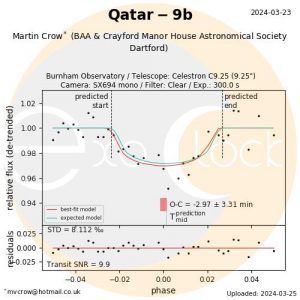
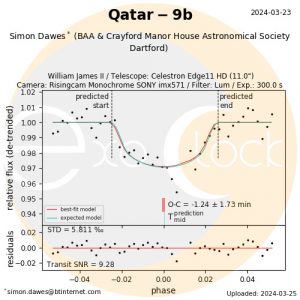
One more for the Exoclock project. This time the transit of exoplanet Qatar-9b measured by Simon Dawes and Martin Crow on the same night.  Qatar-9 b is a hot Jupiter exoplanet in Ursa Major that orbits a K-type star. Its mass is 1.19 Jupiters, it takes 1.5 days to complete one orbit of its star and is 0.0234 AU from its star. Its discovery was announced in 2019.

TOP