
Three fab images of the Moon's craters taken by CMHASD trustee Simon Dawes on the 9th March 2025 from Bexley, Kent. Details of how Simon took the images are on each photo.


Astronomy every Thursday
This category will show a few lines from the last 3 items on the home page.
It will also show the full post on the news page
Three fab images of the Moon's craters taken by CMHASD trustee Simon Dawes on the 9th March 2025 from Bexley, Kent. Details of how Simon took the images are on each photo.
A superb image of the Soul Nebula (IC1848) in Cassiopeia taken by member Kevin Langford from Bexley, Kent.
This image was captured over three nights from the 2nd to the 4th March 2025.
Number of images taken = 130 x 180sec

Kevin took this image using an ES102ED APO with 0.7x focal reducer corrector, Pegasus NYX-101 mount, ZWO asi071, Orion NMAG and a L-enhance filter.
The image is a total of 6.5hrs of exposures.
Software used:
Nina to capture data.
Sirilic to stack images.
Siril to processes image.
Affinity Photo 2 to finish.
Check out Kevin's Flickr page at https://www.flickr.com/photos/77708720@N08/54380781459/ .
NEVER LOOK AT THE SUN DIRECTLY. Please click here for solar observing safely.
A superb selection of astro images taken by member Honor Wheeler on the 1st March 2025 of the Sun, Moon and the planetary parade.
Details of how Honor took her images are written above each image.
Venus phase - Canon M6II with Tamron 18-400mm lens, ISO400, f6.3, 1/16000sec.
Even when Venus is a fine crescent, the albedo of Venus is still high.

Sunset Sunspots - Canon M6II with Tamron 18-400mm lens. ISO100, f29, 1/16000sec.

Sunset - Canon M6II with Tamron 18-400mm lens. ISO200, f10, 1/800sec

Mars, Jupiter, Venus, Moon and Mercury - Canon M6II with Tamron 18-400mm lens. ISO500, 1/2sec taken using Samyang 8mm fish-eye lens.

Venus, Earthshine and Mercury - Canon M6II with Tamron 18-400mm lens. ISO640, f5.0, 1/3sec.

Earthshine - Canon M6II with Tamron 18-400mm lens. ISO640, f6.3, 1"1/3sec

Venus and Mercury taken at 7:03 pm MST Arizona on the 3rd March 2025 by CMHASD member Richard Bohner.
Mercury is just above trees in center.
Richard took the image using a Canon 6D, 105mm f5.0 lens, 1/100 sec exposure, at ISO 10K.

A stunning image of the Rosette Nebula (also known as Caldwell 49) in the constellation Monoceros by CMHASD member Neil Webster taken on the 2nd March 2025.

Neil acquired his image using a WO GT71 Apo, EQ6 R, ZWO ASI 294MC Pro, Astro Essentials 50mm guide scope, ZWO ASI 290MM guide camera and an Optolong L Enhance filter.
Processed using APT, PHD, Nebulosity, Gradient Xterminator, Star Xterminator, and PS (Camera Raw)
52 x 240s Subs, 12 x Darks, 45 x Flats/ Bias.
Check out Neil's Flickr page at https://www.flickr.com/photos/137388222@N05/ to see more of his brilliant images.
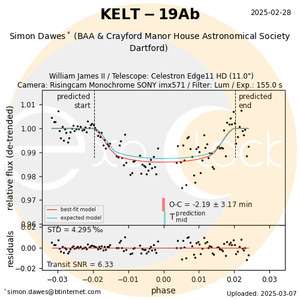
These are the latest Exoplanet transit observations for the ExoClock project that CMHASD are involved in.


NEVER LOOK AT THE SUN DIRECTLY. Please click here for solar observing safely.
A selection of fantastic images of our Sun taken on the 4th March 2025 by CMHASD trustee Simon Dawes from Bexley. Details of how Simon took his images are on the photos.


A lovely image of the Moon taken by CMHASD member Diane Clarke on the 6th March 2025 in the afternoon. Diane used her Seestar S50 smartscope to take the image.

Another stunning image of the Moon taken by CMHASD member Neil Webster on Tuesday evening; 4th March 2025.
The Waxing Crescent Moon was 30.0% illuminated and 4.84 days old.

Neil acquired the image using an AA 115mm Apo, EQ6 R, ZWO ASI 290MM, and a Astronomik R/IR filter. 3 frames stitched in Microsoft ICE. Each 90s x 33fps (20% selected)


Processed using Firecapture, AutoStakkert, and PhotoShop.
CMHASD member George Buckberry caught this plane transit across the sky below Orion on Thursday 27th February from Dartford. George used a Canon EOS 760D and Samyang 14mm wide Angle lens at F4. The camera was set to ISO 3200 and Bulb with Intervalometer set at 10 Sec exposure.
