CMHASD at the BAA Winchester Weekend 2023
Written by member Honor Wheeler
The weekend started off with the majority of us meeting up at a pub for Friday lunch, although the M25 did its best to make that as difficult as possible but thankfully we all made it in the end. Then an A31 closure sent us all on a long, picturesque diversion before finally checking in at the Sparsholt College campus.
The first lecture on the Friday night, after a delicious dinner of course, was titled 'Superluminous Supernovae: Fantastic bursts and where to find them' by Dr Matt Nichol, Queen's University Belfast which was an fascinating talk on Supernovae past and present. This was followed by a trip to the campus pub for some or returning to the common room for a chance of some relaxation for others.

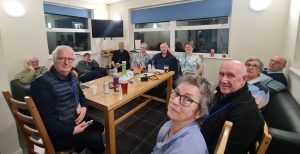
The Crayford Crew
A busy lecture Saturday followed starting with 'Pete & Paul's 2023 Astronomical Challenges' followed by 'OJ287 - a Black Hole Worthy of Amateur Study' by Gary Poyner BAA, 'the Electromagnetic Spectrum' by Paul Hearn BAA, a talk from Dr Alex Cameron on the 'JWST Observing Galaxies in the Very Early Universe' looking even further back in time to 13.1 Billion years and seeing one of the highest Redshifted Galaxies to date.
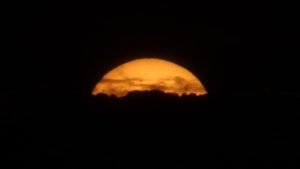
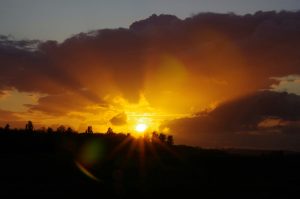
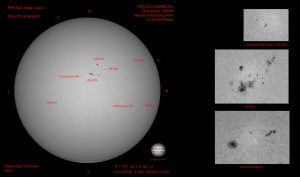
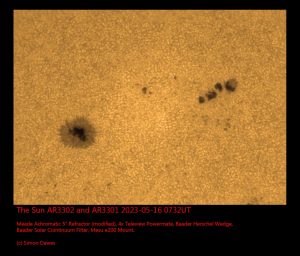
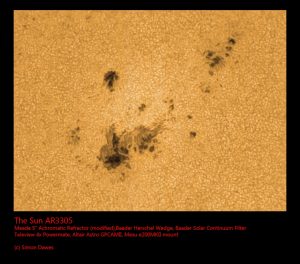
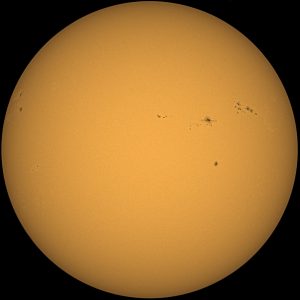
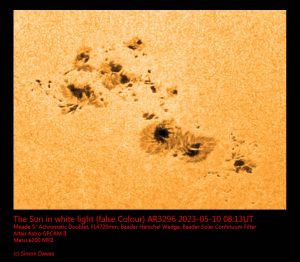
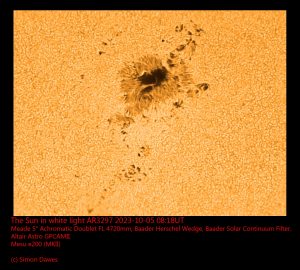
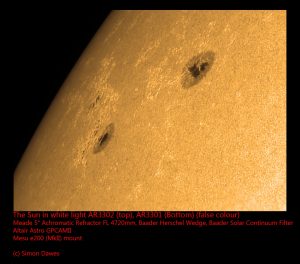
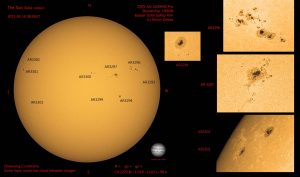
Before the afternoon lectures recommenced, a little Solar observing was achieved with some observations of complex groups of Prominences and Sunspots.
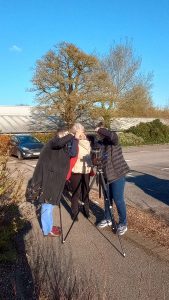
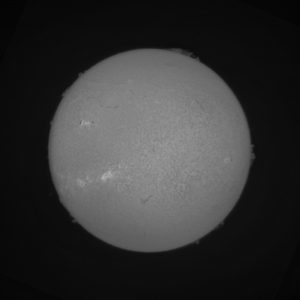
The Sun by Honor Wheeler
The afternoon session was presented by the BAA Mercury and Venus section starting with a look at the 'Sodium Ion Tail of Mercury' by Chris Hooker and how to image this elusive 'Comet like' tail followed by 'Observing Venus in IR and UV' in a variety of short talks by other members of the section.
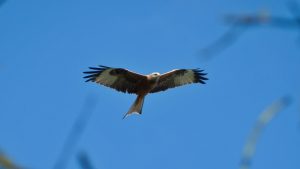
Some members took the opportunity to explore the college grounds which are extensive and enjoyed some great views of the countryside seeing Deer, Buzzards and a rather stunning bird of prey known as a Red Kite.
Saturday evening and we enjoyed the Alfred Curtis Lecture, 'Exploring the Ice Giants of our Solar System' by Prof. Patrick Irwin (University of Oxford) another interesting lecture which left us with the hope that maybe we'll be visiting these enigmatic Planets sooner rather than later.
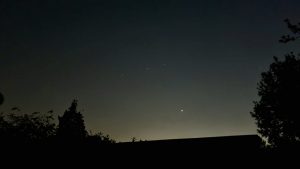
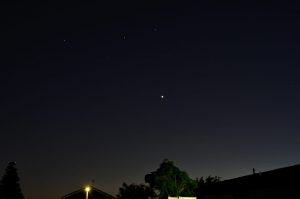
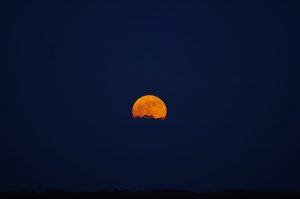
A few members then made the most of clear skies and carried out observations of Venus and its conjunction with the Hyades before retiring to the pub or the common room for discussions about the day's lectures.
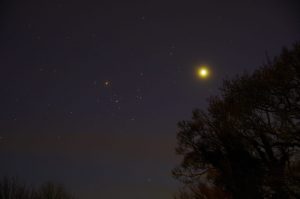
The Hyades & Venus by Jim Burchell
On Sunday the day began with an intriguing lecture 'How Astronomers Can Save The World' by Stuart Eves (SJE Space) but I don't think we were quite convinced that painting an Asteroid with White Paint would save the world from an impending impact (Steve was just kidding!!)
Dr Jen Gupta followed with a lively discussion on seeing 'The Invisible Universe' and looking at how we see through the dust obscuring distant, new stars.
'Let There Be Light' followed with an extensive tour of our local star the Sun by Dr Matthew Malek.
After lunch came the Members session and the opportunity to hear about projects, imaging and observations undertaken by members but which also included a rather different lecture which brought a lighter side to the proceedings.
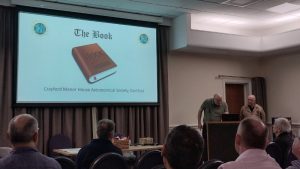
Steve Floodgate & Dave Grist gave us a Stella (Artois) Performance…I mean Lecture on the complex Crayford Astronomical Society's 'The Book'. You had to be there but safe to say the Members session was one everyone will remember until the end of time…! And maybe there will be a Pub at the end of time too…?
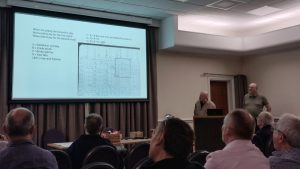
And thus the weekend was over leaving us all heavy with the knowledge gleaned from eminent Doctors, Professors and experts in their field and also filled with an amount of excellent food we just couldn't say no too.
In the end 15 members of the society managed to attend the weekend, with 2 other members who unfortunately had to cancel due to personal reasons.
Overall a thoroughly enjoyable and informative weekend with lots of information to mull over and I'm sure leading to numerous further discussions to be had until next year's BAA Winchester weekend 2024.
[ngg src="galleries" ids="72" display="basic_slideshow"]
The BAA Winchester Programme 2023 is a downloadable and printable as a PDF here: https://britastro.org/wp-content/uploads/2023/04/Winchester-programme-card-2023.pdf
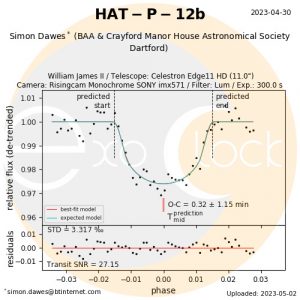
Thankyou to Honor, Jim and Simon for sharing your photos of the weekend.