The Whirlpool Galaxy (M51a) by Diane Clarke

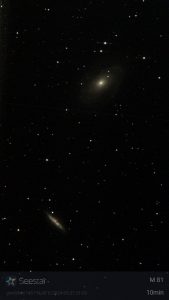
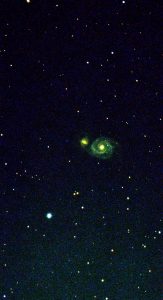
A great image of the Whirlpool Galaxy, also known as Messier 51a (M51a) or NGC 5194 and its companion NGC 5195 taken by member Diane Clarke on the 3rd March 2024. 
 
The Whirlpool Galaxy was the first galaxy to be classified as a spiral galaxy. 
 
NGC 5195, which is also known as Messier 51b (M51b) is a dwarf galaxy and is the smaller object to the upper left to the Whirlpool galaxy in the image. NGC 5195 is gravitationally interacting with the Whirpool Galaxy.  Both galaxies are found in the constellation Canes Venatici.
 
Diane acquired the image using a ZWO SeeStar S50 smart scope, taking 96 x 10sec subs and processed in Affinity photo.
 

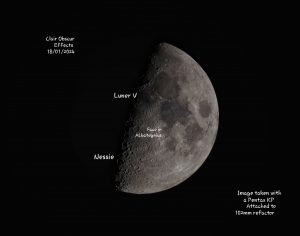
Lunar Clair-obscur Effects – French for “light” (clair) and “shadow” (obscur)

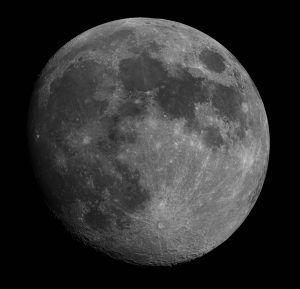
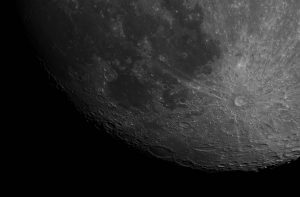
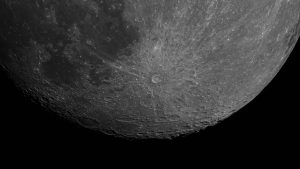
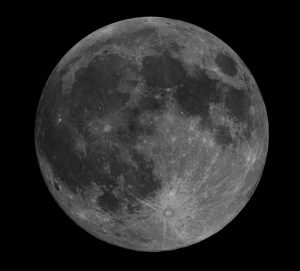
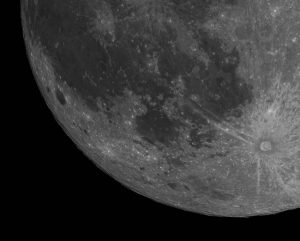
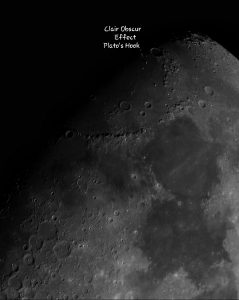
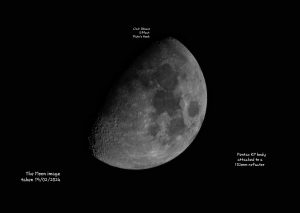
Some fantastic images showing two 'Clair-obscur' effects visible on the surface of the Moon taken by member Jim Burchell on the 19th & 20th January 2024.
 
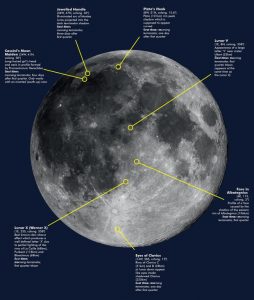
Clair-obscur effects are revealed when light and shadow interact with the Moon's craters and other features to trick the eye into seeing something that isn’t really there.  Below are 7 of the best recognisable shapes created on the surface of the Moon.
Photo ref:https://www.skyatnightmagazine.com/advice/skills/clair-obscur-effects-on-moon
 
Most Clair-obscur effects require specific timing. Some last for days and are easy to see. Others last for a few hours and are more challenging.  Clair-obscur effects on the Moon are not one-time or rare events; this is because lunar lighting patterns repeat in a cycle of approximately 29.5 days, so each effect can be observed from somewhere on Earth once every month.
 
All of Jim's images below were a single shot; taken with a Pentax KP body attached to 102mm Altair Astro refractor. The images where then processed in Snapseed.
 
Lunar V
 
Plato's Hook
 
For more information about Clair-obscur effects check out:

The Sun by Jim Burchell – 1st March 2024

NEVER LOOK AT THE SUN DIRECTLY. Please click here for solar observing safely.
 
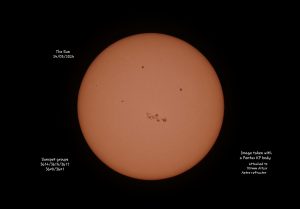
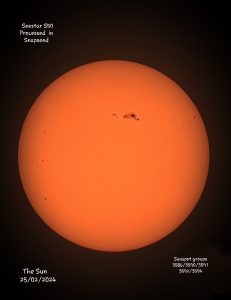
Super image of the Sun taken by member Jim Burchell on the 1st March 2024.
 
The image was taken using a Pentax KP body set at Iso 200 & 1/400 sec, attached to a 102mm F14 Altar Astro refractor fitted with a solar filter (baader solar film). The image was then processed in Snapseed.
 

IC434, Horsehead Nebula and NGC2024 Flame Nebula by Kevin Langford

A fantastic image of IC434, the Horsehead Nebula & Flame Nebula (NGC2024) in the constellation Orion by member Kevin Langford. The image was taken on the 19th January 2024 from Bexley, Kent.

Kevin acquired his image using a ES 102ED APO, 0.7x focal reducer corrector, EQ5 Pro, ZWO ASI071, Orion MMAG and a L-enhance filter.  A total of 2.45 hours of exposures.

IC434 is a bright emission nebula in Orion. It was discovered on February 1, 1786 by William Herschel.

The Horsehead Nebula is a small dark nebula silhouetted against IC 434 and is located near to the star Alnitak (ζ Orionis) which is a triple star system at the eastern end of Orion's belt.  The Horsehead Nebula is approximately 1,375 light-years from Earth. It is one of the most identifiable nebulae because of its resemblance to a horse's head.  

The Flame Nebula (NGC2024) is also an emission nebula, it has a radius of 6 light-years and located about 1350 light-years away from Earth.

AstroFest 2024

[et_pb_section fb_built="1" _builder_version="4.24.0" _module_preset="default" global_colors_info="{}"][et_pb_row _builder_version="4.24.0" _module_preset="default" global_colors_info="{}"][et_pb_column type="4_4" _builder_version="4.24.0" _module_preset="default" global_colors_info="{}"][et_pb_text _builder_version="4.24.0" _module_preset="default" global_colors_info="{}"]

Many members have been at AstroFest this weekend, but it looks like the cost of living crisis and high prices seem to be having an impact, with many retailers and manufacturers not exhibiting at AstroFest this year. At least there isn't the crush of people from past years and a bit more space to have a coffee and cake or get get some practice in docking to the ISS.

[/et_pb_text][et_pb_text _builder_version="4.24.0" _module_preset="default" global_colors_info="{}"]

[ngg src="galleries" ids="79" display="basic_slideshow" arrows="1" show_thumbnail_link="0"]

[/et_pb_text][/et_pb_column][/et_pb_row][/et_pb_section]

Janice Receives the Lydia Brown Medal from the BAA

[et_pb_section fb_built="1" _builder_version="4.24.0" _module_preset="default" global_colors_info="{}"][et_pb_row _builder_version="4.24.0" _module_preset="default" global_colors_info="{}"][et_pb_column type="4_4" _builder_version="4.24.0" _module_preset="default" global_colors_info="{}"][et_pb_text _builder_version="4.24.0" _module_preset="default" global_colors_info="{}"]

Janice received the Lydia Brown medal from the BAA in recognition of meritorious service to the Association in an honorary capacity over many years.

[/et_pb_text][/et_pb_column][/et_pb_row][et_pb_row column_structure="1_3,1_3,1_3" _builder_version="4.24.0" _module_preset="default" global_colors_info="{}"][et_pb_column type="1_3" _builder_version="4.24.0" _module_preset="default" global_colors_info="{}"][et_pb_text _builder_version="4.24.0" _module_preset="default" global_colors_info="{}"]

IMG-20240120-WA0005

[/et_pb_text][/et_pb_column][et_pb_column type="1_3" _builder_version="4.24.0" _module_preset="default" global_colors_info="{}"][et_pb_text _builder_version="4.24.0" _module_preset="default" global_colors_info="{}"]

IMG-20240120-WA0006

[/et_pb_text][/et_pb_column][et_pb_column type="1_3" _builder_version="4.24.0" _module_preset="default" global_colors_info="{}"][et_pb_text _builder_version="4.24.0" _module_preset="default" global_colors_info="{}"]

IMG-20240120-WA0008

[/et_pb_text][/et_pb_column][/et_pb_row][/et_pb_section]

Occultation of Asteroid 2000 SZ278

[et_pb_section fb_built="1" theme_builder_area="post_content" _builder_version="4.24.0" _module_preset="default"][et_pb_row _builder_version="4.24.0" _module_preset="default" theme_builder_area="post_content"][et_pb_column _builder_version="4.24.0" _module_preset="default" type="4_4" theme_builder_area="post_content"][et_pb_text _builder_version="4.24.0" _module_preset="default" theme_builder_area="post_content" hover_enabled="0" sticky_enabled="0"]

Observation of an occultation by Asteroid 2000 SZ278 using an eVscope by Mike Rushton.
 
Mike has just started analysing these himself rather than sending them off to California for a bot to do the work.
Asteroid 2000 SZ278 which is a Main Belt member and only 1.2km in diameter passed in front of a 13th Mag star. The shadow crossed Kent and blocked the stars light for 2.2 secs.
You can clearly see this in the light curve (The time series data are 0.3 secs apart.)
 
[caption id="" align="aligncenter" width="704"]2000-SZ278OCCULTATION-20240126 Occultation by Asteroid 2000 SZ278 on 2024-01-26[/caption]

[/et_pb_text][/et_pb_column][/et_pb_row][/et_pb_section]

The Moon – 17th Dec 2023

A lovely image of a Waxing Crescent Moon taken on the 17th Dec 2023 by member Honor Wheeler. On this day the Moon was 4.72 days old, 27.01% illuminated and in the constellation Aquarius.

The image was taken using a Skywatcher ED80 Refractor, Skywatcher EQ3 Synscan mount, x2 Barlow, Canon M6 MRKII Camera set at ISO100 and exp. 1/20s.

TOP