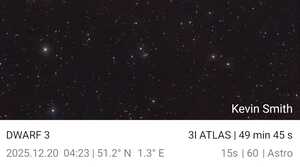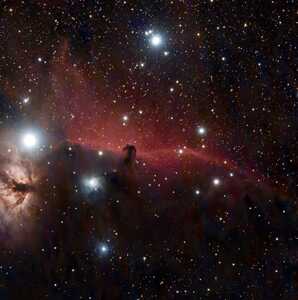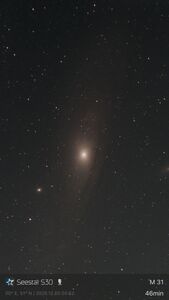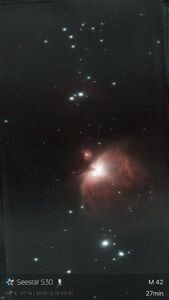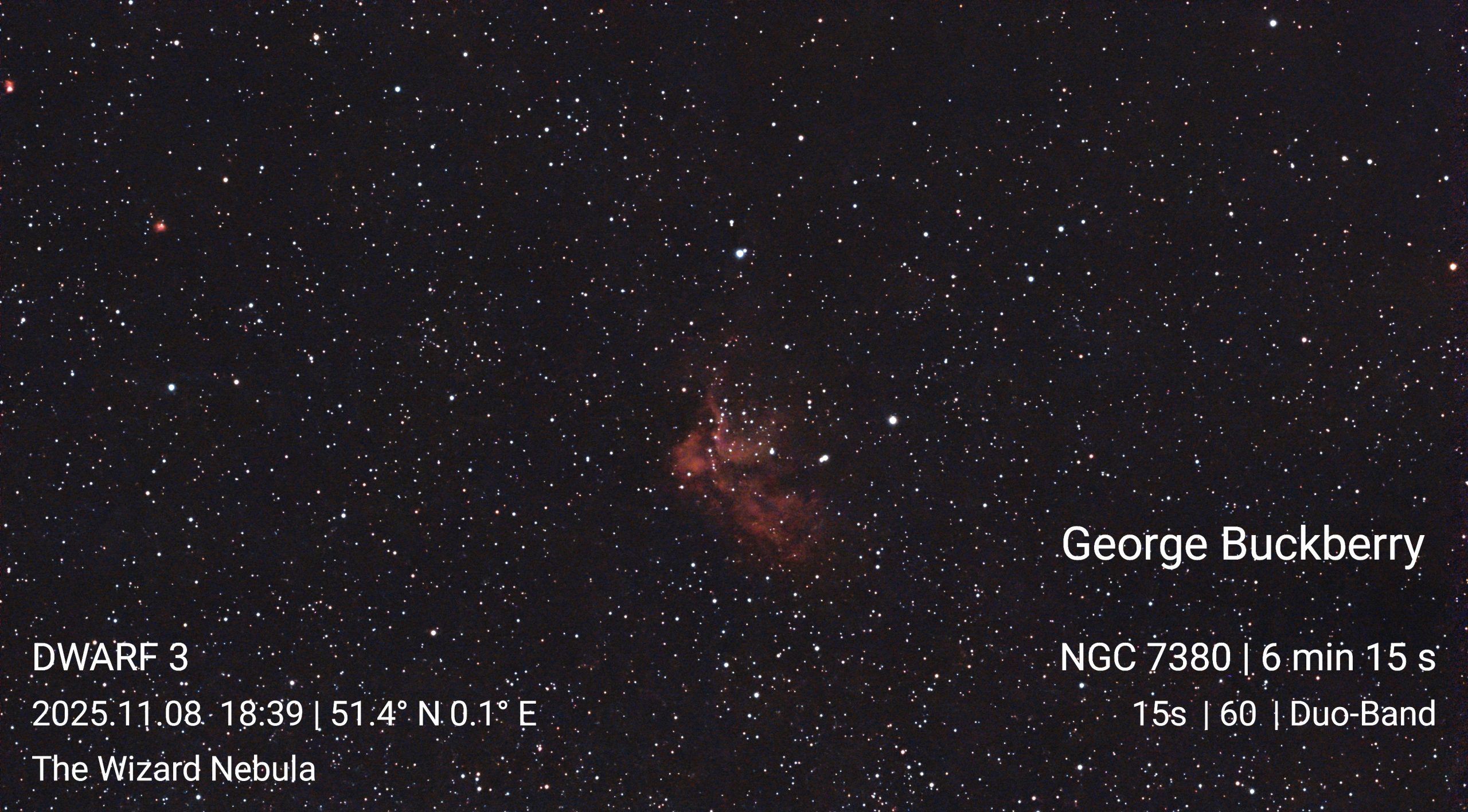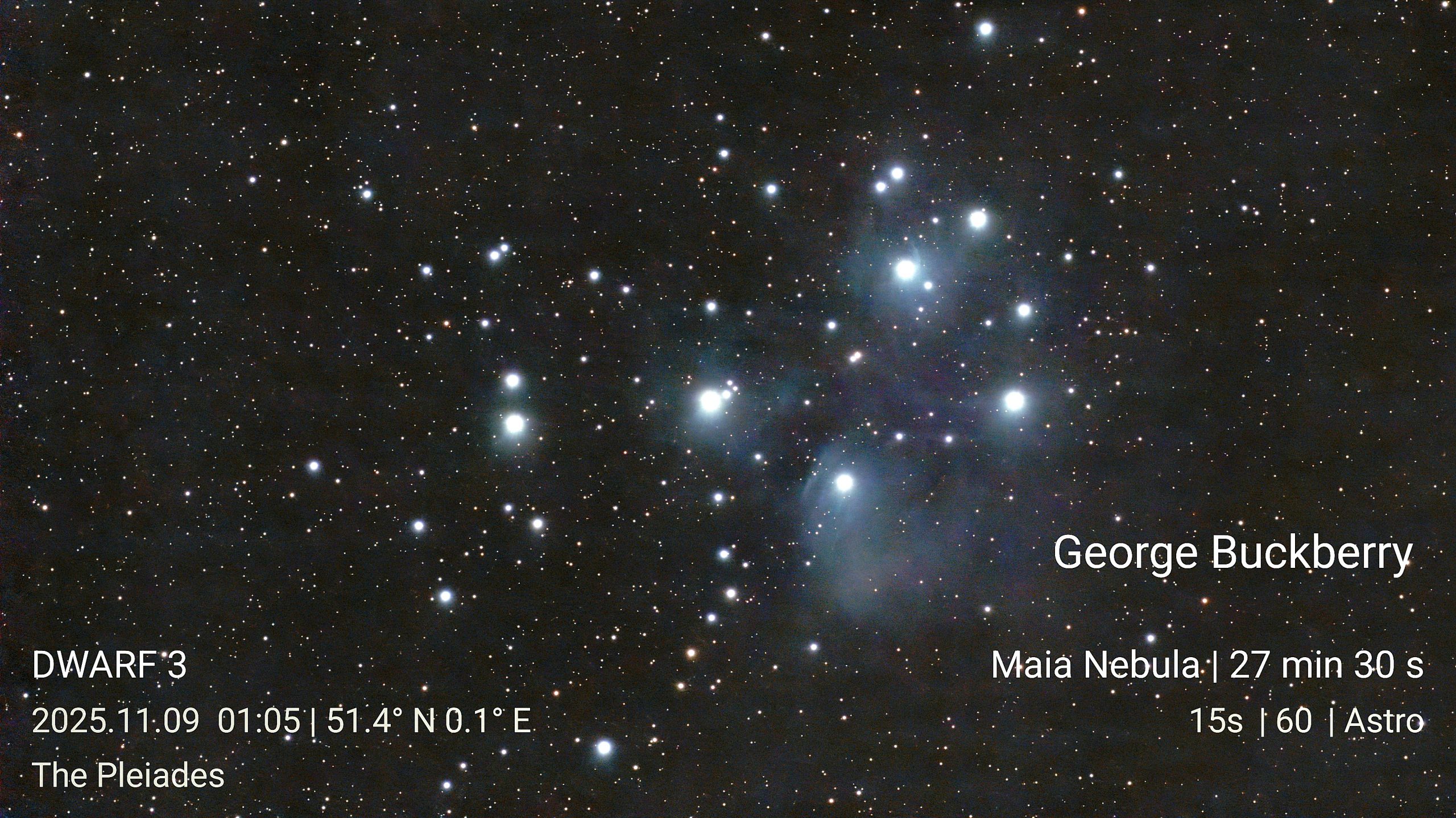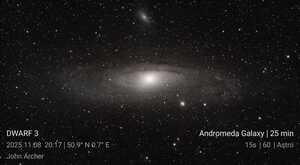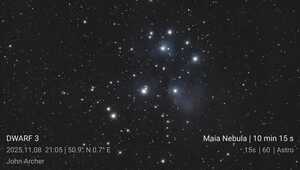
Two fantastic deep sky images by member John Archer taken on the 8th November 2025 using his Dwarf3 smartscope. Details of how John took his images are on the photos.


Astronomy every Thursday
Two fantastic deep sky images by member John Archer taken on the 8th November 2025 using his Dwarf3 smartscope. Details of how John took his images are on the photos.


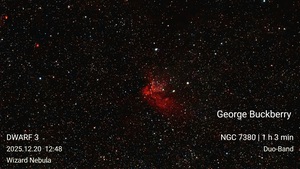
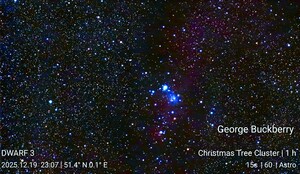
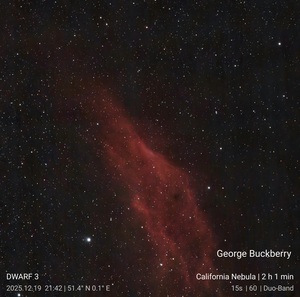
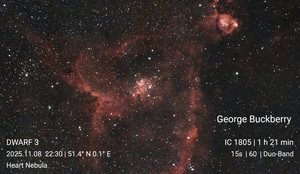
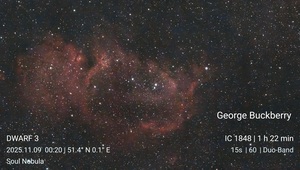
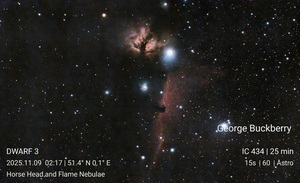
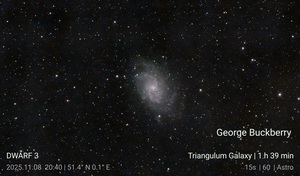
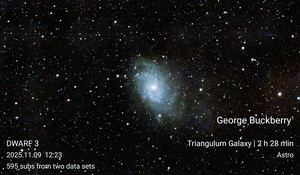
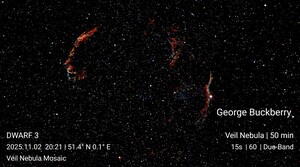
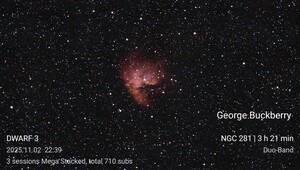
Three super images by member George Buckberry taken on the 2nd November 2025 using a Dwarf3 smart scope. All the images were run through Stella Studio.


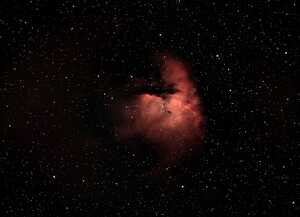
''Shot with an 89% Moon which made processing a challenge!! But, Gradient X Terminator saved the day!!'' said Neil
Image taken using - AA115mm APO, EQ6 R, ZWO ASI294MC Pro, Optolong L Enhance Filter, Orion 50mm Guide Scope and ZWO ASI290 MM Guide Camera.
Processed using APT, PHD, Nebulosity, PS (Camera Raw), Star X Terminator, and Gradient X Terminator.
45 x 240s Light, 12 x Darks, 30 x Flats/Bias
St Marys Platt, Kent 02/11/2025.
To see a higher resolution image of the nebula taken by Neil click the link below to be taken to Neil's flickr page at https://www.flickr.com/photos/137388222@N05/54905884718/
Two super deep sky images by member Kevin Smith taken using his Dwarf3 smart scope from Deal in Kent. The first image is of the North American Nebula and the second of the Maia Nebula.
The North America Nebula, also known as NGC 7000 or Caldwell 20, is an emission nebula in the constellation Cygnus, close to the star Deneb. It is named because its shape resembles North America.

The Maia Nebula is a bright reflection nebula in the Pleiades cluster (M45) within the constellation Taurus. The nebula has the designation NGC 1432 in the New General Catalogue. The Maia Nebula is illuminated by and surrounds the blue giant star Maia (20 Tauri), the fourth brightest star in Messier 45 and is composed of interstellar dust that reflects the star's light creating a distinct ethereal appearance. It is approximately 400 light-years from Earth.

A superb image of the Lobster Claw Nebula with the Bubble Nebula taken on Monday 22nd September 2025 from Bexley by CMHASD member Kevin Langford.

The Lobster Claw Nebula, also known as Sharpless 157 (Sh2-157), is an emission nebula located in the constellation Cassiopeia about 11,000 light-years from Earth. Its name comes from its distinct shape, which resembles a lobster's claw and is formed by glowing gas, dark dust, and stars.
To the left of the claw in the image, you can see NGC 7635 - the Bubble Nebula, which is much more widely known. Also visible is the star cluster NGC 7510, above the lobster claw pincers (Chelae).
Kevin's image consists of 3hrs in total of exposures.
Kevin acquired the image using an ES 102ED APO, 0.7x focal reducer corrector, Pegasus NYX-101, ZWO ASI071, Orion MMAG, L-eNhance filter.
It was then processed in Siril and Affinity photo.
To see a more detailed view of the image check out Kevin's Flickr page at https://www.flickr.com/photos/77708720@N08/54809019524/

The Eastern Veil Nebula, also known as NGC 6992, is an expanding supernova remnant in the constellation Cygnus, bordering the constellation Vulpecula. It was formed by the explosion of a massive star 20 times more massive than the Sun that exploded approximately 8,000 to 10,000 years ago. It is composed of heated gas and dust and is part of a larger structure called the Cygnus Loop.

A superb image of the Soul Nebula (IC1848) in Cassiopeia taken by member Kevin Langford from Bexley, Kent.
This image was captured over three nights from the 2nd to the 4th March 2025.
Number of images taken = 130 x 180sec

Kevin took this image using an ES102ED APO with 0.7x focal reducer corrector, Pegasus NYX-101 mount, ZWO asi071, Orion NMAG and a L-enhance filter.
The image is a total of 6.5hrs of exposures.
Software used:
Nina to capture data.
Sirilic to stack images.
Siril to processes image.
Affinity Photo 2 to finish.
Check out Kevin's Flickr page at https://www.flickr.com/photos/77708720@N08/54380781459/ .
A stunning image of the Rosette Nebula (also known as Caldwell 49) in the constellation Monoceros by CMHASD member Neil Webster taken on the 2nd March 2025.

Neil acquired his image using a WO GT71 Apo, EQ6 R, ZWO ASI 294MC Pro, Astro Essentials 50mm guide scope, ZWO ASI 290MM guide camera and an Optolong L Enhance filter.
Processed using APT, PHD, Nebulosity, Gradient Xterminator, Star Xterminator, and PS (Camera Raw)
52 x 240s Subs, 12 x Darks, 45 x Flats/ Bias.
Check out Neil's Flickr page at https://www.flickr.com/photos/137388222@N05/ to see more of his brilliant images.
A wonderful widefield image of the Horsehead Nebula (IC 434) in Orion; taken on the 3rd Feb 2025 by member Neil Webster.

Neil acquired his image using a WO GT71 Apo, EQ6 R, 0.8x Reducer/Flattener, ZWO ASI 294 MC, 50mm Guide Camera, ZWO 290MM Guide Camera, and a Optolong L Enhance filter.
33 x 240s Subs, 10 x Darks, 45 x Flats/Bias
Processed using APT, PHD, Nebulosity, and Photoshop.
NEVER LOOK AT THE SUN DIRECTLY. Please click here for solar observing safely.
A superb selection of member images taken on Friday 3rd January 2025.
The Sun at midday taken by Dr Mike Rushton taken using a Dwarf II smart scope. 20 x 1/250 sec at Gain 0 with a ND6 solar filter.

The Sun taken by Honor Wheeler

The Sun taken by Jim Burchell

The Pleiades by Dr Mike Rushton using a Dwarf II smart scope. 200 x 10sec exposures at Gain 60.

Crescent Moon and Venus taken by Honor Wheeler. Venus is top right of the Moon.

Saturn, Venus and the Moon taken by Honor Wheeler. Venus is top right of the Moon and Saturn is near the top left corner of the image.