Open Cluster in Vulpecula, NGC 6940

[et_pb_section bb_built="1"][et_pb_row][et_pb_column type="4_4"][et_pb_text _builder_version="3.19.3"]

Open Cluster in Vulpecula.

Observation:

The cluster is bright enough to be seen even with small binoculars, which can partially resolve it.

[/et_pb_text][/et_pb_column][/et_pb_row][et_pb_row][et_pb_column type="4_4"][et_pb_text admin_label="Images by Neil Webster" _builder_version="3.18.7" saved_tabs="all" global_module="3174"]

Images by Neil Webster

[/et_pb_text][/et_pb_column][/et_pb_row][et_pb_row][et_pb_column type="4_4"][et_pb_text admin_label="Neil Webster Image" _builder_version="3.19.3"]

NGC 6940 Sept 2018NW

Altair Astro 115 APO, NEQ6, Canon 600D, ISO800, f/7, ZWO ASI385MC
Exposure 35x 120s
St Marys Platt, England
2018/10/06

[/et_pb_text][/et_pb_column][/et_pb_row][/et_pb_section]

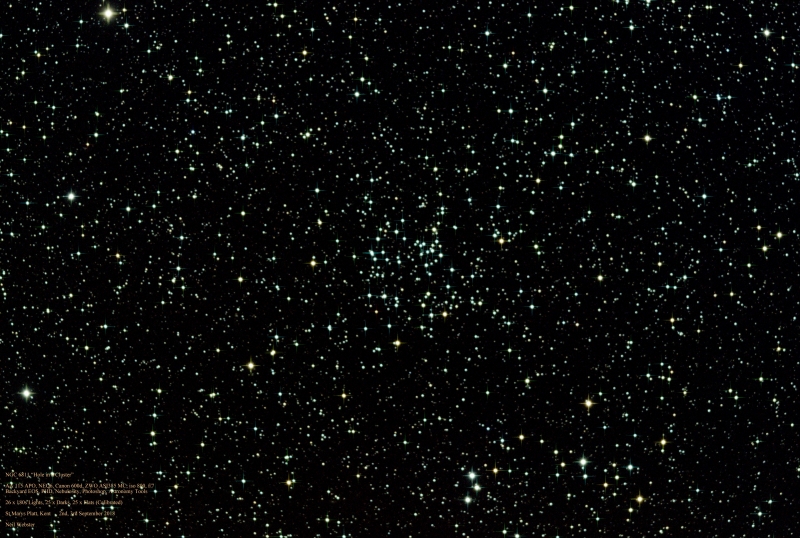
Open Cluster, NGC 6811 in Cygnus

[et_pb_section bb_built="1"][et_pb_row][et_pb_column type="4_4"][et_pb_text _builder_version="3.19.3"]

NGC 6811 is an open cluster in the constellation of Cygnus. It has an angular size half that of the full Moon and includes about 1000 stars of roughly similar magnitude. It has also been called "The Hole in the Cluster" because of its dark centre.

Observing:

It appears as a hazy patch in 10x binoculars, but it is best seen at around 70x with a moderate-aperture telescope.

[/et_pb_text][/et_pb_column][/et_pb_row][et_pb_row][et_pb_column type="4_4"][et_pb_text admin_label="Images by Neil Webster" _builder_version="3.18.7" saved_tabs="all" global_module="3174"]

Images by Neil Webster

[/et_pb_text][/et_pb_column][/et_pb_row][et_pb_row][et_pb_column type="4_4"][et_pb_text admin_label="NW Image" _builder_version="3.19.3"]

NGC 6811 Sept 2018NW

'Hole in a Cluster'
Altair Astro 115 APO, NEQ6, Canon 600D, ZWO AS1385 MC, ISO 800, f/7
Exposure: 26x 180s
St Marys Platt, England

[/et_pb_text][/et_pb_column][/et_pb_row][/et_pb_section]
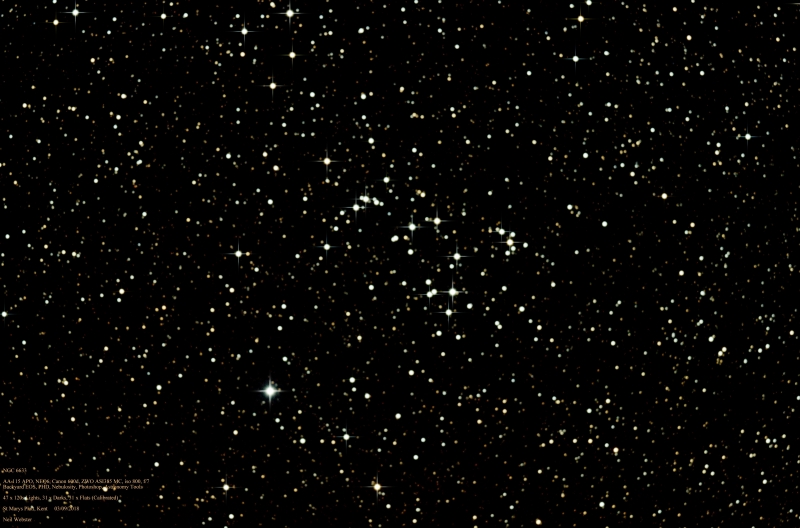
Open Cluster, NGC6633 in Ophiuchus

[et_pb_section bb_built="1"][et_pb_row][et_pb_column type="4_4"][et_pb_text _builder_version="3.19.3"]

NGC 6633 is an open cluster, in the constellation Ophiuchus. Discovered in 1745-46 by Philippe Loys de Chéseaux and independently rediscovered by Caroline Herschel, and catalogued as H VIII.72.

This cluster is nearly as large as the full moon, and contains 30 stars which make it shine at a total magnitude of 4.6; the brightest star is of mag 7.6. Its age was estimated at 660 million years.

[/et_pb_text][/et_pb_column][/et_pb_row][et_pb_row][et_pb_column type="4_4"][et_pb_text admin_label="Images by Neil Webster" _builder_version="3.18.7" saved_tabs="all" global_module="3174"]

Images by Neil Webster

[/et_pb_text][/et_pb_column][/et_pb_row][et_pb_row][et_pb_column type="4_4"][et_pb_text _builder_version="3.19.3"]

NGC 6633 Sept 2018NWAltair Astro 115 APO, NEQ6, Canon 600D, ZWO AS1385 MC, ISO 800, f/7
Exposure 47x 120s

St Marys Platt, England

[/et_pb_text][/et_pb_column][/et_pb_row][/et_pb_section]

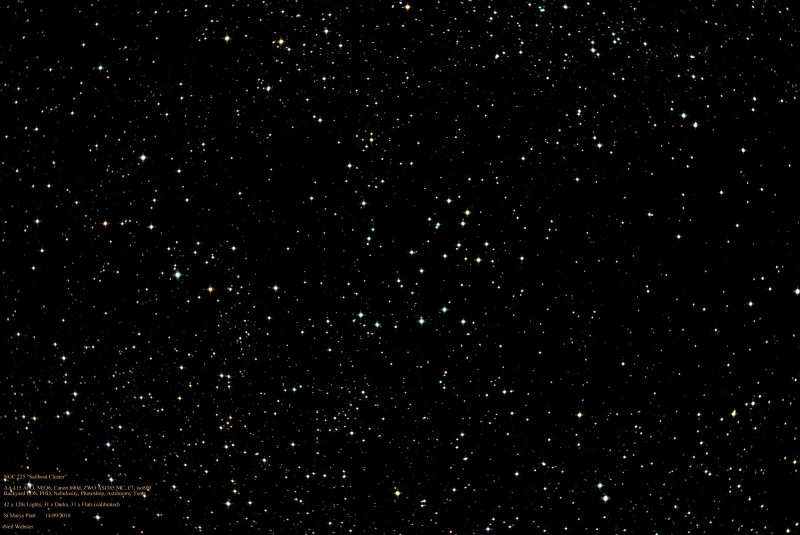
Open Cluster, NGC225 in Cassiopeia

[et_pb_section bb_built="1"][et_pb_row][et_pb_column type="4_4"][et_pb_text _builder_version="3.19.3"]

NGC255, the Sail Boat Cluster is an open cluster in Cassiopeia.

[/et_pb_text][/et_pb_column][/et_pb_row][et_pb_row][et_pb_column type="4_4"][et_pb_text admin_label="Images by Neil Webster" _builder_version="3.18.7" saved_tabs="all" global_module="3174"]

Images by Neil Webster

[/et_pb_text][/et_pb_column][/et_pb_row][et_pb_row][et_pb_column type="4_4"][et_pb_text _builder_version="3.19.3"]

NGC 225 finalNW
NGC255, open cluster, Sail Boat Cluster in Cassiopeia, Image by Neil Webster
Altair Astro 115 APO
Canon 600D, ZWO AS1385 MC, F7, ISO800, Exposure 42x 120s
Taken on 14/09/2018, St. Marys Platt, England.

[/et_pb_text][/et_pb_column][/et_pb_row][/et_pb_section]

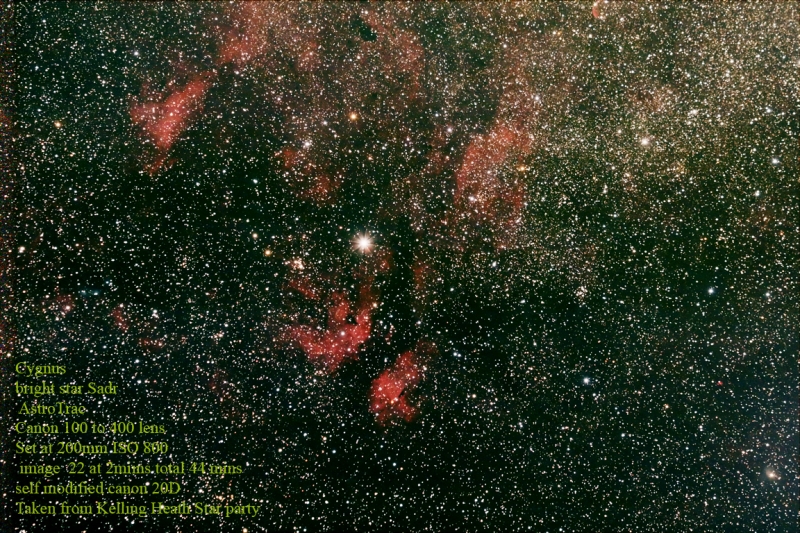
Gamma Cygni Nebula, IC1318

[et_pb_section bb_built="1"][et_pb_row][et_pb_column type="4_4"][et_pb_text _builder_version="3.12.2"]

The Gamma Cygni Nebula describes the patches of nebulosity around Gamma Cygni,  Sadr and consists of emission nebulae, dark dust clouds and star clusters. The area spams 3 degrees of sky so is a good subject to image with a small wide field refractor or prime lens on a tracking mount.

[/et_pb_text][/et_pb_column][/et_pb_row][et_pb_row][et_pb_column type="1_4"][et_pb_text admin_label="JT Image" _builder_version="3.12.2"]

sadr_jt01

[/et_pb_text][/et_pb_column][et_pb_column type="3_4"][et_pb_text admin_label="Julian Tworek Text" _builder_version="3.12.2"]

Gamma Cygni Nebula, imaged by Julian Tworek.
Canon 100-400 zoom lens set to 200m, ISO800, 22x2min exposures. Modified Canon 20D

[/et_pb_text][/et_pb_column][/et_pb_row][/et_pb_section]

Face on Spiral in Aquila, NGC6814

[et_pb_section bb_built="1"][et_pb_row][et_pb_column type="4_4"][et_pb_text _builder_version="3.12.2"]

This face on spiral galaxy lies at a distance of about 66 million light years and is about 75,000 light years across or about half the size of the Milky Way Galaxy. This object has a fairly low surface brightness, and so will be a tougher to observe than the mag 11.3 would suggest. You'll need dark skies and a large aperture to really appreciate this. 

[/et_pb_text][/et_pb_column][/et_pb_row][et_pb_row][et_pb_column type="1_4"][et_pb_text admin_label="DH Image" _builder_version="3.12.2"]

NGC6814_DH01

[/et_pb_text][/et_pb_column][et_pb_column type="3_4"][et_pb_text admin_label="Debrah Holton Text" _builder_version="3.12.2"]

NGC6814, Face on Spiral in Aquila, Imaged by Debra Holton, using the Faulkes 2m telescope

[/et_pb_text][/et_pb_column][/et_pb_row][/et_pb_section]

Globular Cluster in Serpens, NGC6539

[et_pb_section bb_built="1"][et_pb_row][et_pb_column type="4_4"][et_pb_text _builder_version="3.12.2"]

NGC 6539 is a globular cluster in the constellation Serpens. It was discovered by Theodor Brorsen in 1856

[/et_pb_text][/et_pb_column][/et_pb_row][et_pb_row][et_pb_column type="1_4"][et_pb_text admin_label="DH Image" _builder_version="3.12.2"]

NGC6539_DH01

[/et_pb_text][/et_pb_column][et_pb_column type="3_4"][et_pb_text admin_label="Debra Holton Text" _builder_version="3.12.2"]

Globular Cluster NGC6539 Imaged by Debra Holton using the Faulks 2m Telescope.

[/et_pb_text][/et_pb_column][/et_pb_row][/et_pb_section]

Globular Cluster in Baade’s Window, NGC6522

[et_pb_section bb_built="1"][et_pb_row][et_pb_column type="4_4"][et_pb_text _builder_version="3.12.2"]

Two globular clusters very close to each other seen through the dense star field in the direction towards the centre of our Galaxy, in the constellation Sagittarius. These systems are relatively young for globular clusters, being only about 10 million years old.

They can be spotted between gamma1 and W Sagitarii (see finder chart below). NGC6522 (right) sits right in the centre of Baade's Window

[/et_pb_text][/et_pb_column][/et_pb_row][et_pb_row][et_pb_column type="1_4"][et_pb_text admin_label="DH Image" _builder_version="3.12.2"]

NGC6522_DH01

[/et_pb_text][/et_pb_column][et_pb_column type="3_4"][et_pb_text admin_label="Debra Holton Text" _builder_version="3.12.2"]

Image by Debra Holton of NGC6522 taken with the 2m Faulkes Telescope.

[/et_pb_text][/et_pb_column][/et_pb_row][/et_pb_section]

Seyfert’s Sextet, NGC6027

[et_pb_section bb_built="1"][et_pb_row][et_pb_column type="4_4"][et_pb_text _builder_version="3.12.2"]

Seyfert's Sextet is a group of galaxies about 190 million light-years away in the constellation Serpens Caput. The group appears to contain six members, but one of the galaxies is a background object and another "galaxy" is actually a separated part of one of the other galaxies. The gravitational interaction among these galaxies should continue for hundreds of millions of years. Ultimately, the galaxies will merge to form a single giant elliptical galaxy.

[/et_pb_text][/et_pb_column][/et_pb_row][et_pb_row][et_pb_column type="1_4"][et_pb_text admin_label="DH Image" _builder_version="3.12.2"]

NGC6027_DH01

[/et_pb_text][/et_pb_column][et_pb_column type="3_4"][et_pb_text _builder_version="3.12.2"]

NGC 6027 Seyfert's Sextet, imaged by Deborah Holton using the Faulks 2m Telescope

[/et_pb_text][/et_pb_column][/et_pb_row][/et_pb_section]

Edge on Spiral in Serpens – NGC5964

[et_pb_section bb_built="1"][et_pb_row][et_pb_column type="4_4"][et_pb_text _builder_version="3.12.2"]

Edge on Spiral galaxy in Serpens

[/et_pb_text][/et_pb_column][/et_pb_row][et_pb_row][et_pb_column type="1_4"][et_pb_text admin_label="DH Image" _builder_version="3.12.2"]

NGC5964_DH01

[/et_pb_text][/et_pb_column][et_pb_column type="3_4"][et_pb_text admin_label="Deborah Holton Text" _builder_version="3.12.2"]

NGC5964 Imaged by Deborah Holtan using the Faulkes 2m Telescope

[/et_pb_text][/et_pb_column][/et_pb_row][/et_pb_section]

TOP