
Our equipment posts cover the making, modification and use of observatories, telescopes and equipment. Select the posts for more information on the topics.
Time Delay Integration a.k.a Drift Scanning
What is Drift Scanning?
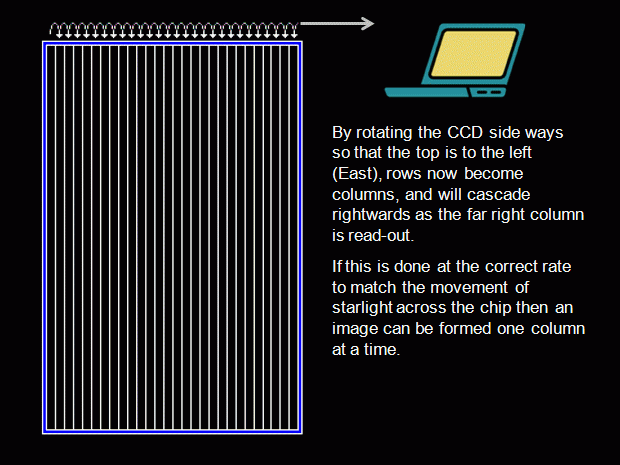
If you try to take an image on an un-driven mount the stars will trail as the Earth rotates. Now imagine a star on a CCD, it will move from pixel to pixel producing a line rather than a point source. Now if we could move the image on the CCD at the same rate as the star is moving across it, we would be able to keep the star as a point source on the image even though it is moving across the CCD. The total time of the exposure would be the time it takes for the star to cross the CCD.
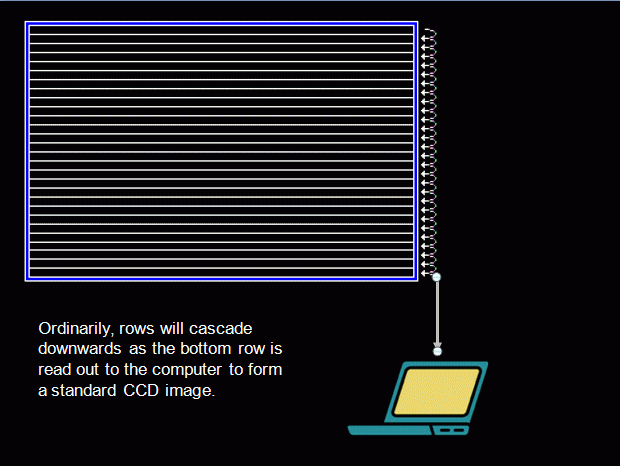
Drift scanning employs a special feature of some CCD cameras, such as the SBIG ST-7XME CCD camera. Data on these CCD’s can be read out one line at a time, and when this is done, the the whole image is shifted, so as the bottom line is read out to the computer, all the other lines move down. If the CCD is rotated correctly it can be read out in the same direction a star travels across it, and if it is read out at the same speed as a star travels across the chip from pixel to pixel we will have pin point stars.
Why Bother
This seems a lot of bother when you could simply drive your mount, so why do it? Well by employing this method it is possible to produce very long images like the one below.
Software
Two pieces of software are available for drift scanning;
Maxim DL (commercial ~$199 to $665)
WinScan 2.33 (freeware) www.driftscan.com
Pros and Cons
The Pros
- The set-up does not have to be driven
- Is simple (?)(!)
- Wide field shots can be taken
- Polar alignment is not required
- Little equipment is needed:CCD camera Telescope / Long Lens
- Tripod
- Laptop
The Cons:
- Pointing, because the image will be a strip of the sky so when you start you won’t be on your target(s)
- Obtaining accurate parallel/perpendicular alignment
- Focussing is a nightmare if not on a driven mount, but is achievable
Setting up the software
Only works with certain focal lengths
Differential trailing can be a problem
Viewing the images (they are large up to 32,000 pixels wide not many viewers will display them
Crayford Eyepiece Mount (Crayford Focuser)
Introduction
Designed and donated to the world by telescope maker and former member John Wall.
The design has two principle features:-
- Restriction of movement of the eyepiece focusing tube to one degree of motion – which is linear – and a secondary motion of rotation.
- The rapid interchange of eyepieces having different magnifications.
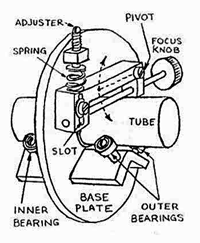
The restricted linear motion is achieved by mounting the eyepiece tube on rollers in a VEE formation using well known kinematic principles. This configuration eliminates side wobble and sticking, and the need to machine high precision bushings for the eyepiece tube in order to achieve accurate focusing action. Most CEM’s use this system only, especially in conjunction with motorised focusing for CCD work. The linear motion is achieved by using a smooth pinion, which bears onto the focusing tube under light pressure.

Classical CEM
Features: VEE block ball race support rollers for eyepiece tube; hinged bracket; actuating lever. The smooth pinion bears directly on the eyepiece tube – one of a suite of removable and interchangeable eyepieces.
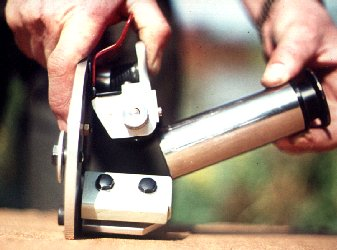
The quick release of the eyepiece tube: note the thumb tab action – this is an alternative to the sidelever.
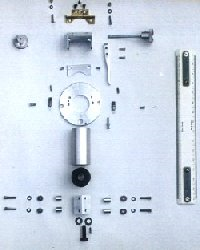
Exploded view of components to make a classical CEM. Scale rule is 300 mm.
The quick action release is the second and more important function of the CEM. By lifting a lever the focusing pinion is moved away from the eyepiece tube, in order to release it. This enables rapid eyepiece changing in the dark. The focusing pinion is mounted on a hinged, spring loaded, bracket. The application of this mode is most useful for visual observations and camera work.
It’s Home!
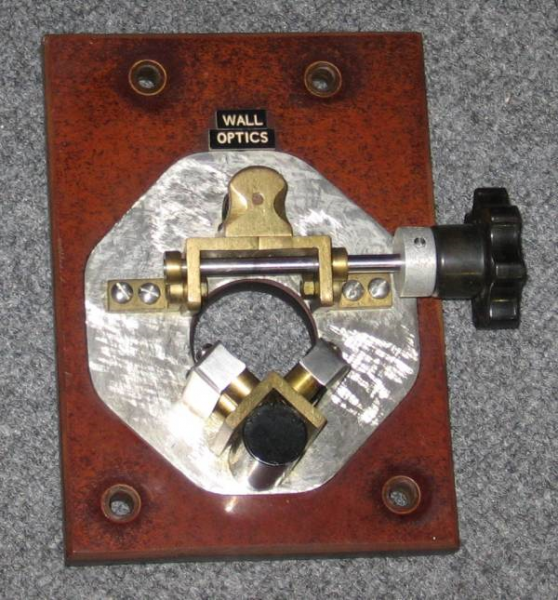
The original Crayford Eyepiece Mount has returned home! It has been donated by creator and telescope maker John Wall and is now on display in its special Perspex box at the Pavilion. Below is a picture of it.
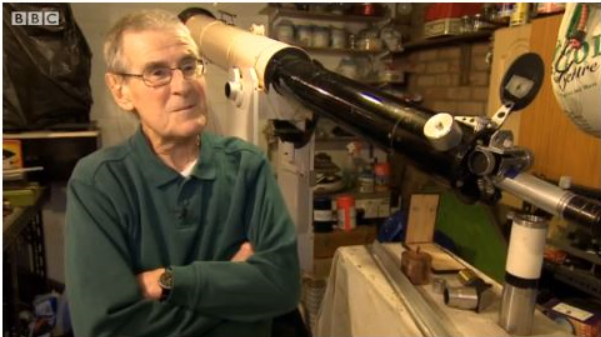
John Wall Interviewed by the BBC
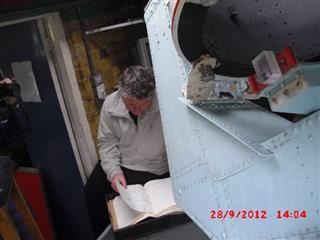
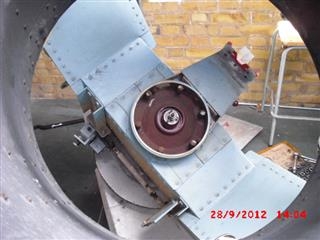
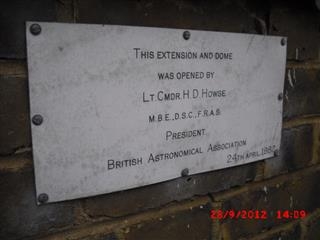
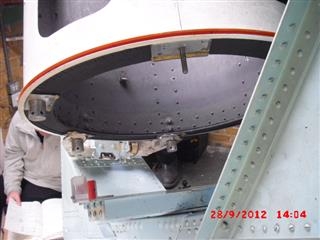
Dismantling the 24 inch Telescope built by John Wall
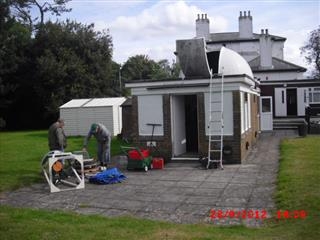
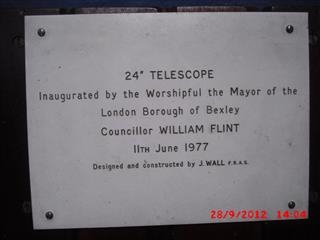
When the Manor house closed in December 2011 we lost our 50 year old observatory so we had to find a new home for our 24″ telescope built by John Wall 🙁
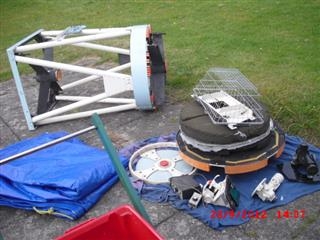
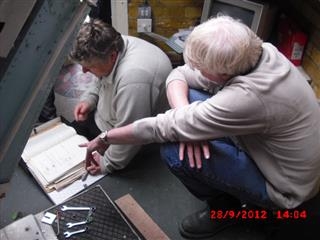
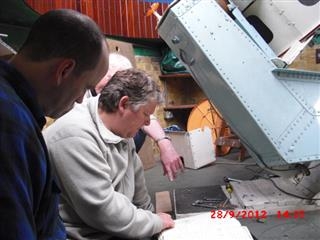
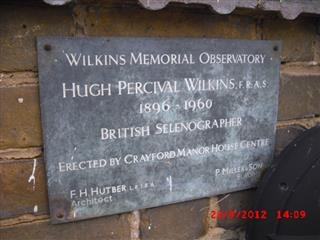
York Astronomical Society agreed to rehouse the telescope. Below are a selection of photos showing what happened that day.



Multiple Papers on the APT
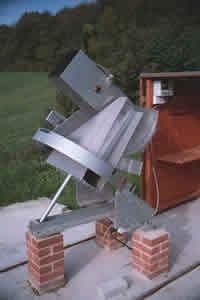
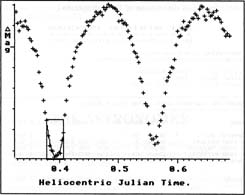
Here we describe the construction and scientific output of the Automatic Photometric Telescope, built in the mid 1980’s the APT became the most productive variable star observation platform in the UK – possibly the world.
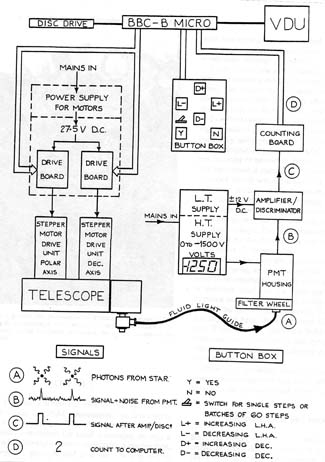
Another first for Crayford Manor House Astronomical Society is the automatic photoelectric telescope designed and built by Jack Ells. This instrument undertakes photometry unaided throughout the night and was the most productive amateur telescope in the UK during it’s use.
Papers:
Microcomputer-assisted photoelectric photometry system
PAPERS_JBAA_100-1-1990 Part 2 and 3
Construction Notes:
No Results Found
The page you requested could not be found. Try refining your search, or use the navigation above to locate the post.