
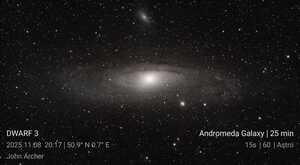
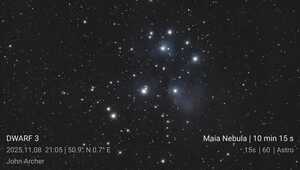
Two fantastic deep sky images by member John Archer taken on the 8th November 2025 using his Dwarf3 smartscope. Details of how John took his images are on the photos.
Astronomy every Thursday
This category will show a few lines from the last 3 items on the home page.
It will also show the full post on the news page
Two fantastic deep sky images by member John Archer taken on the 8th November 2025 using his Dwarf3 smartscope. Details of how John took his images are on the photos.
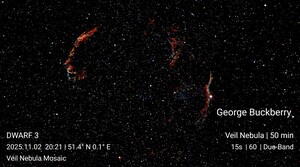
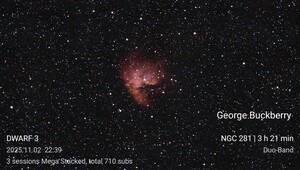
Three super images by member George Buckberry taken on the 2nd November 2025 using a Dwarf3 smart scope. All the images were run through Stella Studio.
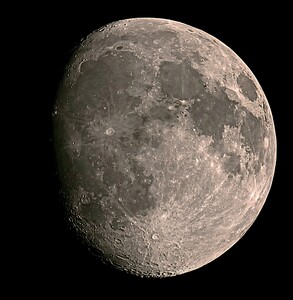
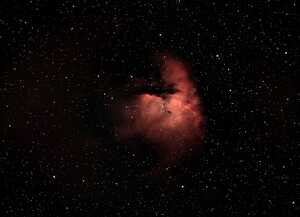
''Shot with an 89% Moon which made processing a challenge!! But, Gradient X Terminator saved the day!!'' said Neil
Image taken using - AA115mm APO, EQ6 R, ZWO ASI294MC Pro, Optolong L Enhance Filter, Orion 50mm Guide Scope and ZWO ASI290 MM Guide Camera.
Processed using APT, PHD, Nebulosity, PS (Camera Raw), Star X Terminator, and Gradient X Terminator.
45 x 240s Light, 12 x Darks, 30 x Flats/Bias
St Marys Platt, Kent 02/11/2025.
To see a higher resolution image of the nebula taken by Neil click the link below to be taken to Neil's flickr page at https://www.flickr.com/photos/137388222@N05/54905884718/
Congratulations to member Honor Wheeler for her image below of the Lunar Eclipse taken on the 7th September 2025 being published in the British Astronomical Association (BAA) Lunar section circular and at the BAA meeting sky notes.
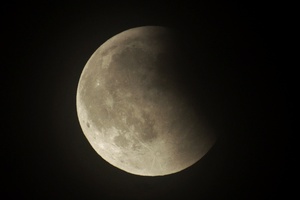
Info: Canon M6II, 18-400mm lens, ISO1000, F6.3 and 1/500sec.
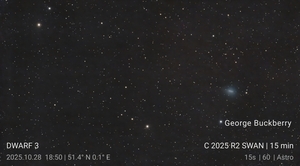
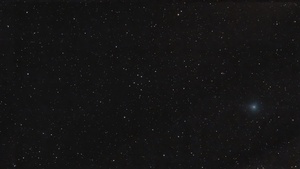
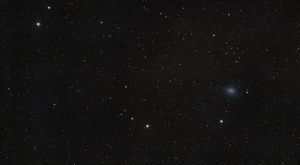
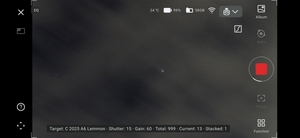
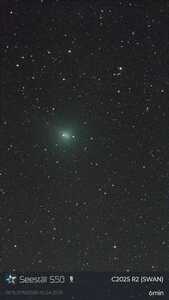
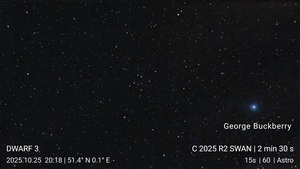
Two super images of Comet C/2025 R2 (SWAN) taken by members Jim Burchell and George Buckberry using their smart scopes.
''C/2025 R2 (SWAN), initially designated as SWAN25B, is a long period comet discovered on September 10, 2025 by Vladimir Bezugly on images captured by the Solar Wind Anisotropies (SWAN) camera of the Solar and Heliospheric Observer (SOHO). At the time of discovery the comet was just a few hours away from its perihelion transit, already as bright as magnitude 7.3 and with a well developed tail.'' Ref:https://theskylive.com/c2025r2-info
Jim Burchell
George Buckberry
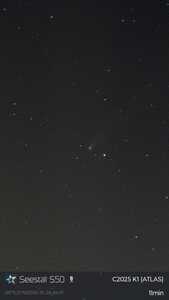
Member Jim Burchell managed to capture the Comet C/2025 K1 Atlas on the 24th October 2025 in Virgo. C/2025 K1 (ATLAS) was discovered in May 2025 by the Asteroid Terrestrial-impact Last Alert System (ATLAS).
On the 24th & 25th October 2025 several CMHASD members took the opportunity to image Comet C/2025 A6 Lemmon whilst there was a break in the clouds or thin cloud. Below are their superb images.
George Buckberry
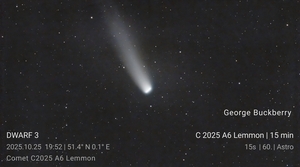
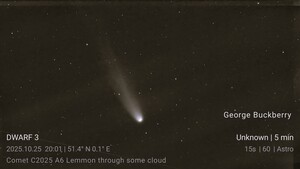
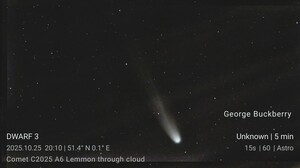
All 3 images taken using a Dwarf3 smart scope on the 25th October 2025.
Jim Burchell
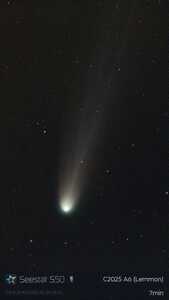
Taken on the 25th October 2025 using a Seestar S50 smart scope.
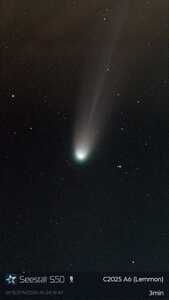
Taken on the 24th October 2025 using a Seestar S50 smart scope.
Mike Rushton
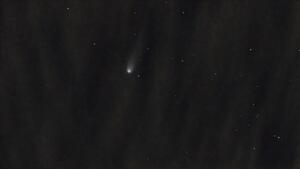
Taken on the 24th October using a Dwarf3 smart scope - looking through thin cloud.
Kevin Smith
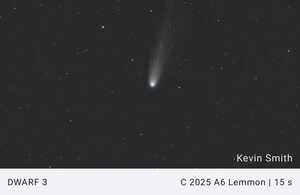
Taken on the 24th October 2025 using a Dwarf3 smart scope.
Honor Wheeler
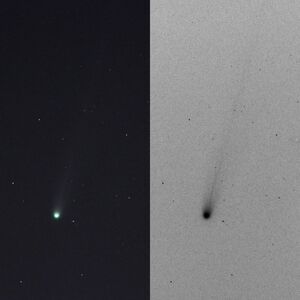
Colour image and an inverted image of the comet taken on the 24th October 2025 at 7.43pm.
Honor used a Canon M6II, Tamron 18-400mm lens and a Skywatcher Star Adventurer mount. The camera settings were ISO1600, F13 and 30sec.
Comet Lemmon, or C/2025 A6 (Lemmon), was discovered by astronomers at the Mount Lemmon Survey, in Arizona, on the 3rd January 2025.
The comet is currently low in the northwestern sky after nightfall in the constellation of Boötes, not far from the bright star Arcturus.
On the 24th Oct it will still be above Arcturus but near the star Izar. (Note: The handle of the Big Dipper points towards Arcturus.), and in the coming days it will move into the constellation Serpens.
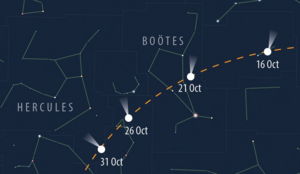
Sky chart showing the location of C/2025 A6 (Lemmon) at the end of October 2025. Credit: Astronomy Now magazine.
On the evening of the 21st Oct 2025, several CMHASD members managed to image the comet quickly through a gap in the clouds or with a thin veil of cloud.
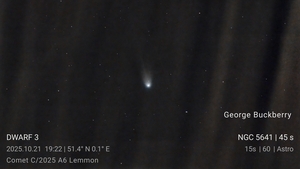
CMHASD member George Buckberry captured the comet at 7:40pm using his Dwarf3 smart scope. His fantastic image below is made up of only 3 stacked images at 15S, gain 60 and Astro filter. Then run through Stellar Studio and no other processing.
The Water mark also shows NGC 5641 which was a little further West at the time George took the images of the comet.
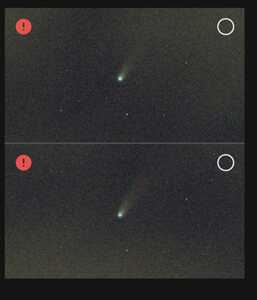
Kevin Smith captured the comet also using a Dwarf3 smart scope on the 21st Oct around the same time as George. His fantastic images are below.
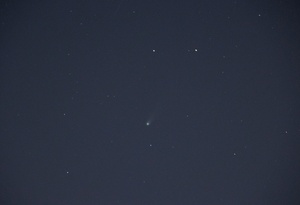
Honor Wheeler captured the comet at 7.19pm using a Canon M6II, Tamron 18-400mm, set at ISO3200, 3" and F6.3. Her superb image is below.
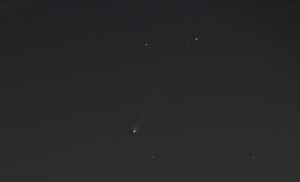
Finally member Jim Burchell captured the comet a little bit later on the 21st Oct at 20:19 BST. Jim used a Pentax KP set at F5.6, 20sec, 135 mm and iso 800 on a Skywatcher star adventure. His super image is below.
On Saturday the 19th July several CMHASD members of the society went to The SAGAS Astronomical Convention. This was a one day event for amateur astronomers and enthusiasts held this year at the South Downs Planetarium & Science Centre, Chichester.
SAGAS was established in 1973 to provide a forum where Astronomical Societies across the South of England to meet, share ideas and discuss issues or concerns of mutual interest. This has allowed member societies to support and inspire each other, and further the interests of their own members.
SAGAS provides a hub that helps Astronomical Societies collaborate and share of knowledge.
Member Diane Clarke wrote....
''The event was hosted by Dr John Mason and the volunteers at the South Downs Planetarium & Science Centre. John can be seen here liaising with one of the volunteer staff, all of whom looked after us throughout the day.
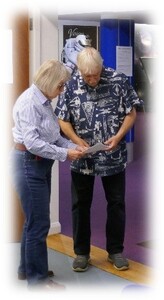
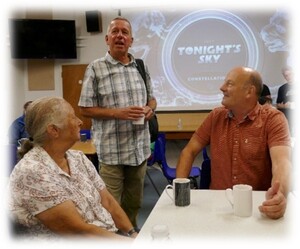
Nick James, the BAA Comet section director spoke to us about viewing comets such as “C/2020 f3 Neowise among others from various locations and Mr Ian Sharp spoke to us about getting started with Photometry. Nick & Ian can be seen in this photo chatting with CMHASD member Rita Whiting.
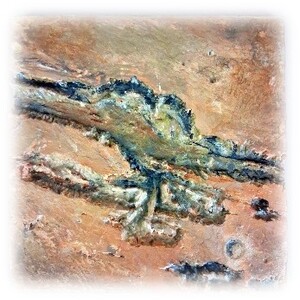
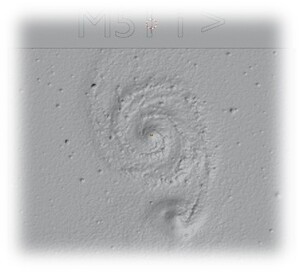
Dr Nicolas Bonne, a Public Engagement and Outreach Fellow, from the University of Portsmouth spoke to us about making astronomy accessible to the visually impaired community. This was achieved by using 3D printed models such as the Martian Grand Canyon, known as the Valles Marineris and The Whirlpool galaxy also known as Messier 51.
Dr Samantha J. Penny from the University of Portsmouth, spoke to us about a ''Universe of Tiny Galaxies'' with regard to how they helped illuminate the universe with UV light clearing the fog of hydrogen gas that permeated the universe in its first billion years.
Dr Kathy Romer from the University of Sussex spoke to us about ''Explaining Cosmology through Analogies'' using such everyday items as a chocolate orange & a cheese triangle.


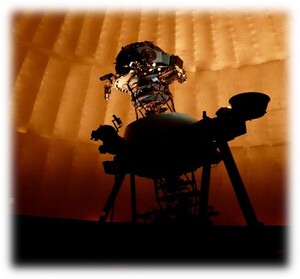
Then to finish the day Dr John Mason took us on a virtual trip to see ''The Skies Over Southern England in 15000 CE'' using the Planetarium’s 48-year-old Viewlex-Minolta S-IIb star projector. To quote John “We use this venerable projector to give pin point stars”.
The whole day was very interesting & enjoyable and I look forward to the next one!''