
On the 25th August 2026 a new Nova in the constellation Sagitta was discovered.
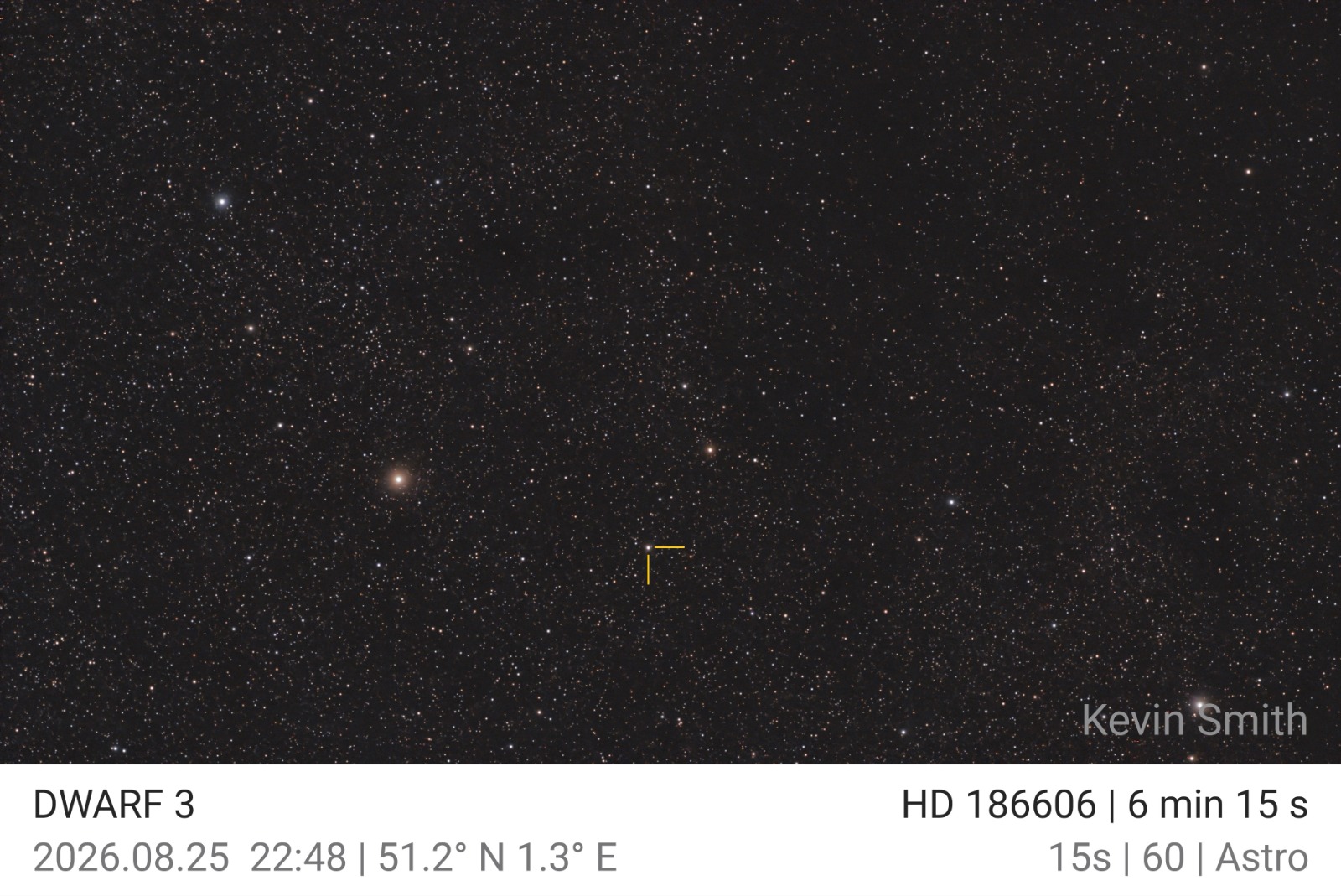
A few hours after the announcement member Kevin Smith managed to take an image of it using his Dwarf3 smart scope and posted it on the BAA forum https://britastro.org/forums/topic/likely-bright-nova-in-sagitta
The Nova is highlighted on Kevin’s image by the 2 small yellow lines at right angles to each other. The bright star to the left is delta Sagittae.
”The object was picked up on August 25, 2026, by the NMW-TexasTech survey, one of several automated sky-patrol programs that scan wide swaths of sky night after night looking for exactly this kind of change. Within the same day, amateur astronomer K. Yoshimoto in Yamaguchi, Japan, logged a magnitude of 7.42 — a striking brightness for an object that, by all indications, wasn’t visible at all before the eruption. The discovery was formalized through the Central Bureau for Astronomical Telegrams (CBAT), the Harvard-hosted clearinghouse astronomers have relied on for over a century to rapidly circulate news of transient objects. CBAT assigned it the provisional designation PNV J19450648+1822422, pinning its position at RA 19h45m06.48s, Dec +18°22’42.2″
Provisional designations don’t last long once a spectrum comes in. Follow-up spectroscopy revealed the signature astronomers were watching for: clear P Cygni profiles in the hydrogen-alpha and hydrogen-beta lines, with expansion velocities around 1,500 kilometers per second. That combination — a blueshifted absorption trough sitting next to an emission peak, produced by material blasting outward from the star faster than the speed of a jet engine’s exhaust by a factor of thousands — is close to a textbook confirmation of a classical nova. The object has since been given its permanent variable-star name: Nova Sagittae 2026, or V488 Sge.” Ref:https://www.cosmicherald.com/article/nova-sagittae-v488-sge-2026
http://www.cbat.eps.harvard.edu/unconf/followups/J19450648+1822422.html
https://vsx.aavso.org/index.php?view=detail.top&revid=852445