
Below are a super selection of 15 images of the Moon taken by Simon Dawes from Bexley. Details of how and when Simon acquired the images are on the photos.
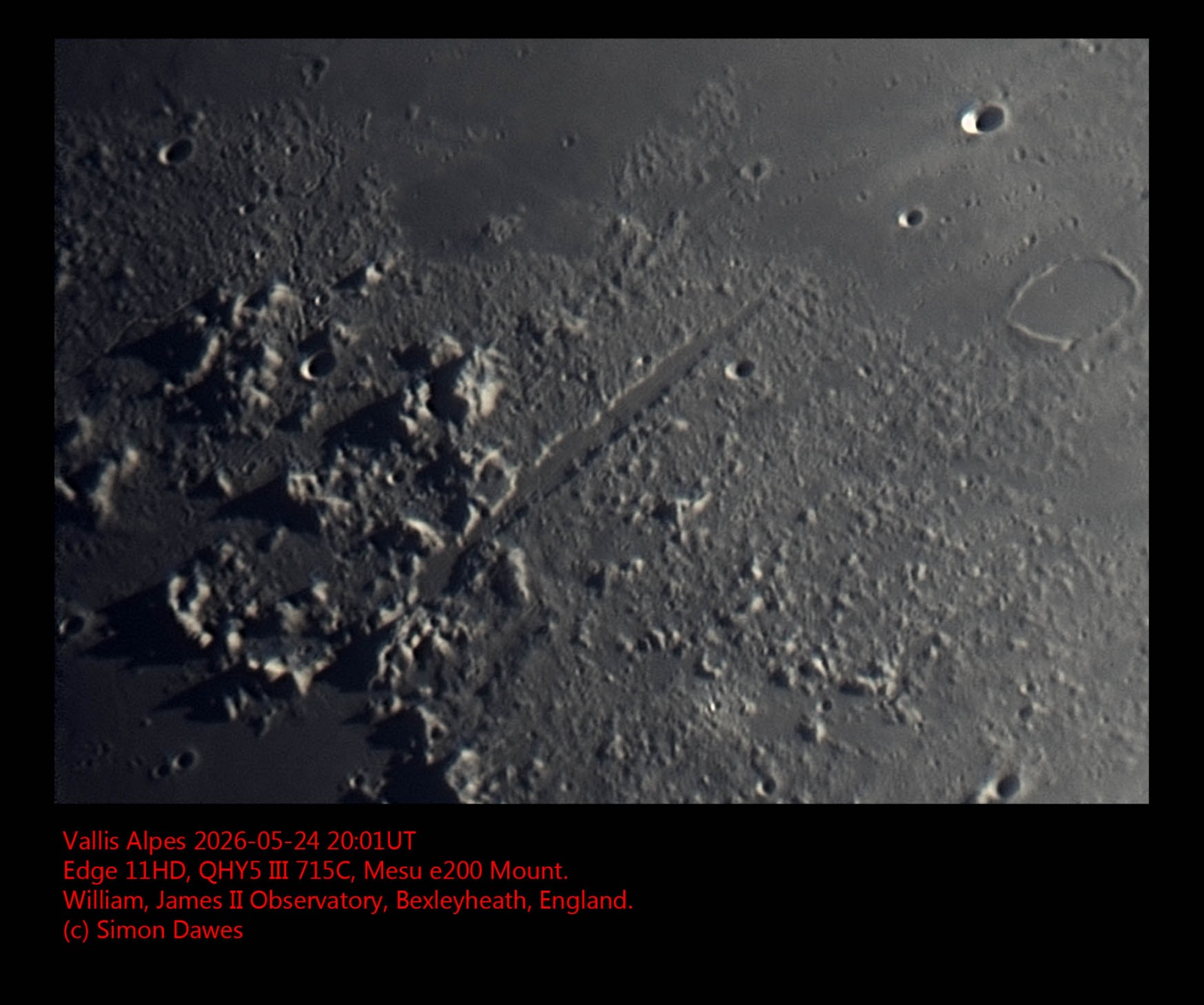
Vallis Alpes (Latin for “Alpine Valley”) is a lunar valley feature that bisects the Montes Alpes range. It extends 166 km from the Mare Imbrium basin, trending east-northeast to the edge of the Mare Frigoris. The valley is narrow at both ends and widens to a maximum width of about 10 km along the middle stretch. Ref:https://en.wikipedia.org/wiki/Vallis_Alpes
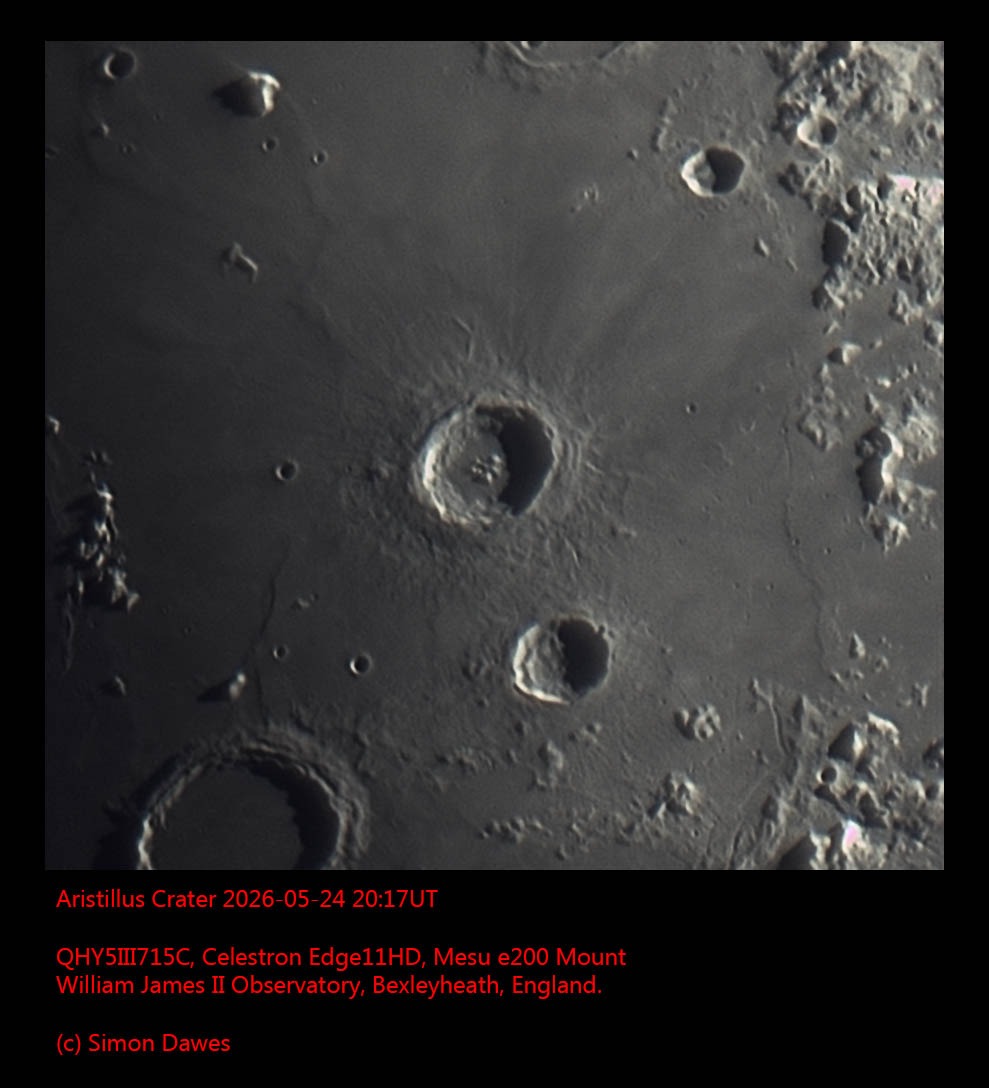
Centre of the image is Aristillus is a prominent lunar impact crater that lies in the eastern Mare Imbrium. To the south is the smaller crater Autolycus, while to the southwest is the large Archimedes. To the northeast are the craters Theaetetus and Cassini. Ref:https://en.wikipedia.org/wiki/Aristillus_(crater)
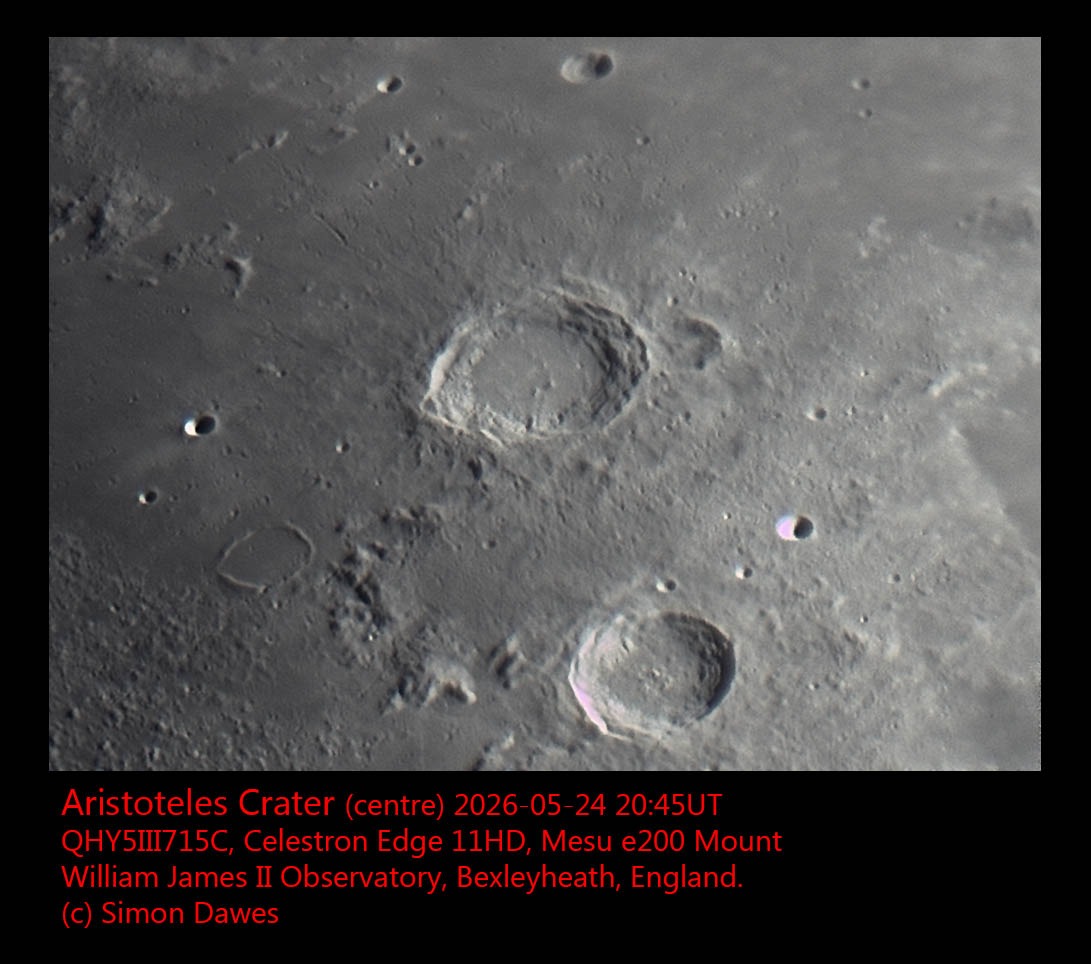
Aristoteles is a lunar impact crater that lies near the southern edge of the Mare Frigoris and to the east of the Montes Alpes mountain range. It was officially named in 1935 after the ancient Greek philosopher and astronomer Aristotle (383-322 B.C.) by the International Astronomical Union, using the classical form of his name.
To the immediate south of Aristoteles lies the slightly smaller crater Eudoxus, and these two form a distinctive pair for a telescope observer. An arc of mountains between these craters bends to the west before joining the walls. The smaller crater Mitchell is directly attached to the eastern rim of Aristoteles. To the west is the low, flooded feature Egede. Ref:https://en.wikipedia.org/wiki/Aristoteles_(crater)
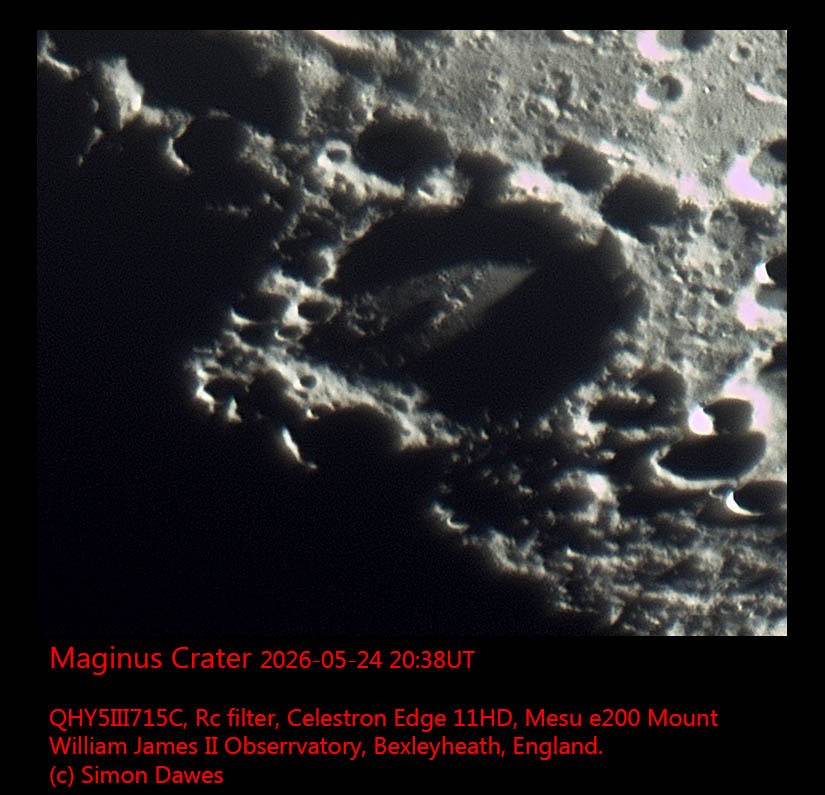
Maginus is an ancient lunar impact crater located in the southern highlands to the southeast of the prominent crater Tycho. It is a large formation almost three quarters the diameter of Clavius, which lies to the southwest. Ref:https://en.wikipedia.org/wiki/Maginus_(crater)
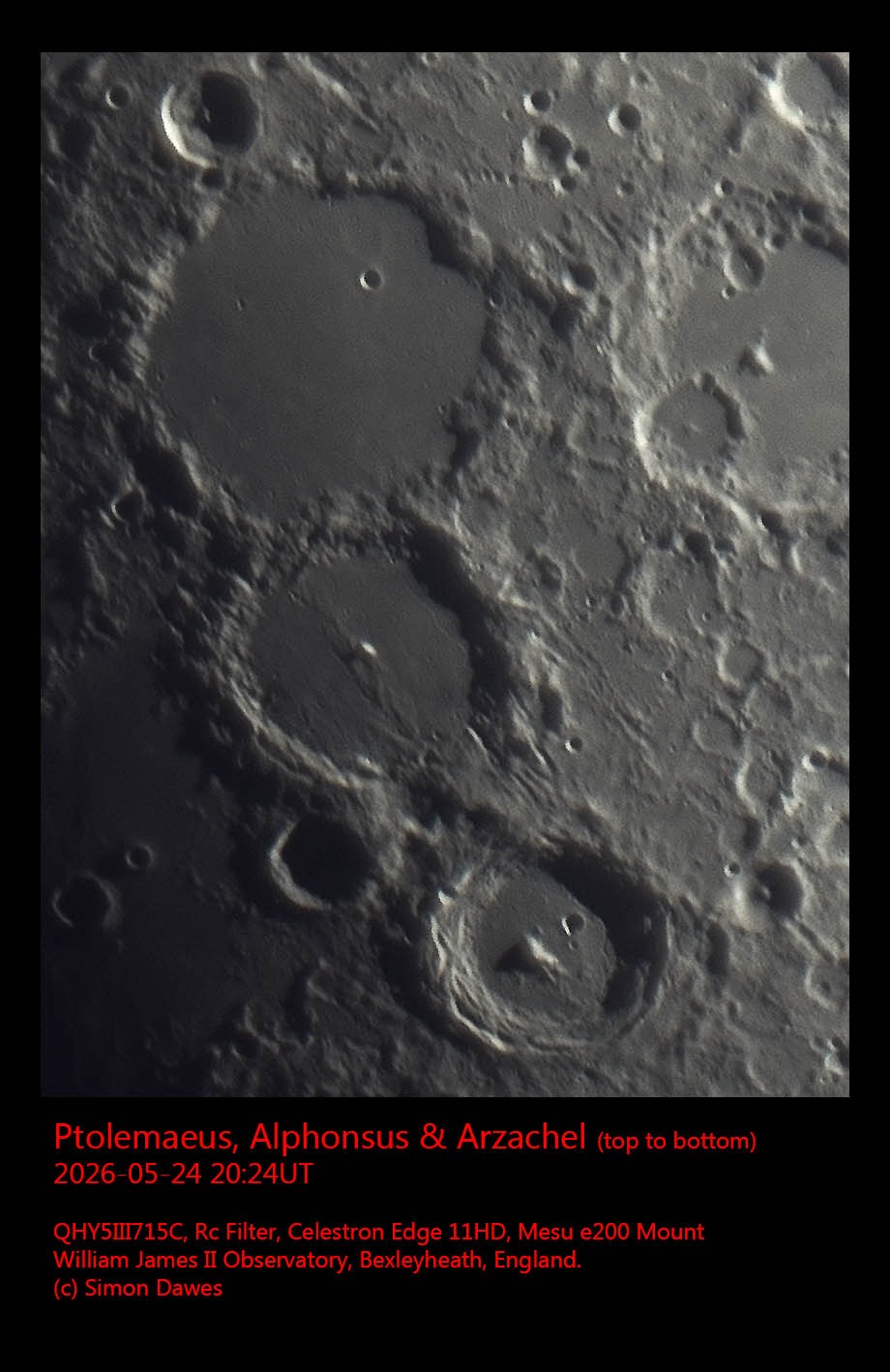
Ptolemaeus is an ancient lunar impact crater close to the center of the near side, named for Claudius Ptolemy, the Greco-Roman writer, mathematician, astronomer, geographer and astrologer. It measures approximately 154 kilometers in diameter.
To the south-southwest, Ptolemaeus is joined to the rim of the crater Alphonsus by a section of rugged, irregular terrain, and these form a prominent chain with Arzachel to the south. Ref:https://en.wikipedia.org/wiki/Ptolemaeus_(lunar_crater)
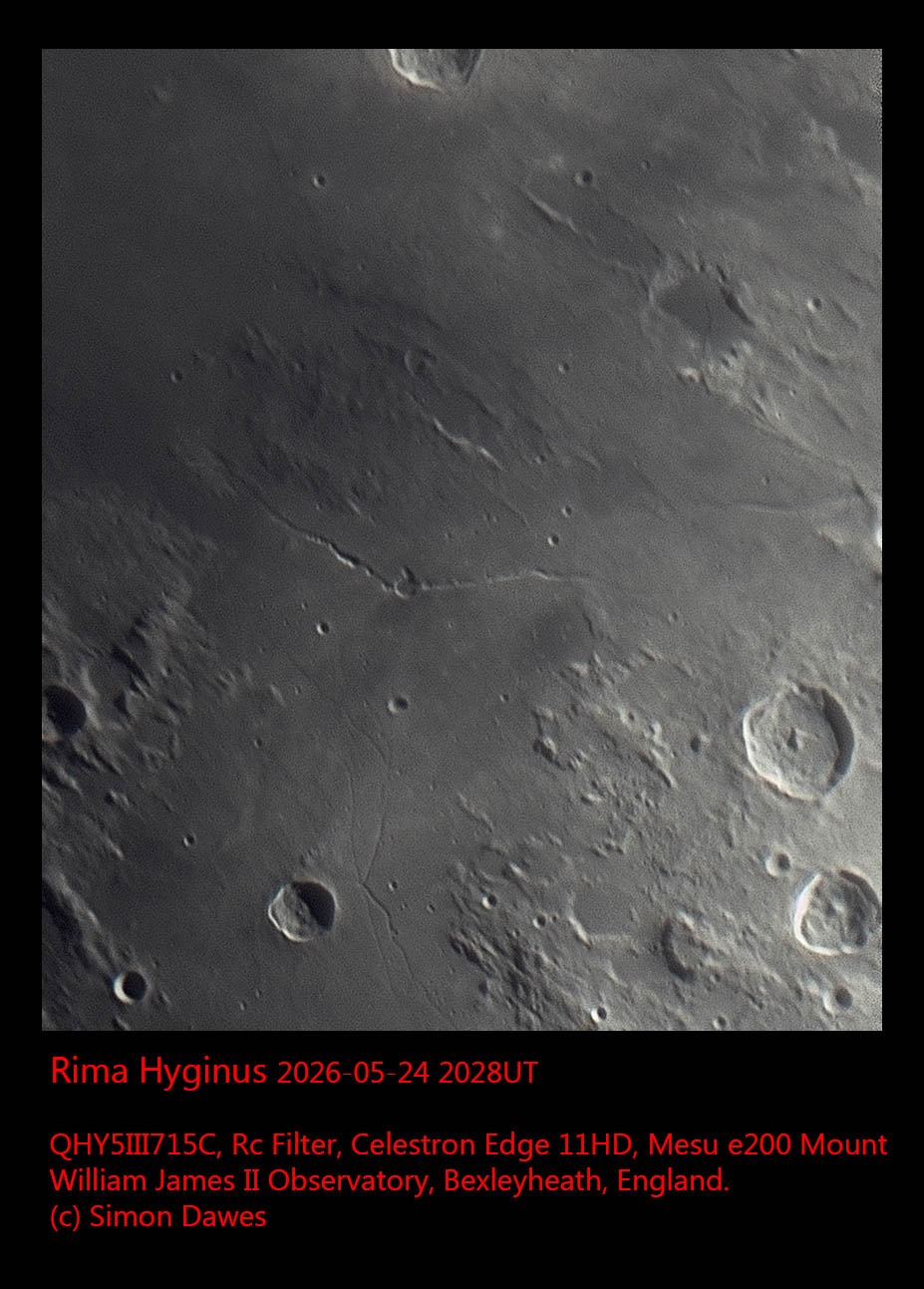
Hyginus is a lunar caldera located at the east end of the Sinus Medii. It was named after ancient Roman astronomer Gaius Julius Hyginus. Its rim is split by a 220 kilometer-long rille, Rima Hyginus, that branches to the northwest and to the east-southeast. The crater is deeper than the rille, and lies at intersection of the rille’s branches. Together, the crater and the rille form a prominent feature in an otherwise flat surface. Smaller craters along the length of the rille may have been caused by the collapse of an underlying structure.
Hyginus is one of the few craters on the Moon that were not created as a result of an impact, and is instead believed to be volcanic in origin. Ref:https://en.wikipedia.org/wiki/Hyginus_(crater)
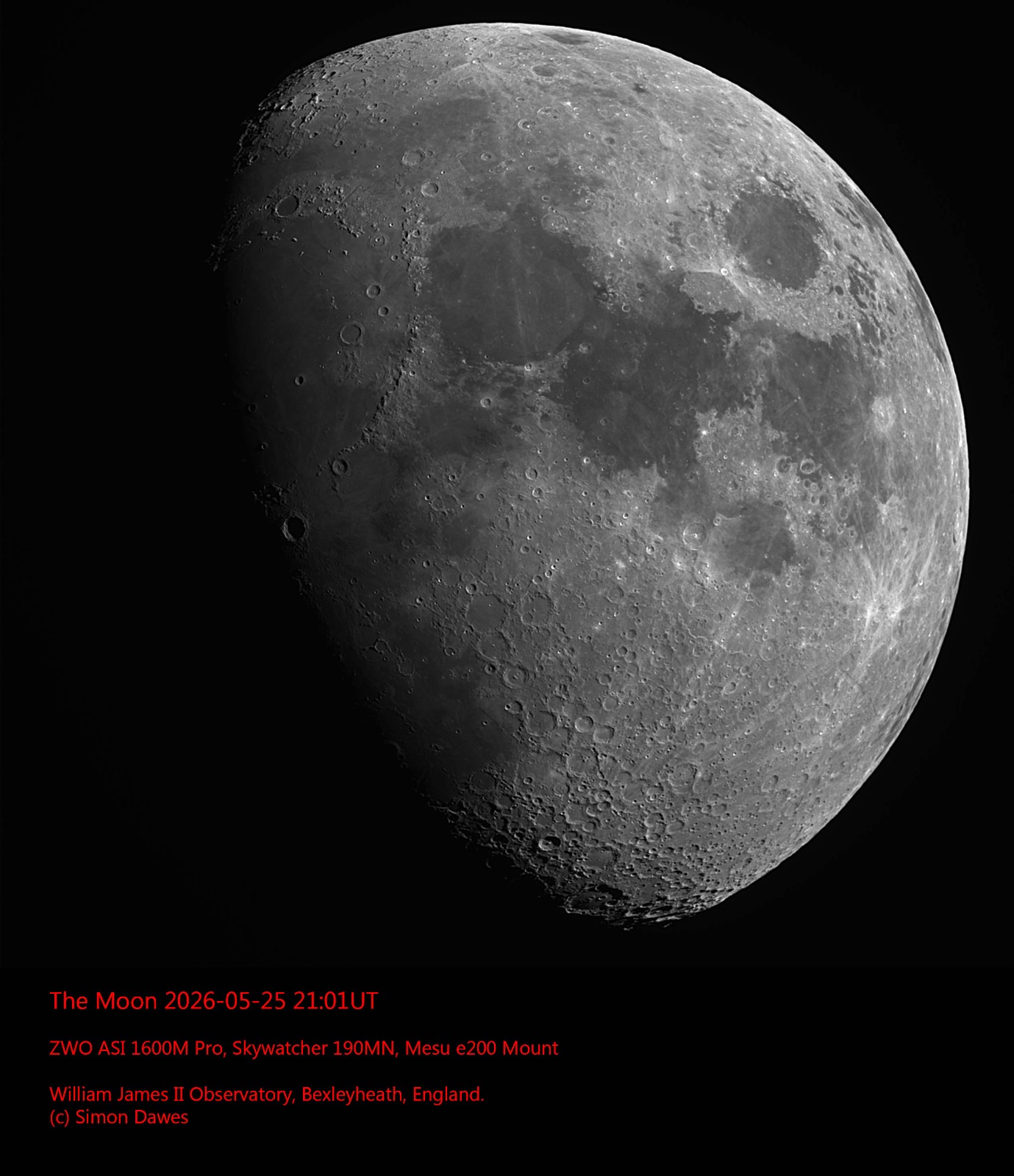
On Monday, May 25, 2026 the Moon was in its
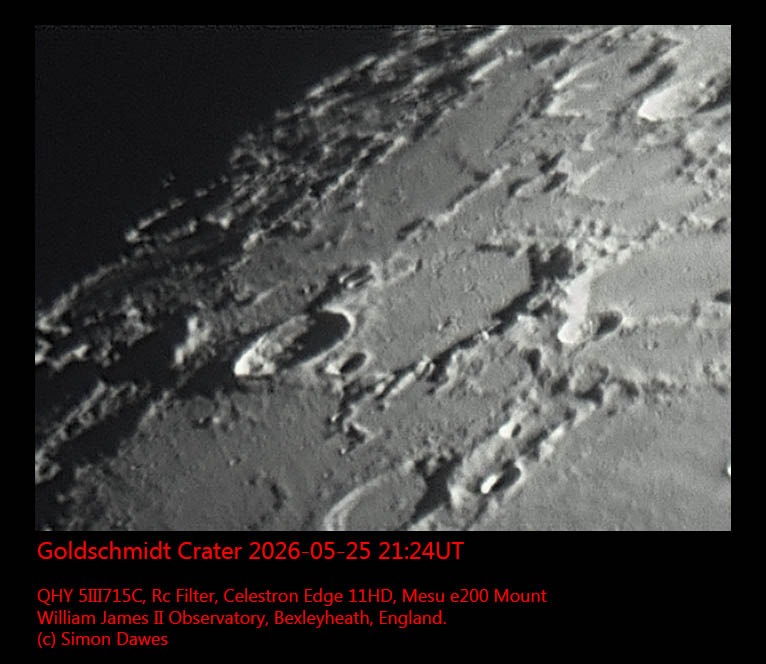
Goldschmidt is a large lunar impact crater of the variety commonly termed a walled plain. Ref:https://en.wikipedia.org/wiki/Goldschmidt_(crater)
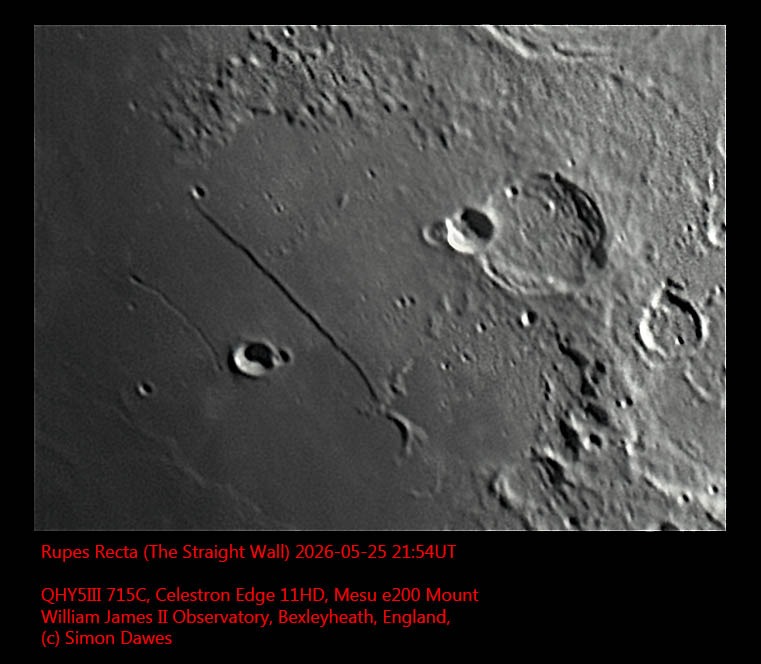
Rupes Recta is a linear fault on the Moon, in the southeastern part of the Mare Nubium. The name is Latin for straight cliff, although it is more commonly called the Straight Wall. This is the best-known escarpment on the Moon. Ref:https://en.wikipedia.org/wiki/Rupes_Recta
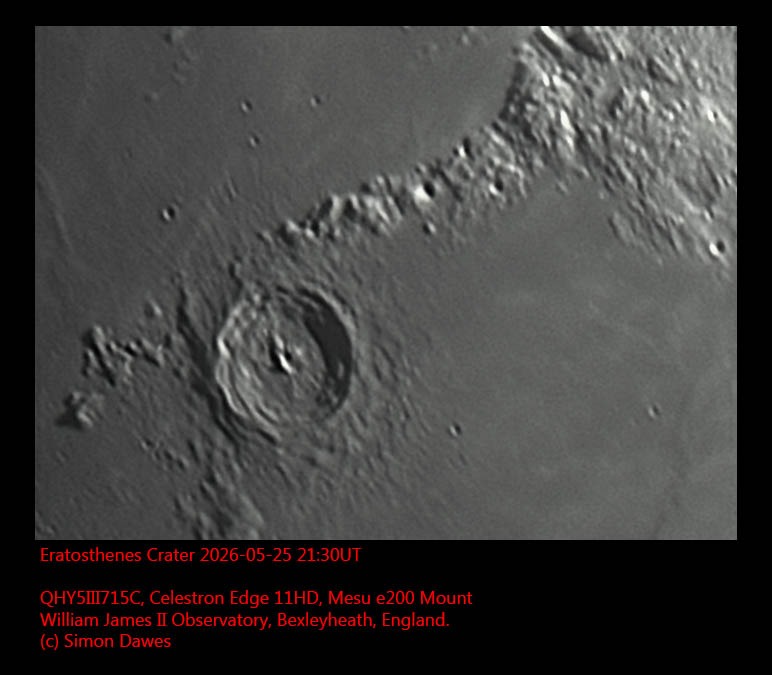
Eratosthenes crater is a relatively deep lunar impact crater that lies on the boundary between the Mare Imbrium and Sinus Aestuum mare regions. It forms the western terminus of the Montes Apenninus mountain range. It is named after ancient Greek astronomer Eratosthenes of Cyrene, who estimated the circumference of the Earth, and the distance from the Earth to the Sun.
The crater has a well-defined circular rim, terraced inner wall, central mountain peaks, an irregular floor, and an outer rampart of ejecta. Ref:https://en.wikipedia.org/wiki/Eratosthenes_(crater)
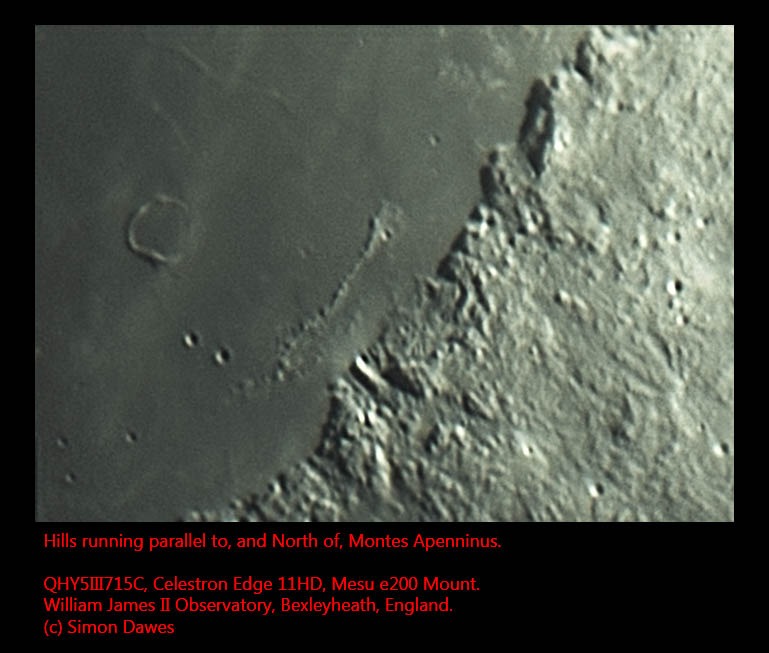
Montes Apenninus are a rugged mountain range on the northern part of the Moon‘s near side. They are named after the Apennine Mountains in Italy. Montes Apenninus is the most prominent remnant of the outer ring of the Imbrium basin. Ref:https://en.wikipedia.org/wiki/Montes_Apenninus
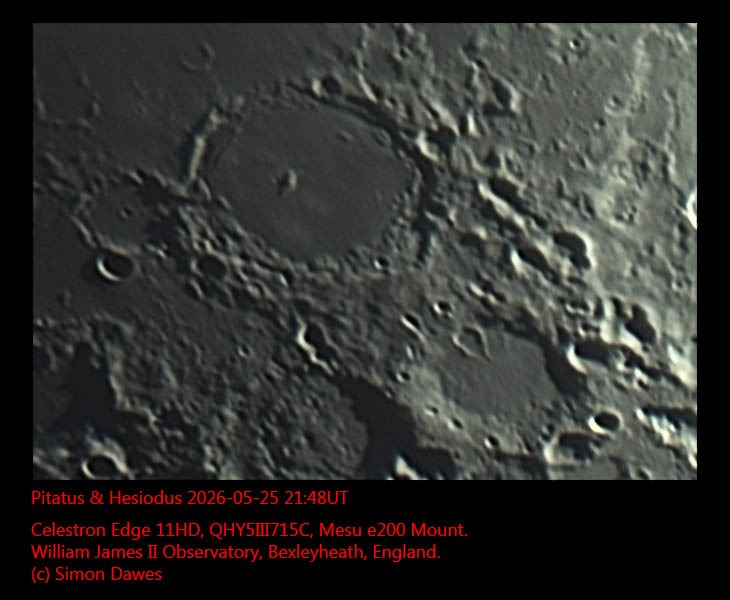
Hesiodus is a lunar impact crater located on the southern fringes of Mare Nubium, to the northwest of the crater Pitatus. It was named after the ancient Greek poet Hesiod. Ref:https://en.wikipedia.org/wiki/Hesiodus_(crater)
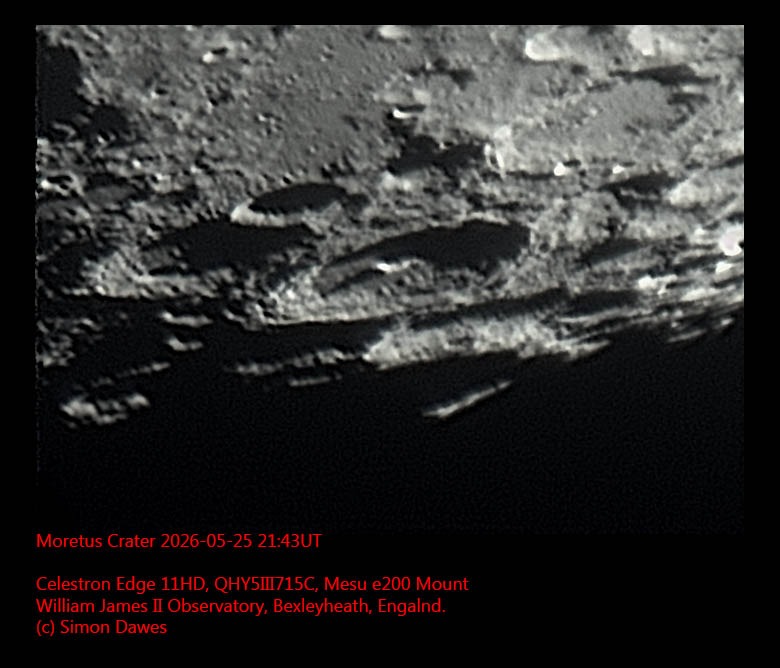
Moretus is a lunar impact crater located in the heavily cratered highland region near the south pole of the Moon.
South of Moretus, the crater Short is located, while to the north is Cysatus. To the northwest lies Gruemberger, and Curtius is located to the northeast. Due to the location near the lunar limb, the crater appears oblong because of foreshortening. The crater is named after the 17th-century Flemish mathematician and geometer Theodorus Moretus.
On the lunar geologic timescale, this formation dates to the Imbrian period. Ref:https://en.wikipedia.org/wiki/Moretus_(crater)
Clavius is one of the largest crater formations on the Moon and the second largest crater on the visible near side (very close in size to Deslandres). It dates to the Nectarian period of the lunar geologic timescale. This crater is located in the rugged southern highlands of the Moon, to the south of the prominent ray crater Tycho. It is named for the Jesuit astronomer Christopher Clavius. Ref:https://en.wikipedia.org/wiki/Clavius_(crater)
